Gemini 4 Argon vs GPT-6 Astra: A Comprehensive Comparison on Vision Tasks

Gemini 4 Argon leads most vision benchmarks at 1/4–1/6 Astra's cost, but OCR reasoning and speed remain weak spots.
Roboflow's Peter benchmarked Google Gemini 4 Argon and OpenAI GPT-6 Astra on object detection, segmentation, OCR, and video tasks. Argon reclaimed first place in object detection but requires a specific 0–1000 coordinate normalization with y-first prompts, and supports box prompting with positive/negative samples; it is the first model to segment objects with holes and disconnected parts, but takes about 2 minutes per image. In OCR, Google models lead single-string extraction but still err on reasoning cases like mechanical meters; structured JSON extraction reaches about 90%, and text localization/recognition accuracy is 60–80%. Argon is 4–6× cheaper than Astra in actual runs. Via prompt engineering and interpolation, Argon can do video player re-identification, though keypoint detection remains unstable.
In a Roboflow livestream, Peter thoroughly tested Google's newly released Gemini 4 Argon and OpenAI's GPT-6 Astra on vision tasks including object detection, segmentation, and OCR. Based on test data from multiple sources, Argon leads in most benchmarks, but Astra and Soul perform better on certain OCR tasks.
Object Detection: Argon Takes the Top Spot, but Gemini Requires Specialized Prompts
Peter's team has long maintained an object detection benchmark. Gemini models previously led, but recent improvements from OpenAI and Anthropic models pushed Gemini down in the rankings. With the release of Argon, it reclaimed first place and leads on nearly all benchmarks.
Argon has specific prompt format requirements: coordinates must be normalized from 0 to 1000, with the y-coordinate first. The team tried 20–30 prompt combinations before finding the optimal one. Test images included overlapping carrots, satellite banana trees, LEGO bricks, and checkerboards, all of which Argon handled well.
Box Prompting and Positive/Negative Samples
Beyond text prompts, Argon also supports box prompting, where users draw bounding boxes to indicate targets. Unlike Astra and Qwen, Argon responds well to both text and box prompts. Additionally, users can provide positive and negative sample boxes to help the model distinguish specific categories. For example, on a soccer field, by annotating only players in dark jerseys, Argon understands the negative samples and excludes other people.
Box prompting is an interaction method for vision-language models: users draw bounding boxes directly on an image rather than describing targets only in text, and the model locates or segments accordingly. Compared with text prompts, box prompting conveys spatial position and target extent more precisely, especially for shapes or dense scenes that are hard to describe in words. Positive sample boxes mark the target instances the model should recognize, while negative sample boxes mark similar distractors to exclude (such as jerseys of a different color); the model learns to distinguish the two through contrastive learning. This mechanism lets the model quickly adapt to specific categories under few-shot conditions without retraining—an important capability as general-purpose vision models move toward practical deployment.
Image Segmentation: Supports Holes and Disconnected Masks
Argon is the first segmentation model that can handle objects with holes and disconnected parts. For example, for a donut with a hole or separated carrots, Argon can generate masks that include internal holes, whereas Astra produces solid masks. In addition, Argon can identify disconnected mask parts, such as individual items in a stack of packages.
However, segmentation is time-consuming, taking about 2 minutes per image, while traditional models like Soul can complete it in sub-second time. Peter believes that current segmentation technology resembles object detection from a year or two ago and expects significant speedups within a year.
Mask is the output form of image segmentation, assigning a category or instance label to each pixel to precisely outline target contours. Traditional segmentation models often output solid masks, filling the entire interior of the target, which makes it difficult to represent hollow structures (such as donuts or parts with holes) or objects composed of multiple disconnected parts (such as individual items in a stack of packages). Being able to generate masks with holes and disconnected masks means the model understands the target's topology rather than merely performing region filling. This is especially critical for industrial inspection, medical imaging, and remote sensing, where precise boundaries are required, and is also an important dimension for evaluating segmentation model sophistication.
OCR: Performance Varies Across Subtasks
Roboflow updated its OCR benchmark, dividing it into four subtasks: single-string extraction, transcription, structured JSON extraction, and text localization and recognition.
Single-String Extraction
Google models stand out on this task, with Argon able to handle difficult scenarios such as low resolution, glare, and small fonts. But on cases requiring reasoning (such as mechanical electricity meters), Argon still makes errors, for example reading 5 as 9.
Structured JSON Extraction
Models score highly (about 90%) on tasks such as receipts and nutrition labels, but still make many errors on handwritten medical prescriptions and checks. When tables are input as a single image, Argon's accuracy is about 85%.
Text Localization and Recognition
This task requires locating and reading text in images, such as floor plan dimensions, map labels, and PCB text. Argon achieves about 60–80% accuracy on difficult cases, making it the best option currently available, though it may still be insufficient to solve certain business problems.
Efficiency and Cost: Argon Is 4–6× Cheaper Than Astra
Argon takes about 20 seconds to process a single image—slower but powerful. In terms of per-token unit price, Astra is twice as expensive as Argon, but in actual runs, because Astra consumes more tokens (possibly due to chain-of-thought), the cost of completing the same task is 4–6 times that of Argon.
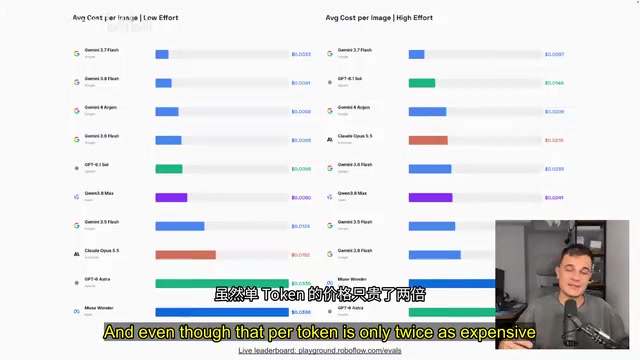
Token is the basic unit used by large models to process text and images, and APIs bill based on the number of input and output tokens. In vision tasks, images are encoded into a large number of visual tokens, and the model also generates output tokens during inference. Some models (such as Astra) use chain-of-thought reasoning, generating a large number of intermediate reasoning tokens before giving an answer, which makes the actual token consumption per task far higher than what the nominal unit price suggests. Therefore, when comparing model costs, one cannot look only at the per-token price but must also consider actual token usage—this is why Astra's per-token price is twice that of Argon, yet its actual task cost is 4–6 times higher.
Video and Re-Identification: Cross-Frame Tracking Is Feasible
Although Argon is not a video model, it can handle video tasks through clever prompt engineering. In a basketball game re-identification test, Argon could match player IDs across frames and maintain consistency even when players were occluded. Peter ran the prompt every half second and interpolated bounding boxes between keyframes to achieve smooth tracking. The method was validated across multiple games.
Keypoint Detection and Auto-Labeling
Argon can detect keypoints based on reference images, such as hand poses or human poses, but results for automatic keypoint labeling on basketball courts remain unstable, with jitter and insufficient accuracy. Peter believes the direction is promising but not yet mature.
Re-identification refers to determining whether a target across different video frames or camera views is the same entity, commonly used in player tracking, footfall analysis, and similar scenarios. Due to occlusion, pose changes, and lighting differences, re-identification requires the model to have stable identity feature extraction capabilities. Argon is not a native video model, but through prompt engineering—running a detection prompt on keyframes every half second and then interpolating bounding boxes between keyframes—it can simulate continuous tracking. Interpolation means linearly estimating the box coordinates of intermediate frames based on the positions in the preceding and following frames, thereby obtaining smooth trajectories without per-frame inference, balancing effectiveness and computational cost.
Summary and Outlook
Gemini 4 Argon performs best on most vision benchmarks, especially in object detection and segmentation tasks, and is significantly more cost-effective. However, on certain OCR subtasks (such as single-string extraction), Google models still face challenges, while Astra and Soul perform better in specific scenarios. As models continue to iterate, the accuracy and efficiency of vision tasks are expected to improve further, bringing new possibilities for auto-labeling and business applications.
One-line Summary
Gemini 4 Argon leads most vision benchmarks at 1/4–1/6 the cost of Astra, but OCR reasoning and speed remain weak spots.
Paragraph Summary
Roboflow's Peter benchmarked Google Gemini 4 Argon and OpenAI GPT-6 Astra on object detection, segmentation, OCR, and video tasks using in-house tests. Argon reclaimed first place in object detection but requires a specific 0–1000 coordinate normalization with y-first prompt format, and supports box prompting with positive/negative samples; it is the first model able to segment objects with holes and disconnected parts, but takes about 2 minutes per image. Among OCR subtasks, Google models lead in single-string extraction but still err on reasoning cases such as mechanical meters; structured JSON extraction reaches about 90%, and text localization/recognition accuracy is 60–80%. In cost, Argon is 4–6× cheaper than Astra in actual runs. Through prompt engineering and interpolation, Argon can perform video player re-identification, though keypoint detection remains unstable.
Related articles

Free Unlimited Claude Code Solution: Agnes AI + CC Switch Setup Guide
No paid subscription needed — pair the free AI platform Agnes AI with the open-source tool CC Switch to provide a backend for Claude Code, enabling unlimited free calls to text, image, and video models. This guide covers the full setup, test results, and usage boundaries.

A Complete Zero-Cost Guide to Getting Started with Claude Code for Beginners in China
A beginner's guide to Claude Code for users in China: two installation methods (command line and IDE plugin), full configuration steps for replacing the official API with the free domestic LongCat model, and a hands-on demo of building a small tool with natural language, plus tips.

When the NSA Gets Involved: The AI Supply Chain Crisis Behind Open-Source CVEs and API Key Hijacking
Multiple open-source projects disclosed severe CVEs in one day, PHP flaws alarmed the FBI, and Railway and OpenCode were breached with API keys stolen. This article breaks down the vulnerability window, AI-accelerated exploitation, and the AI supply chain crisis behind the API key black market, with a developer defense checklist.