What Is DeepSeek Harness? The Entire Engineering Layer Beyond the Model
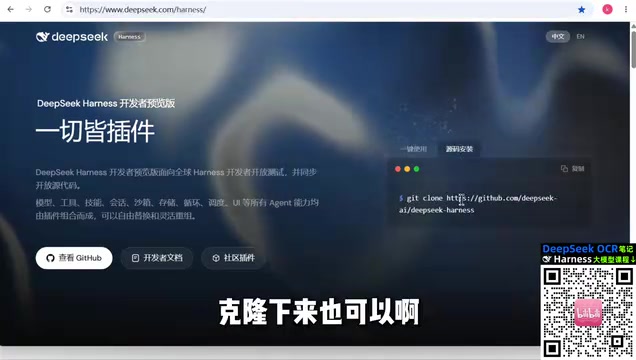
DeepSeek Harness is the engineering system beyond the model, harnessing Agent capabilities through an everything-is-a-plugin approach.
The article centers on DeepSeek's Harness developer preview, clarifying that it is neither a new model nor an ordinary client but a complete engineering system beyond the model, covering system prompts, tool calls, file system, sandbox, memory, context management, constraint mechanisms, and orchestration logic. Using the "horse tack" metaphor, it explains the positioning: the model makes judgments, and Harness handles everything else. Architecturally, Harness advocates "everything is a plugin," with models, tools, skills, sandboxes, storage, loops, and UI all freely replaceable and combinable, installable with a single command and open-sourced alongside. The article also discusses how the four operating modes adapt to task complexity, the key role of the memory system in long tasks, and the value of an open-source Agent engineering layer for the ecosystem. The author notes that developer preview interfaces may still change, making it suitable for exploration and validation but not yet for direct production use.
Since DeepSeek released the developer preview of Harness and open-sourced its code alongside, discussion around this new concept has not stopped. Some treat it as yet another client, others assume it is a new model. If you share that confusion, this article may help clarify things.
Starting from the "harness" metaphor
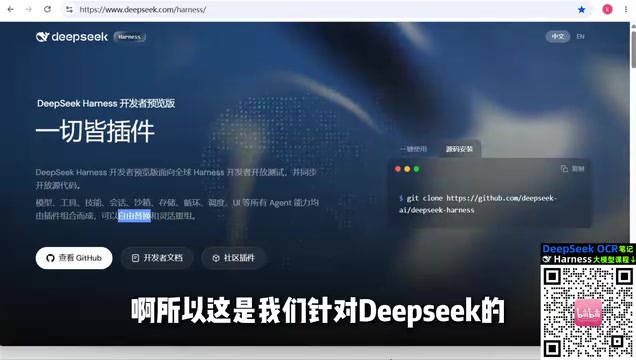
The word Harness originally means horse tack—the reins, saddle, and lantern as a complete set of equipment. A Bilibili creator's explanation in a video is vivid: no matter how powerful an AI large model is, using it is like handling an untamed wild horse—you must put reins and a saddle on it before it will run according to human intent.
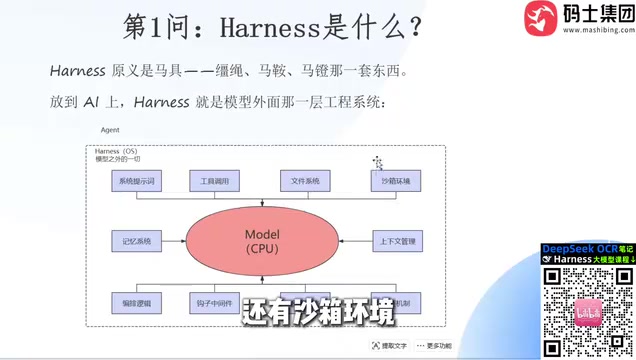
In the AI context, Harness refers to the engineering layer outside the model. It is not responsible for "thinking" but for making the model's thinking controllable and actionable. The definition given in the video is fairly complete: system prompts, tool calls, file system, sandbox environment, memory system, context management, constraint mechanisms, feedback loops, hook middleware, orchestration logic—all of these fall within the scope of Harness.
In one sentence: the model makes judgments, and Harness handles everything else.
Agent is the prerequisite concept for understanding Harness. An Agent refers to a software system driven by a large model that can autonomously perceive its environment, formulate plans, call tools, and execute multi-step tasks to achieve goals. Unlike traditional question-answering invocation, an Agent's core characteristics are "autonomy" and "multi-turn loops": it decides its next action based on the task goal, observes the execution result, and then decides whether to continue or adjust. This also explains why Agents need Harness—the model provides reasoning and decision-making capabilities, while everything from the format conventions for tool calls, the return of execution results, retries after failures, to context trimming and memory persistence must be carried by an external engineering layer. Without Harness, the model is just a passive text generator; with Harness, the model can be organized into a runnable, observable, and constrainable Agent.
A great interview question
The creator initiated this series of follow-up questions because concepts like this are increasingly common in interviews. When faced with a question like "What is Harness," being able to answer "everything outside the model" basically captures the key point.
This answer holds because it draws a clear boundary. Over the past few years, many engineering innovations around large models—prompt engineering, retrieval augmentation, Agent frameworks, toolchains—have essentially been filling the gap between models and real tasks. Harness formally names this gap as an engineering layer, meaning it is no longer a pile of scattered tricks but a system component with a clearly defined scope of responsibility.
For developers, this shift in perspective is valuable: when you stop treating the model as everything and start treating it as a judgment unit within a system, many design decisions become clearer.
Everything is a plugin: Harness's architectural approach
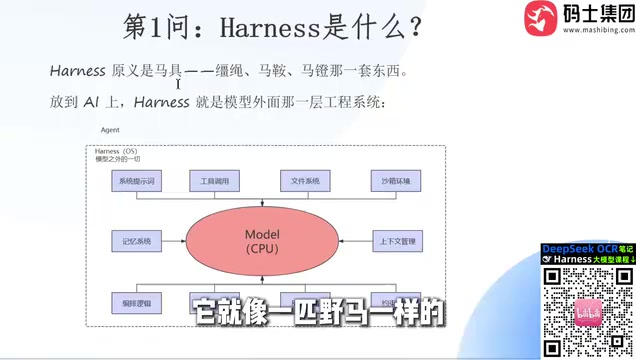
The Harness developer preview proposes a clear design philosophy—"everything is a plugin." All capabilities an Agent needs—models, tools, skills, sandboxes, storage, loops, UI—are composed of plugins that can be freely replaced and flexibly combined.
The engineering significance of this approach lies in decoupling. In traditional practice, an Agent's capabilities are often deeply bound to the framework: switching models requires rewriting the invocation logic, and adding a tool requires modifying the core code. With pluginization, each capability is a pluggable unit, and replacing models or adding/removing tools no longer affects the whole system.
According to the creator's demonstration, installation can be completed with a single command, and those who want to study the source code can clone it directly from the code hosting platform. Opening testing to global developers while open-sourcing the code shows that DeepSeekAd wants Harness to become infrastructure for the ecosystem, not an appendage of its own products.
Function Calling / Tool Use is a key mechanism for Agent operation and one of Harness's most central responsibilities. The basic flow is: the system describes a set of available tools to the model (names, functions, parameter schemas), the model outputs a structured call request after reasoning, Harness parses the request, actually executes the corresponding function (such as reading/writing files, making network requests, running code), and then passes the execution result back to the model as a new message, entering the next loop. This mechanism connects the model's language capabilities with the external world, but it also brings a series of engineering challenges—parameter validation, timeout control, error handling, permission and security boundaries, call count and cost limits—none of which are the model's responsibility but are handled uniformly by Harness. The plugin-based design is precisely to allow these tools to be registered, replaced, and combined as needed without affecting the main loop logic.
Highlights of the four operating modes
The video title mentions that Harness has four modes, though the original content does not elaborate on each. Judging from common paradigms in Agent engineering, these modes most likely correspond to different levels of task complexity and automation—some lean toward lightweight single-turn question-answering invocation, some toward multi-step task orchestration, some involve code execution in a sandbox environment, and some emphasize continuous maintenance of memory and context.
For the specific definitions of the modes, refer to the official documentation and source code. What is worth emphasizing here is what the very division of modes reveals: Harness does not assume all tasks look the same. Using heavy orchestration for lightweight tasks is wasteful, while lightweight invocation cannot support complex tasks. Explicitly distinguishing operating modes is a pragmatic engineering trade-off.
The memory system is singled out in the screenshot, which is also worth noting. Context management has always been a pain point for Agent deployment; the strategies for writing, retrieving, and evicting memories directly determine whether an Agent can maintain coherence in long tasks.
Sandbox is an isolated environment for an Agent to execute code and operate files, and it plays the role of security fallback in the Harness system. Code or commands generated by large models cannot be guaranteed to be absolutely correct; executing them directly on a production host may cause data corruption, unauthorized access, or even security vulnerabilities. A sandbox provides an isolated, rollback-capable, resource-constrained space for execution through containers, virtual machines, or restricted processes: the file system is isolated from the host, network access can be restricted, CPU, memory, and runtime can be capped, and abnormal exits will not affect external systems. For Harness, the sandbox is both a capability (enabling the Agent to actually run code and verify results) and a constraint (keeping risks within boundaries)—this is the concrete manifestation, in the security dimension, of the positioning that "the model makes judgments, and Harness handles everything else."
What the open-source ecosystem means
Harness being open-sourced as a developer preview is a noteworthy signal for the domestic large-model ecosystem. Open-sourcing the Agent engineering layer means third-party developers can build their own plugin ecosystems on top of it—tool plugins, skill plugins, and UI plugins may all grow into independent community projects.
This is different from open-sourcing a model. Open-sourcing a model delivers capability; open-sourcing Harness delivers the methodology and infrastructure for harnessing that capability. The former determines the ceiling, the latter determines the floor: the same model, equipped with a mature Harness, will have noticeably different practical usability.
Of course, a developer preview means interfaces and designs may still change; at this stage it is more suitable for exploration and validation, and it is not recommended to bet directly on production environments.
Conclusion
Back to the original question: DeepSeek Harness is not a model, nor a client in the ordinary sense, but the engineering layer outside the model. It gathers once-scattered engineering elements—prompts, tools, memory, sandbox, orchestration—into a pluggable whole, reducing replacement costs through "everything is a plugin." Once you understand this boundary, you also understand where Agent engineering is currently heading.
Related articles

How Do Cursor, Devin, TRAE, and Copilot Compare on Price? Calculate Your Credits Before You Compare Monthly Fees
Side-by-side comparison of individual and team pricing for Cursor, Devin Desktop, TRAE, and Copilot, breaking down credit rules, third-party model inclusion, overage billing, and practical methods for measuring usage before paying, setting spending caps, and choosing the right tool.
Copilot Retires Three Models: Pro Users Left With Only One Alternative
GitHub Copilot retires Claude Opus 4.8, Claude Opus 5, and GPT-5.6 Tera on Nov 16 across Chat, code completion, and Agent mode. Pro users have only GPT-6 Luna left; Legacy annual plans miss Opus 5.5; admins must enable replacements manually.
Gemini 4 Carbon Arrives: The LLM Race Enters the Era of Million-Token Context and Trillion-Parameter Open Source
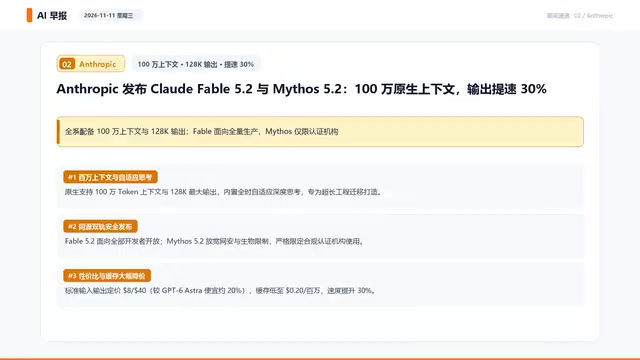
Google launches Gemini 4 Carbon and multi-agent tool Swarm; Anthropic debuts million-context Fable 5.2 and Mythos 5.2; OpenAI releases security-focused GPT-6 Cyber; Mistral and Kimi open-source trillion-parameter models — the LLM race accelerates across the board.