Gemini 4 Carbon Lands on Devin: Coding Benchmark Score Jumps, Lower Costs
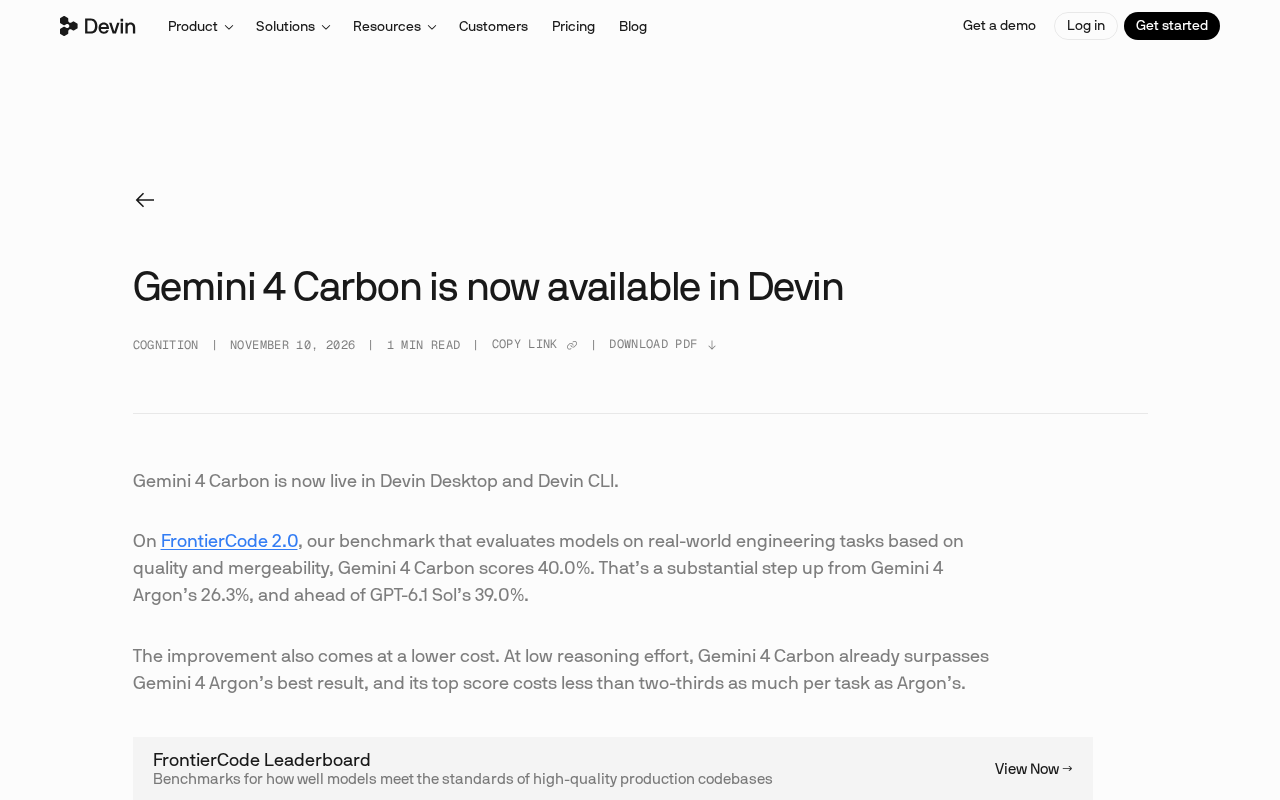
Gemini 4 Carbon arrives on both Devin interfaces with a 40.0% benchmark score and lower cost.
Devin has launched Gemini 4 Carbon on Devin Desktop and Devin CLI, replacing Gemini 4 Argon. Its FrontierCode 2.0 score rises from 26.3% to 40.0% with lower per-task cost. The dual launch covers desktop visualization and CLI automation workflows, and developers are advised to compare against Argon before switching defaults.
AI coding tool Devin has announced that Gemini 4 Carbon is now officially available on Devin Desktop and Devin CLI. Compared with the previous generation, Gemini 4 Argon, the new model's score on the coding benchmark FrontierCode 2.0 has risen from 26.3% to 40.0%, while per-task cost is lower. This change is worth attention for developers who rely on AI coding agents: stronger benchmark performance combined with lower per-task overhead means more complex coding tasks can be completed on the same budget.
Where Gemini 4 Carbon Fits in Devin
Devin is an AI agent platform for software engineering, offering both desktop and command-line interaction modes. The fact that Gemini 4 Carbon is being integrated into both Devin Desktop and Devin CLI shows that the platform wants developers to get consistent model capabilities across graphical-interface and terminal workflows.
Judging by the naming, Carbon is a version in the Gemini 4 series, and Argon is its predecessor. Devin chose this moment to launch Carbon, with the core selling points being improved coding capability and lower cost. For users who treat Devin as a daily coding assistant, model switching usually requires no extra configuration, but the actual experience will show up in task completion rates and interaction turns.
It should be noted that both Gemini 4 Carbon and Gemini 4 Argon belong to Google's Gemini 4 model family. As a third-party integration platform, Devin calls these models via API to complete coding tasks. Devin itself is not a model developer but an agent vendor that combines the autonomous agent capabilities developed by Cognition with external large language models. Therefore, model switching usually involves backend configuration updates and is transparent to end users. This architecture means Devin can flexibly integrate models from different vendors or versions, and what developers need to focus on is how the model performs on specific tasks rather than underlying technical details.
FrontierCode 2.0 Score: What Does 40.0% Mean?
FrontierCode 2.0 is a coding benchmark. According to official disclosures, Gemini 4 Carbon scores 40.0% on this benchmark, while Gemini 4 Argon scores 26.3%. An absolute improvement of nearly fourteen points is a fairly notable advance in coding benchmarks.
To view this objectively, the absolute score of 40.0% shows that this kind of benchmark remains quite difficult—the model does not pass all tasks. But the main value of benchmark scores lies in horizontal comparison: under the same test conditions, the improvement of Carbon relative to Argon can help developers judge whether switching is worthwhile. For teams already running automated coding workflows in Devin, this improvement may directly translate into fewer failed retries and less human intervention.
Changes in the Cost Dimension
The official announcement also mentions that Gemini 4 Carbon's per-task cost is lower than Argon's. Putting "higher score" and "lower cost" together, the improvement in cost-effectiveness is bidirectional. The operating cost of AI coding agents often accumulates from multiple model calls, and a lower per-task cost will be amplified in batch-task scenarios.
FrontierCode 2.0 is one of the benchmarks for evaluating the capabilities of AI coding agents. Its design usually includes multi-step programming tasks that require the model to understand code context, write runnable code, and pass tests. Unlike single-turn code generation benchmarks, FrontierCode places more emphasis on the agent's performance across the full task lifecycle, including error fixing and iteration. A score of 40.0% indicates that the model can fully solve about forty percent of the test tasks, with the remaining tasks partially or completely failing. The absolute score of such benchmarks is affected by task difficulty and scoring criteria, so horizontal comparison of different model versions under the same benchmark is more informative.
In the context of AI coding agents, "per-task cost" usually refers to the total model-call cost consumed to complete a typical coding task, including multiple interactions, code generation, test runs, and other steps. Because agentic workflows often require multiple rounds of model calls, small differences in per-call pricing are amplified at the task level. Lower costs may stem from improved model inference efficiency, fewer output tokens, or pricing adjustments. For teams processing tasks in batches, lower per-task cost directly reduces operating budgets, making it possible to attempt more tasks or expand automation scope under the same expenditure.
Impact on Developer Workflows
The dual launch on Devin Desktop and Devin CLI covers two typical usage scenarios. The desktop version suits developers who need to visually track task progress, while the CLI suits teams that want to embed Devin into scripts and CI processes.
Improvements in model capability will show up in agentic coding in several ways: understanding of codebase context, planning of multi-step tasks, and self-correction after errors. The score improvement on FrontierCode 2.0 can be seen as a composite indicator of these capabilities, but for any individual project, actual performance still depends on codebase size, language ecosystem, and task type. Developers are advised, after switching to Carbon, to first run a round of comparative tests with existing task sets before deciding whether to replace the default model entirely.
The Special Value of CLI Scenarios
Teams using Devin in the CLI usually care more about the degree of automation and cost controllability. Carbon's lower per-task cost fits well with the batch-processing characteristics of the CLI, making it suitable for expanding usage in repetitive tasks such as code review, dependency upgrades, and test completion.
Selection Advice Under the Pace of Model Iteration
The Gemini 4 series has moved from Argon to Carbon in a short period, with benchmark scores rising sharply while costs fall, reflecting that competition among model vendors in coding scenarios is still accelerating. For Devin users, the platform's completion of model integration means switching costs are very low, and the real decision point is verifying how well the new model matches their own projects.
A pragmatic approach is: keep Argon as a control, rerun recently failed or inefficient tasks on Carbon, and observe changes in pass rates and interaction turns. If the improvement meets expectations, then adjust the default model configuration. For cost-sensitive teams, the drop in per-task cost may itself constitute a reason to switch, even if the benchmark improvement is less obvious on individual projects.
Overall, the launch of Gemini 4 Carbon in Devin is a pragmatism-leaning update: it does not pursue parameter-level narratives, but speaks through the two metrics developers care about most—benchmark scores and cost.
One-line Summary
Gemini 4 Carbon launches on both Devin interfaces, raising benchmark score to 40.0% at lower cost.
Paragraph Summary
Devin has announced that Gemini 4 Carbon is officially available on Devin Desktop and Devin CLI, replacing the previous generation Gemini 4 Argon. The new model's score on the coding benchmark FrontierCode 2.0 has risen from 26.3% to 40.0%, while per-task cost is lower, achieving bidirectional improvement in cost-effectiveness. As an AI coding agent platform, Devin covers two types of workflows through its dual interfaces: desktop visualization and CLI automation. The article analyzes the significance of the benchmark improvement and the amplifying effect of lower costs in batch tasks, and advises developers to keep Argon as a control and compare using existing task sets before switching the default model. Overall, this is a pragmatism-leaning update that speaks through two core metrics: benchmark score and cost.
Related articles

How Do Cursor, Devin, TRAE, and Copilot Compare on Price? Calculate Your Credits Before You Compare Monthly Fees
Side-by-side comparison of individual and team pricing for Cursor, Devin Desktop, TRAE, and Copilot, breaking down credit rules, third-party model inclusion, overage billing, and practical methods for measuring usage before paying, setting spending caps, and choosing the right tool.

Copilot Retires Three Models: Pro Users Left With Only One Alternative
GitHub Copilot retires Claude Opus 4.8, Claude Opus 5, and GPT-5.6 Tera on Nov 16 across Chat, code completion, and Agent mode. Pro users have only GPT-6 Luna left; Legacy annual plans miss Opus 5.5; admins must enable replacements manually.
Gemini 4 Carbon Arrives: The LLM Race Enters the Era of Million-Token Context and Trillion-Parameter Open Source
Google launches Gemini 4 Carbon and multi-agent tool Swarm; Anthropic debuts million-context Fable 5.2 and Mythos 5.2; OpenAI releases security-focused GPT-6 Cyber; Mistral and Kimi open-source trillion-parameter models — the LLM race accelerates across the board.