Gemini 4 Carbon Launches Today: Google's New Model Is Here
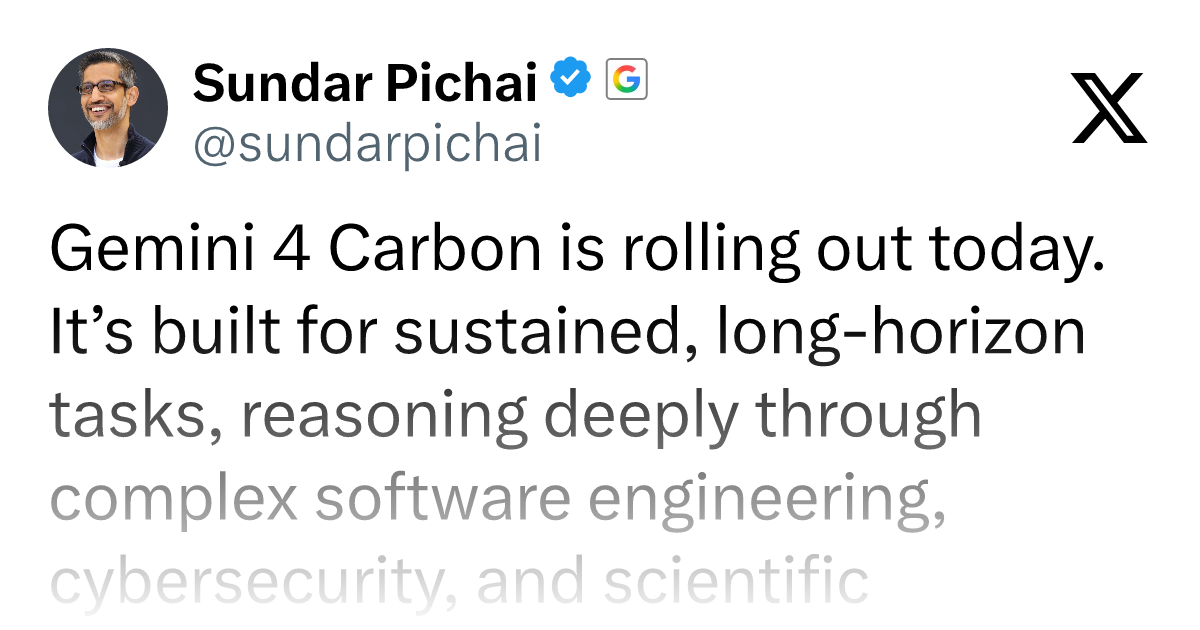
Gemini 4 Carbon starts rolling out today, but details are nearly blank—developers should first verify via side-channel testing.
Gemini 4 Carbon began rolling out today, sourced from Hacker News with low discussion volume—fresh first-hand info. The original only confirms launch timing; parameter count, context length, benchmarks, pricing, and regions lack official documentation, and the "Carbon" suffix meaning has nothing to reference. The article speculates it may be a derivative targeting a specific capability (inference cost, latency, or multimodality) within the same generation, but stresses this is only a naming-convention guess. For developers, it recommends integrating first in a side-channel environment, comparing old and new versions with existing regression test sets on output style, refusal boundaries, and structured output stability—especially format-sensitive areas like JSON parsing and function calling parameters—before deciding whether to migrate production traffic.
Gemini 4 Carbon Starts Rolling Out Today
Google's Gemini family has a new member. According to information on Hacker News, Gemini 4 Carbon began rolling out today. The news quickly drew attention after appearing on HN, though discussion volume is still low—the post has only 7 points and no comments, suggesting it's likely a fresh, first-hand leak that hasn't yet gained traction in the developer community.
Judging from the name, "Carbon" is a suffix that hasn't appeared before. Google hasn't consistently stuck to a single numeric sequence in Gemini's version naming lately, so the specific meaning of this suffix (whether it's a codename for a particular capability direction or a specific version branch) currently has no official documentation to reference. In the absence of a model card, technical blog, or official docs, the only confirmable fact is this: it starts rolling out today.
Rolling out is a common release strategy for software and cloud services: a new version isn't made available to all users at the same moment, but is gradually opened up by batch, region, or account type. The purpose is to control risk in real-world environments—issues exposed by early batches can be fixed before expanding scope, avoiding a large-scale outage from a full release. For a company like Google that serves both consumer products and cloud APIs, rolling out often means the web, mobile, and API console availability times don't align. So when developers see a "launching today" announcement, actual API availability may lag by hours to days, and availability varies by region.
Known Information and Information Gaps
Currently verifiable content is very limited. The original material only gives the "launching today" timing point, without any details on parameter count, context length, benchmark scores, pricing, or available regions.
This is crucial for judging the model's positioning. Past Gemini versions have had clear distinctions in capability focus, and if Carbon is a derivative version of the same generation, it's more likely an adjustment targeting a specific scenario (e.g., inference cost, response latency, or one aspect of multimodality) rather than a full generational upgrade. But this is only speculation based on naming conventions and needs confirmation once the official model card is released.
Also unknown is the rollout pace. "Rolling out" means gradual release, and different users will see the entry point at different times; developers eager to try it may need to refresh the product interface or API console several times.
Model card is a standardized documentation that accompanies AI model releases, typically including the model's capability scope, training data overview, known limitations, applicable and inapplicable scenarios, and safety evaluation results. It was first proposed by Google in 2019 and later widely adopted across the industry. For developers, the model card is a key basis for judging whether a model can be used for a specific business—such as whether it supports sufficiently long context, performance on multilingual tasks, and handling strategies for sensitive content. The article mentions "lack of model card," meaning Carbon's capability boundaries currently can't be verified through official channels, relying only on community testing.
What It Means for Developers
For teams already building applications with the Gemini API, the first thing to do when a new version launches is usually not to switch, but to observe behavioral differences. The same prompt may produce changes in output style, refusal boundaries, and structured output stability between versions, and these differences often aren't written in release notes—they can only be surfaced by running your own evaluation set.
The recommended approach: first integrate the new version in a side-channel environment, compare outputs using the team's existing regression test set, focusing on format-sensitive areas (JSON parsing, function calling parameters). Once community feedback and official documentation are complete, then decide whether to migrate production traffic.
Side-channel environment (also known as shadow traffic or shadow deployment) refers to sending real or simulated requests to the new version simultaneously without affecting production traffic, recording only its output without returning it to users. This differs from traditional A/B testing: it doesn't change the actual user experience and is purely for observing new version behavior. In model upgrade scenarios, a side-channel environment combined with a regression test set can quantify differences in output consistency between old and new versions. Note that LLM outputs are non-deterministic—the same prompt may yield different results across multiple calls—so comparisons typically require multiple samples and distribution statistics rather than comparing single outputs.
What to Watch Next
The value of this news lies more in the signal than the content: it shows Gemini's product iteration is still advancing rapidly. Key points to watch include whether official model cards and benchmark data are released, whether pricing changes, and community comparative evaluations on real tasks. Until more details surface, treating Carbon as an "launched but unverified" option is the more prudent attitude.
One-line Summary
Gemini 4 Carbon starts rolling out today, but details are nearly blank—developers should first verify via side-channel testing.
Paragraph Summary
Gemini 4 Carbon began rolling out today, with the news originating from Hacker News and discussion still low—it's fresh first-hand information. The original text only confirms the launch timing; parameter count, context length, benchmark scores, pricing, and available regions all lack official documentation, and the meaning of the "Carbon" suffix has nothing to reference. The article speculates it may be a derivative version targeting a specific capability direction (inference cost, latency, or multimodality) within the same generation, but emphasizes this is only a guess based on naming conventions. For developers, it's recommended to first integrate in a side-channel environment, using existing regression test sets to compare old and new versions on output style, refusal boundaries, and structured output stability—especially format-sensitive areas like JSON parsing and function calling parameters—and decide whether to migrate production traffic after community feedback and official documentation are complete.
Related articles

How Do Cursor, Devin, TRAE, and Copilot Compare on Price? Calculate Your Credits Before You Compare Monthly Fees
Side-by-side comparison of individual and team pricing for Cursor, Devin Desktop, TRAE, and Copilot, breaking down credit rules, third-party model inclusion, overage billing, and practical methods for measuring usage before paying, setting spending caps, and choosing the right tool.
Copilot Retires Three Models: Pro Users Left With Only One Alternative
GitHub Copilot retires Claude Opus 4.8, Claude Opus 5, and GPT-5.6 Tera on Nov 16 across Chat, code completion, and Agent mode. Pro users have only GPT-6 Luna left; Legacy annual plans miss Opus 5.5; admins must enable replacements manually.
Gemini 4 Carbon Arrives: The LLM Race Enters the Era of Million-Token Context and Trillion-Parameter Open Source
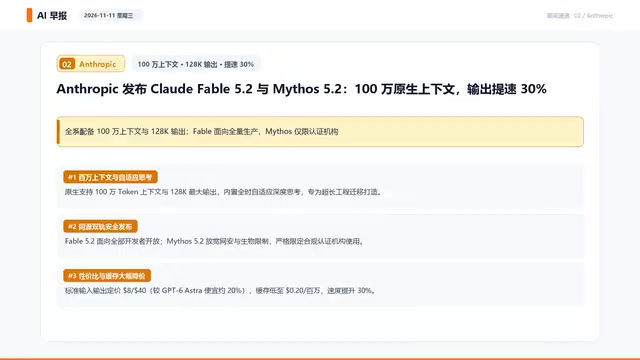
Google launches Gemini 4 Carbon and multi-agent tool Swarm; Anthropic debuts million-context Fable 5.2 and Mythos 5.2; OpenAI releases security-focused GPT-6 Cyber; Mistral and Kimi open-source trillion-parameter models — the LLM race accelerates across the board.