Gemini 4 Carbon Release Sparks Discussion: Technical Details and Controversy Coexist
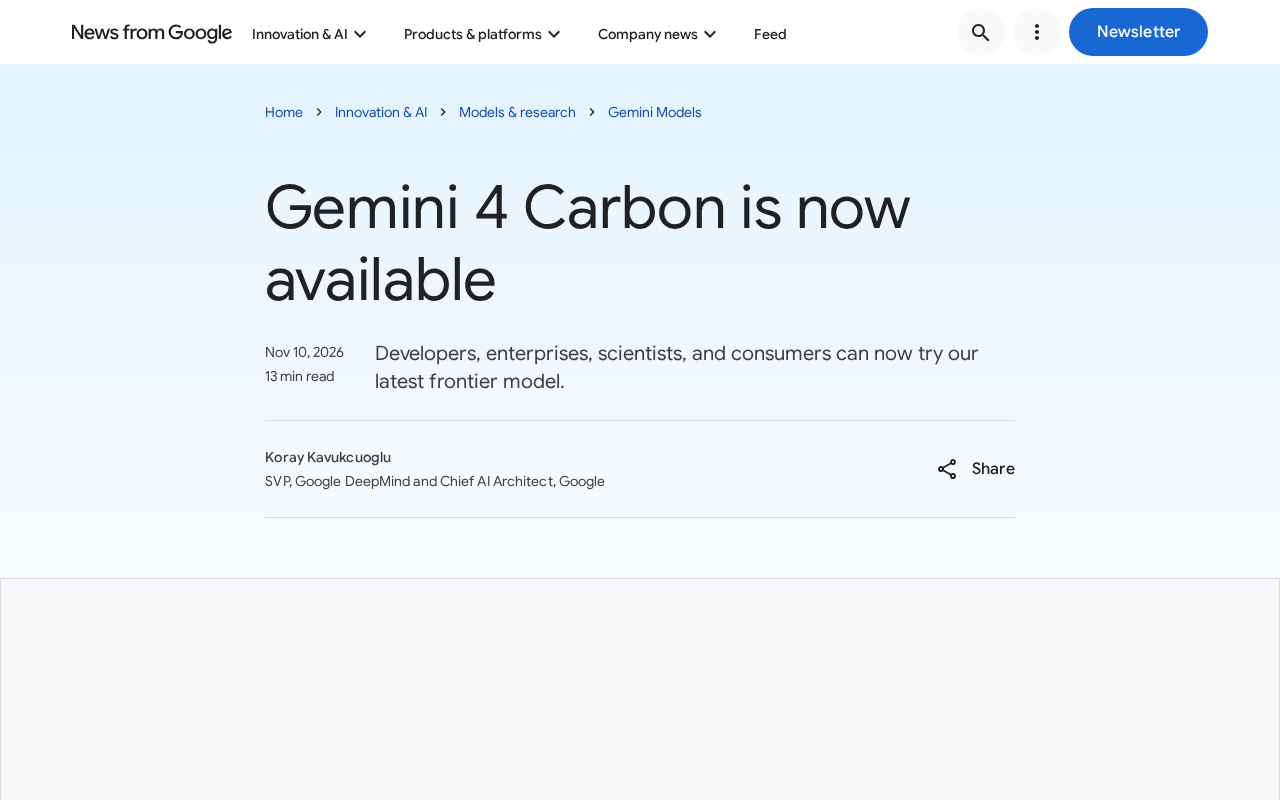
Gemini 4 Carbon's release sparks Hacker News discussion, but official specs are undisclosed and community views are divided.
According to Hacker News, Gemini 4 Carbon is now officially available, with the related post gaining 145 points and 62 comments. As a new Gemini series member, the meaning of the "Carbon" suffix remains officially unexplained. Community discussion focuses on API stability, response speed, output quality, and whether the name implies a lightweight or efficiency-optimized positioning. With limited original information, most comments are based on early experience and speculation, and no consensus has formed; some users question the pace of official disclosure. The article speculates, based on the Gemini series' development path, that it may target cost-sensitive or low-latency scenarios, but stresses this is only a community judgment. It advises developers to wait for technical reports, pricing, and migration guides, and to verify through benchmarks and real-world scenarios before making technology choices.
Gemini 4 Carbon Officially Released
According to the Hacker News community, Gemini 4 Carbon is now officially available. The news quickly gained 145 points of community heat and 62 comments, drawing widespread attention from developers and AI researchers. As a new member of the Gemini series, the "Carbon" name suggests a possible new positioning in performance or efficiency, though official technical specifications have not yet been disclosed.
Currently, discussion around this version centers on availability, actual capabilities, and the meaning of the name. Due to the lack of detailed official documentation, community opinions are divided.
Community Discussion Focus
The Hacker News comment section shows typical characteristics of technical community discussion. Some users focus on the actual calling experience of Gemini 4 Carbon, including API stability, response speed, and output quality; others speculate about the "Carbon" suffix, suggesting it may represent some direction toward lightweight or carbon-efficiency optimization.
Notably, because the original post contained limited information, most comments are based on preliminary experiences or speculation, and no consensus has formed. This information asymmetry has also led to questions in the discussion about the pace of official disclosure.
Technical Interpretation and Industry Background
Given the previous development path of the Gemini series, new version releases are usually accompanied by model capability upgrades or expanded application scenarios. If Carbon is positioned as an efficiency-optimized version, it may target scenarios that are cost-sensitive or require low-latency inference. However, this judgment is currently only community speculation and lacks official data support.
From an industry perspective, model version updates are becoming more frequent and naming systems increasingly complex, creating higher cognitive costs for users when making choices. The release of Gemini 4 Carbon also reflects the tension between "version iteration" and "information transparency" in the competitive large-model market.
Hacker News community heat mechanism: Hacker News is operated by Y Combinator. Its post ranking is not simply calculated by upvotes, but combines vote count, posting time, and comment activity, among other factors, and includes anti-voting-ring and penalty mechanisms. The "points" a post receives reflect voting heat, while the comment count reflects the controversy of the topic and willingness to participate. 145 points and 62 comments represent a moderately above-average discussion scale on HN, usually meaning the topic reached the front page or came close to it within a certain period, but it still cannot be compared with major release events that receive thousands of points. Understanding this scale helps objectively assess the true strength of "community attention" and avoid misreading moderate heat as an industry-level sensation.
Large-model version naming and suffix conventions: Major model vendors often add suffixes after the main version number to distinguish capability tiers or optimization directions, such as lightweight versions (mini, flash, nano), enhanced reasoning versions (thinking, reasoning), and variants for specific deployment scenarios. Such suffixes usually mean sharing the same architecture as the base model but differing in training data, distillation strategy, or inference configuration, thereby creating differentiated trade-offs among cost, latency, and quality. "Carbon" is not an industry-standard naming convention, so its exact meaning can only be defined by official documentation. When readers encounter version names lacking official explanations, they should be wary of capability assumptions derived from naming associations and use benchmark tests and pricing information as the basis for judgment.
Items to Watch
For developers and enterprise users, the actual performance of Gemini 4 Carbon still needs to be verified through benchmark tests and real-world scenarios. Going forward, it will be important to watch whether the official team releases a technical report, pricing strategy, and migration guide. With information still insufficient, it is advisable to maintain a cautious assessment and avoid making technology selection decisions based solely on community heat.
One-line Summary
Gemini 4 Carbon's availability has sparked discussion on Hacker News, but official specifications have not been disclosed and community opinions are divided.
Paragraph Summary
According to the Hacker News community, Gemini 4 Carbon is now officially available, and the related post received 145 points of heat and 62 comments. As a new member of the Gemini series, the meaning of the "Carbon" suffix has no official explanation yet. Community discussion focuses on actual calling experience such as API stability, response speed, and output quality, as well as whether the name suggests a lightweight or efficiency-optimized positioning. Because original information is limited, most comments are based on preliminary experience and speculation, and no consensus has formed; some users have questioned the pace of official disclosure. Based on the Gemini series' development path, the article speculates that it may target cost-sensitive or low-latency scenarios, but emphasizes that this is only a community judgment. The conclusion recommends that developers wait for technical reports, pricing strategies, and migration guides, and verify through benchmark tests and real-world scenarios before making technology choices.
Related articles

How Do Cursor, Devin, TRAE, and Copilot Compare on Price? Calculate Your Credits Before You Compare Monthly Fees
Side-by-side comparison of individual and team pricing for Cursor, Devin Desktop, TRAE, and Copilot, breaking down credit rules, third-party model inclusion, overage billing, and practical methods for measuring usage before paying, setting spending caps, and choosing the right tool.
Copilot Retires Three Models: Pro Users Left With Only One Alternative
GitHub Copilot retires Claude Opus 4.8, Claude Opus 5, and GPT-5.6 Tera on Nov 16 across Chat, code completion, and Agent mode. Pro users have only GPT-6 Luna left; Legacy annual plans miss Opus 5.5; admins must enable replacements manually.
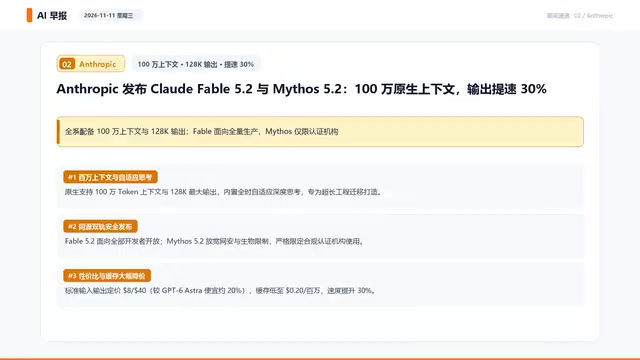
Gemini 4 Carbon Arrives: The LLM Race Enters the Era of Million-Token Context and Trillion-Parameter Open Source
Google launches Gemini 4 Carbon and multi-agent tool Swarm; Anthropic debuts million-context Fable 5.2 and Mythos 5.2; OpenAI releases security-focused GPT-6 Cyber; Mistral and Kimi open-source trillion-parameter models — the LLM race accelerates across the board.