Gemini 4 Carbon Released: AI Agent Swarm Feature Draws Attention

Google releases Gemini 4 Carbon, billed as its most powerful model ever, targeting Anthropic and OpenAI with an agent swarm feature.
Google announced this week that its latest AI model, Gemini 4 Carbon, is officially open to the public. The model was previously made available to a limited group of cybersecurity defenders, and the company calls it its "most powerful model ever," claiming it can compete with the top systems from Anthropic and OpenAI. A major highlight of this release is the "swarm" agent cluster feature mentioned in the title, which may allow multiple AI agents to work collaboratively and has potential in complex task decomposition, parallel processing, and dynamic scheduling. However, Carbon's specific parameters, benchmark results, pricing strategy, and technical documentation for the swarm feature have not been disclosed, and its actual capabilities remain to be verified.
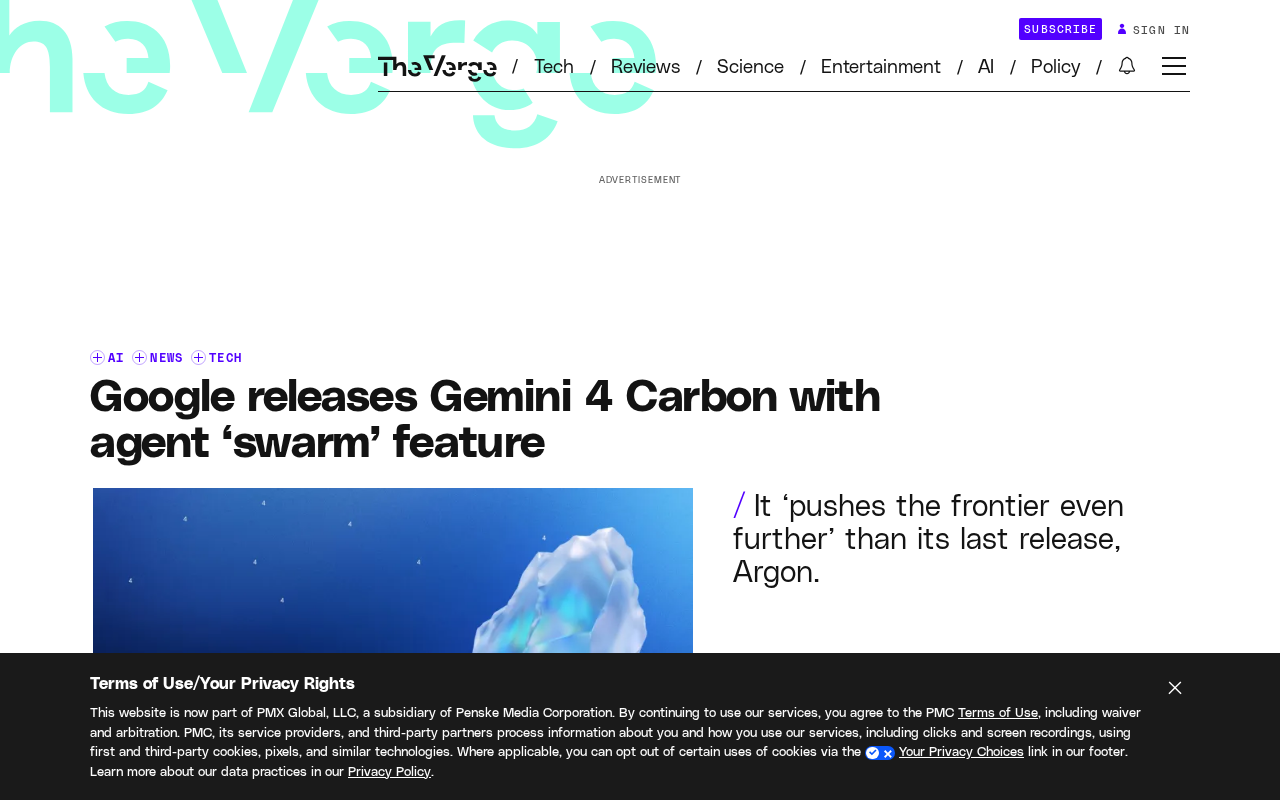
Google announced this week that its latest AI model, Gemini 4 Carbon, is now officially open to the public. Two weeks ago, the model was made available to a limited group of "cybersecurity defenders"; now ordinary users can experience it too. Google claims Carbon is its "most powerful model ever" and is capable of competing with the top systems from Anthropic and OpenAI.
From Targeted Testing to Full Public Release
The release cadence of Gemini 4 Carbon is worth noting. Google first opened it to specific users in the security field, then gradually rolled it out to the general public—a strategy that allows it to collect feedback in a controlled environment while also accumulating safety cases for the official launch. According to the company, Carbon performs exceptionally well in cybersecurity scenarios, which is one reason the first batch of trial users was concentrated in the defense sector.
Google said Gemini 4 Carbon "continues..." (the original text is truncated here and does not provide the complete statement)
Although details are limited, the positioning as the "most powerful model" and the intent to benchmark against competitors are clear. Currently, Anthropic's Claude series and OpenAI's GPT series dominate the market, and Google needs a product that can prove its technical strength to secure its position.
The Agent "Swarm" Feature: A New Direction for Collaborative AI
The "swarm" feature mentioned in the title is a major highlight of this release. Although the original text does not elaborate on technical details, judging from the name, this feature may allow multiple AI agents to work collaboratively in a swarm, rather than a single model responding independently. This architecture has potential in complex task decomposition, parallel processing, and dynamic scheduling.
For developers, agent swarms mean more flexible workflows can be built. For example, one agent handles information retrieval, another handles logical reasoning, and a third handles output validation, with the agents coordinating through some protocol. This model could bring efficiency gains in scenarios such as automated programming and multi-step research. However, the specific implementation mechanisms, performance, and availability still await official documentation and real-world verification.
AI Agent: An AI agent is an AI system capable of perceiving its environment, making autonomous decisions, and taking actions to achieve goals. Unlike the passive "question-and-answer" responses of large models, agents typically have capabilities such as planning, tool use, and memory, and can complete multi-step tasks without step-by-step human intervention. A common implementation approach is to use a large language model as the reasoning core, connected to external tools such as retrieval, code execution, and browser operation.
Multi-Agent Collaboration: When a single agent's capabilities or context window are limited, tasks can be decomposed and assigned to multiple specialized agents. Common patterns include the Manager-Worker structure, the Debate structure, and the Pipeline structure. Agents coordinate through message passing, a shared blackboard, or standard protocols (such as tool-calling interfaces), thereby achieving parallel processing and mutual validation on complex tasks.
Competitive Landscape and Industry Impact
Google positioning Carbon as a product that directly competes with Anthropic and OpenAI reflects the intensifying competition in the large model arena. The three giants each have different technical approaches and ecosystem advantages: Google relies on search and cloud services, Anthropic emphasizes safety and controllability, and OpenAI continues to iterate on general capabilities.
Whether the public version of Carbon can deliver on its "most powerful" promise in real-world scenarios will directly affect the choices of developers and enterprises. In addition, if the agent swarm feature matures, it could drive AI applications to evolve from "single-turn Q&A" to "multi-agent collaboration," which opens up imaginative possibilities for fields such as AI programming and automated operations and maintenance.
The "Big Three" Landscape of Large Models: The current general large model market is mainly dominated by OpenAI, Anthropic, and Google. OpenAI's GPT series is known for its general capabilities and thriving ecosystem, Anthropic's Claude series is known for safety alignment and long-context processing, and Google's Gemini series leverages search, Android, and Google Cloud to form a software-hardware synergy advantage. The three companies trade wins and losses on model capabilities, but they differ in their focus on the enterprise market, developer ecosystem, and security compliance. Benchmarking against competitors when releasing a new model has become an industry convention, and it also reflects the continued lack of unified, transparent benchmarks for evaluating model capabilities.
Open Questions
Currently, publicly available information is rather limited. Carbon's specific parameters, benchmark results, pricing strategy, and technical documentation for the "swarm" feature have not been disclosed. For researchers and developers hoping to evaluate the model, more empirical data and official explanations are still needed.
Google's release undoubtedly adds a new variable to the AI model competition, but the title of "most powerful" will ultimately need to be verified by real-world performance.
One-line Summary
Google releases Gemini 4 Carbon, billed as its most powerful model ever, targeting Anthropic and OpenAI, and introduces an agent swarm feature.
Paragraph Summary
Google announced this week that its latest AI model, Gemini 4 Carbon, is officially open to the public. The model was previously made available to a limited group of cybersecurity defenders, and the company calls it its "most powerful model ever," with the capability to compete with the top systems from Anthropic and OpenAI. A major highlight of this release is the "swarm" agent cluster feature mentioned in the title, which may allow multiple AI agents to work collaboratively and has potential in complex task decomposition, parallel processing, and dynamic scheduling. However, Carbon's specific parameters, benchmark results, pricing strategy, and technical documentation for the swarm feature have not been disclosed, and its actual capabilities remain to be verified.
Related articles

How Do Cursor, Devin, TRAE, and Copilot Compare on Price? Calculate Your Credits Before You Compare Monthly Fees
Side-by-side comparison of individual and team pricing for Cursor, Devin Desktop, TRAE, and Copilot, breaking down credit rules, third-party model inclusion, overage billing, and practical methods for measuring usage before paying, setting spending caps, and choosing the right tool.
Copilot Retires Three Models: Pro Users Left With Only One Alternative
GitHub Copilot retires Claude Opus 4.8, Claude Opus 5, and GPT-5.6 Tera on Nov 16 across Chat, code completion, and Agent mode. Pro users have only GPT-6 Luna left; Legacy annual plans miss Opus 5.5; admins must enable replacements manually.
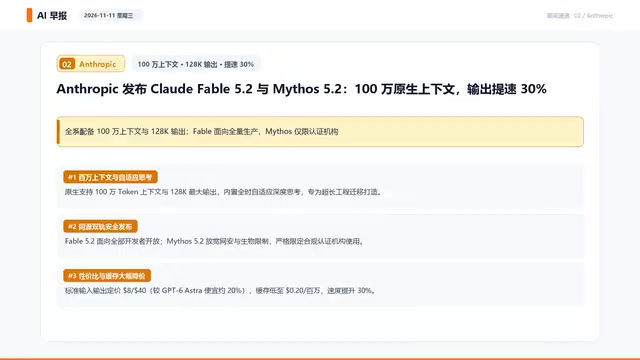
Gemini 4 Carbon Arrives: The LLM Race Enters the Era of Million-Token Context and Trillion-Parameter Open Source
Google launches Gemini 4 Carbon and multi-agent tool Swarm; Anthropic debuts million-context Fable 5.2 and Mythos 5.2; OpenAI releases security-focused GPT-6 Cyber; Mistral and Kimi open-source trillion-parameter models — the LLM race accelerates across the board.