Gemini 4 Hydrogen Architecture Breakdown: Carbon-Derived Reasoning and the Truth Behind Million-Token Output
Gemini 4 Hydrogen is directly adapted from Carbon, beating the flagship at a low price point, but requires layered orchestration and cost auditing.
Google restructured the Gemini 4 product line in November 2026, replacing the FLASH name with Hydrogen. Hydrogen is not a distilled, shrunk-down version of Argon, but is directly adapted from the multi-agent frontier model Carbon, migrating chain-of-thought capabilities into a reasoning engine at roughly 200 tokens per second, and sharing a context window and output limit exceeding 1 million tokens with the other two models. On benchmarks, it surpasses the flagship Argon's 50 with a score of 54 at the extra-high tier, but extra-high raises task cost by 69% while Terminal Bench accuracy stays flat; its hallucination rate of 8.5% is also higher than Argon's 4.3%. The article emphasizes evaluating by total cost per task rather than nominal unit price, and recommends a layered orchestration scheme with Carbon as architect and Hydrogen as executor.
From Carbon Direct Adaptation, Not a Shrunk-Down Argon
In the past, lightweight models took the approach of aggressive distillation—trading cognitive depth for throughput. Speed went up, but complex multi-turn logic collapsed. Hydrogen takes a completely different route.
According to DeepMind's official technical disclosure, Hydrogen is not a trimmed variant of Argon, but is directly adapted from Gemini 4 Carbon, the multi-agent frontier model. Google migrated Carbon's reasoning pathways into a reasoning-optimized engine, allowing it to maintain roughly 200 tokens-per-second generation speed while retaining fairly complete chain-of-thought capabilities. This is the fundamental reason it can deliver above-expectation performance in the low-price tier.
The three Gemini 4 models now share the same context window exceeding 1 million tokens. More critically, through long-decode execution, the maximum output limit has been extended to 1 million tokens, meaning even the small model can complete full-repository-level code generation or exhaustive data synthesis in a single API call, no longer constrained by the old bottleneck.
Chain-of-Thought (CoT) capability refers to the model's ability to explicitly generate intermediate reasoning steps before producing a final answer. It is typically implemented by injecting large numbers of samples with reasoning traces during training, or by using prompting at inference time to guide the model to "think first, then answer." Models with strong CoT capabilities perform significantly better on multi-step logic, math, and code debugging tasks, but the cost is that generation consumes a large number of internal reasoning tokens, driving up latency and cost. If lightweight models are compressed using traditional distillation, this capability is often sacrificed, manifesting as "fast on easy problems, collapse on complex ones." Hydrogen emphasizes retaining complete chain-of-thought because it directly determines whether the model can handle agent-style multi-step tool calling and self-correction.
Benchmark Data: Low-Price Model Surpasses the Flagship
On the Artificial Intelligence Index 5.0.1, Gemini 4 Carbon achieves a ceiling score of 60 with high-intensity reasoning. Hydrogen scores 51 at the high-intensity tier and can climb to 54 under the new extra-high reasoning tier. This score directly places Google's lowest-cost model ahead of the dedicated flagship Gemini 4 Argon (capped at 50).
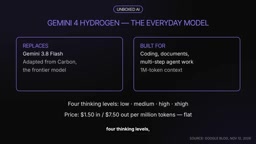
Hydrogen also introduces Google's first four-tier reasoning parameter (low, medium, high, default), plus a brand-new extra-high tier.
On speed, independent telemetry from Agent Arena shows Hydrogen completing multi-step tool queries approximately 3 times faster than frontier competitors, maintaining high responsiveness in real-time agent execution. On code synthesis, it achieves a perfect 43/43 on the standardized Plotly evaluation set, with accuracy aligned to frontier models while taking only a fraction of their time.
Two Failure Modes That Cannot Be Ignored
An objective engineering evaluation must audit failure points. Hydrogen is not a universal replacement for frontier models, and blind deployment brings significant operational risk.
The Cost-Effectiveness Trap of extra-high
Rising from high to extra-high, the benchmark score goes from 51 to 54, but the token consumption curve is nonlinear. In comprehensive evaluations, enabling extra-high raised average task execution cost by 69%, from $1.87 to $3.16 per workflow, because the model generates large numbers of internal reasoning tokens. Yet in real-world environments like Terminal Bench 4.0, accuracy remained completely flat at 54%. Running Hydrogen on extra-high in production software often means spending noticeably more money without corresponding returns.
Reasoning effort / thinking budget is a inference-time parameter commonly introduced by reasoning models in recent years, used to control how many internal reasoning tokens the model may consume before giving an answer. Low tiers respond quickly at low cost, suitable for simple tasks; high tiers allow longer thinking processes, usually improving accuracy on hard problems, but cost grows nonlinearly with token count. The key point is that the benefit of raising the tier is not linear: on simple tasks, high tiers often only add expense without improving results. Therefore engineering practice requires dynamically selecting tiers by task type rather than maxing out globally—this is the root cause of extra-high's flat accuracy on Terminal Bench mentioned in the article.
The Hallucination Profile Trade-off
In audit testing under the VOWELS framework, Gemini 4.0 Argon maintains an industry-leading 4.3% hallucination rate, Hydrogen sits at 8.5%, and Carbon is higher still at 11.4%. In mission-critical environments such as financial compliance, legal contract analysis, and medical records, a lower hallucination rate is valuable in itself.

Hallucination rate typically refers to the proportion of cases where the model generates plausible-sounding but factually incorrect content when lacking grounding, often quantified using audit frameworks like VOWELS across dimensions such as fact-checking, QA consistency, and citation accuracy. Tolerance for hallucination varies enormously across tasks: creative writing can accept some fabrication, while in scenarios such as financial compliance, legal contracts, and medical records, a single misstatement can bring direct legal or financial consequences. Therefore in mission-critical environments, model selection cannot rely solely on benchmark scores and unit price—hallucination rate is a hard constraint that requires separate auditing.
The Real Metric Beyond Unit Price: Total Cost per Task
Carbon and Argon are currently on promotional pricing: $2 per million input tokens and $10 per million output tokens. Google has confirmed that starting December 1, 2026, both flagship tiers will double in price to $4 input and $20 output. At that point, the cost premium relative to Hydrogen will be 2.66x.
But per-token pricing is often misleading. What engineering leaders should really look at is the total cost per completed workflow. Comparing Hydrogen with the nominally cheaper Gemini 3.8 Flash ($0.75 input, $3 output), an economic paradox emerges: in benchmark tests, 3.8 Flash often gets stuck on complex agent iterations, accumulating 21 minutes of runtime and $7.77 in cloud compute across multiple retries; Hydrogen solves the same task in a single 8-minute run for $1.87. Because higher intelligence avoids wasteful prompt loops, Hydrogen's actual cost per successful production task is about one quarter that of the model whose nominal unit price is half its own.
Multi-Layer Orchestration: Where Hydrogen Belongs
A more sensible system design for modern developers is layered model orchestration, rather than using one model to carry the entire stack. Google has built a dual-tier workflow into the anti-core system, implemented through an anti-gravity IDE called Orchestrator.
Traditional routers attempt to pre-judge prompt difficulty using heuristic rules; this judgment often fails when a seemingly simple prompt triggers deep, complex dependencies. The anti-gravity approach is different: Gemini 4 Carbon serves as lead architect, reading in the codebase, mapping file dependencies, and drafting an execution plan; then fine-grained code writing, linting, and unit test generation are delegated to Hydrogen running at 200 tokens per second. Once Hydrogen hits a compilation failure or syntax anomaly, state control immediately returns to Carbon to diagnose the error and adjust the trajectory.
In benchmarks, this hybrid orchestration mode reaches 100% of Carbon's frontier success rate while reducing frontier API quota consumption by 24% and improving end-to-end task completion speed by 19%. This is the architecture engineering teams should replicate in their own microservices.
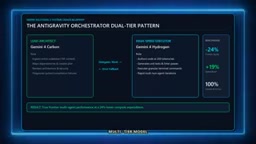
Model routing vs. layered orchestration are two different system design approaches. Traditional routers rely on heuristic rules or lightweight classifiers to predict task difficulty when a request arrives and assign it to the appropriate model; the problem is that "prediction" itself is error-prone—a seemingly simple prompt may trigger deep dependencies. Layered orchestration instead divides models by role: the strong model handles planning, diagnosis, and state control, while the weak model handles high-frequency, fine-grained execution and hands control back to the strong model on failure. The advantage of this pattern is that it replaces static prediction with runtime feedback; the cost is the need to design a clear state machine and fallback mechanism. The anti-gravity Orchestrator described in the article belongs to the latter.
Subscription and API Access Landscape
On the API development side, Google AI Studio offers a free tier with access to the full Gemini 4 Hydrogen and Argon, subject to rate limits. Free-tier prompts are logged for model training, so it is suitable only for prototyping—do not use it for proprietary intellectual property.
Among consumer subscriptions, the $4.99/month AI Plus tier unlocks manual access to Hydrogen with double the free tier's rate limits; the $19.99 Pro tier adds Argon support and more storage. The flagship Carbon is strictly restricted behind the $99–$199 Google AI Ultra subscription, or accessed via enterprise Vertex AI billing. Additionally, verified university students can get 12 months of free Gemini Advanced subscription before December 31, providing considerable sandbox space for academic research.
Decision Framework
For roughly 85% of standard engineering workloads—day-to-day application development, automated CI/CD pipelines, document extraction, fast agent loops—Hydrogen is the primary daily driver. Its Carbon-derived reasoning capability, sub-second latency, and the post-December-1 pricing structure make it a clear operational choice.
Reserve Gemini 4 Carbon for the hardest, highest-complexity engineering challenges: distributed system architecture, offensive/defensive security audits, and lead multi-agent coordination. Isolate Gemini 4 Argon in highly regulated compliance environments, where the 4.3% low-hallucination threshold is a legal necessity.
Selection need not be guesswork: architect for throughput, orchestrate for intelligence, optimize for total cost of completion.
One-line Summary
Gemini 4 Hydrogen is directly adapted from Carbon, beating the flagship at a low price point, but requires layered orchestration and cost auditing.
Paragraph Summary
Google restructured the Gemini 4 product line in November 2026, replacing the FLASH name with Hydrogen. Hydrogen is not a distilled, shrunk-down version of Argon, but is directly adapted from the multi-agent frontier model Carbon, migrating chain-of-thought capabilities into a reasoning engine at roughly 200 tokens per second, and sharing a context window and output limit exceeding 1 million tokens with the other two models. On benchmarks, it surpasses the flagship Argon's 50 with a score of 54 at the extra-high tier, but extra-high raises task cost by 69% while Terminal Bench accuracy stays flat; its hallucination rate of 8.5% is also higher than Argon's 4.3%. The article emphasizes evaluating by total cost per task rather than nominal unit price, and recommends a layered orchestration scheme with Carbon as architect and Hydrogen as executor.
Related articles
Cheapest Gemini 4 Tested: Scores 51 to Narrowly Beat a Flagship at Double the Price
Google's cheapest Gemini 4 model Hydrogen narrowly beats the double-priced Argon 51-50 on an independent leaderboard, but GPT 6.1 Tera ties it at half the cost. This article analyzes its pricing, terminal-task performance, the cost of the extra high level, and buying advice.

Gemini 4 Hydrogen Released: A Lightweight AI Option Focused on Speed and Cost-Effectiveness
Google releases lightweight model Gemini 4 Hydrogen, positioned as a Gemini 3.8 Flash replacement. It beats its own Argon in benchmarks, costs less than Sol and Opus, leads peers in speed, and can generate a playable game from a single prompt.
Anthropic Races Toward IPO as Google's Gemini Releases a Flurry of Updates
A roundup of Google Gemini's latest updates and Anthropic's progress: Gemini launches a decision API, a DNA vision model, and the mid-tier model Hydrogen; Anthropic releases Claude Meetings and advances its IPO, with analysis of benchmarks and revenue trends.