Gemini 4 Hydrogen Generates 3D Islands from a Single Sentence, 145B On-Device Model Operates Blender

Google launches a lightweight model and an on-device large model in one day, as world models and open-source robot models advance.
In one day, Google released the lightweight Gemini 4 Hydrogen, which generates interactive 3D scenes from a single prompt at 2.5× the speed of its predecessor, and the 145-billion-parameter Edge 0, which autonomously operates Blender offline to build a Manhattan block model in an hour. Fei-Fei Li's Atlas world model is fully open, supporting photo-based 3D completion and Gaussian-to-mesh conversion; Runway open-sourced the 27-billion-parameter robot world model Plexus-E under Apache 2.0. NVIDIA's Jensen Huang resigned as CEO, shrinking market cap by about $182 billion. The trend: generated content moves toward real-time interactivity, with capability下沉 and open source in parallel.
Google dropped two major bombshells in a single day—one on model capability, one on on-device deployment. The lightweight Gemini 4 Hydrogen model generates real-time multiplayer 3D island scenes from a single prompt and can even animate Python spreadsheet formulas. Meanwhile, the 145-billion-parameter Edge 0 on-device model autonomously operates Blender for modeling and inspection entirely offline. Fei-Fei Li's team has also fully opened its Atlas world model to the public.
Gemini 4 Hydrogen: Real-Time 3D Scenes from a Single Prompt
According to a tech news roundup on Bilibili, Gemini 4 Hydrogen's standout feature is that "a single prompt generates a real-time multiplayer 3D island"—not just an image or a video, but an interactive, real-time 3D scene. The model is already integrated into the API and Search, and its pricing—$1.50 per million input tokens and $7.50 per million output tokens—signals it's built for real production rather than pure demo.
On the Artificial Analysis composite index, the model scores 51 in the High tier and 54 in X-High, with a self-reported Terminal Bench 4.1 score of 57%. These numbers still lag behind top flagships, but they're impressive for a "lightweight" positioning. The model supports four levels of thinking adjustment and runs 2.5× faster than Gemini 3.8 Flash; paired with Gemini 4 Carbon for concurrency, it can save 24% of quota. For developers making large-scale API calls, the direct value of this combination is lower cost and lower latency.
Another official demo is even more intriguing: using Python to shrink spreadsheet cells and combining formulas to render pixel animations in real time. Turning a spreadsheet into an animation engine means the model's understanding of structured data is moving from "reading" toward "manipulating and presenting."
The model can even hand-write a 3D Earth shader in the browser, converting real-time lightning data into dynamic ambient music—this kind of cross-modal real-time creation showcases the model's potential for unified orchestration of graphics pipelines and audio generation.
Edge 0 145B: Operating Blender Without a Network
Edge 0 has released a 145-billion-parameter on-device version. According to the source data, it activates 10.12 billion parameters per token, peaks at 29GB of memory on a laptop, and decodes at 98.3 tokens per second on a single GPU. It scored 86.5 on the Terminal Bench 2.1 internal test—even higher than the lightweight model's Terminal Bench 4.1 result mentioned above. Though different test versions make direct comparison inappropriate, the on-device model's maturity on terminal tasks is clear.
In an actual demo, the model invoked Blender autonomously to model and inspect while offline, building a Manhattan block model within an hour. The model card, confirmed by Hiker News, shows the base is adapted from Qwen Q1 3.8 Flash Next under a custom community license, with commercial hosting requiring a separate agreement. Currently only the CUDA 13 build is available, and benchmarks include community reproductions.
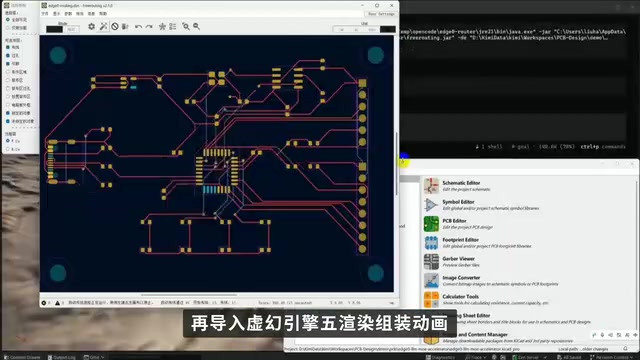
Another local workflow showed the model completing double-layer PCB routing in K-CAD, then importing into an engine to render an assembly animation. The value of on-device models is shifting from "it runs" to "it gets the whole job done"—offline, local, and privacy-controllable. That's a clear draw for industrial and design scenarios.
Mixture of Experts (MoE) architecture is the key to understanding "145 billion parameters, 10.12 billion activated per token." An MoE model consists of multiple expert sub-networks plus a gating network; during each forward pass, the gate selects only a few experts to participate, so while the total parameter count is large, the actually activated count is much smaller. This design lets model capacity and knowledge scale with total parameters while inference compute and memory usage depend mainly on activated parameters. That's precisely the key to deploying large models on-device: the 145B total size delivers strong capability, while ~10B activation keeps it running on a laptop with 29GB memory and single-GPU decoding near 100 tokens per second. The trade-off is higher training complexity and memory usage than a dense model with the same activation count.
Atlas World Model Fully Open: Photos into 3D Space
According to public information from Fei-Fei Li's team, the 3D world model Atlas is now fully open to the public. Viewfinder supports uploading photos to complete 3D spaces and edit camera movements; Frameboy supports 15fps web-based roaming, and results can be converted to triangle meshes and imported into Blender, with the API also open.
In a Chisell demo, users upload a hand-drawn courtyard sketch to generate a 3D wireframe and switch between day and night lighting. The official site also offers real-time previews of depth maps and point clouds, with one-click export to mainstream game engines. The latter part of the demo uses 7 keyframes for orbiting camera movement, converting 1.98 million Gaussian points into a solid 3D mesh—the conversion from Gaussian splatting to solid meshes is precisely the key step for 3D content to enter traditional game and film pipelines.
Gaussian Splatting is an emerging 3D scene representation and rendering technique. It approximates a scene using a large number of 3D Gaussian ellipsoids with position, rotation, scale, and opacity, each also carrying color information. Rendering synthesizes images by projecting and blending these Gaussian points, without needing traditional triangle meshes. Compared with Neural Radiance Fields (NeRF), Gaussian splatting trains and renders faster and preserves sharper details, making it suitable for quickly reconstructing real scenes from multiple photos. But its output is a point-cloud-style representation that can't be directly used as a solid mesh by game engines and film pipelines—so the "converting 1.98 million Gaussian points into a solid 3D mesh" mentioned above is the key transformation step for 3D content to enter traditional production workflows, and a hot direction in current 3D reconstruction research.
Runway Open-Sources Robot World Model Plexus-E
Runway extends world models into robotics, open-sourcing the 27-billion-parameter Plexus-E under the Apache 2.0 license. In 1,200 evaluations on NVIDIA Robolab E20, it achieved a 46.2% success rate, with internal testing speeds reaching 15.6× that of GPT-6 Astra.
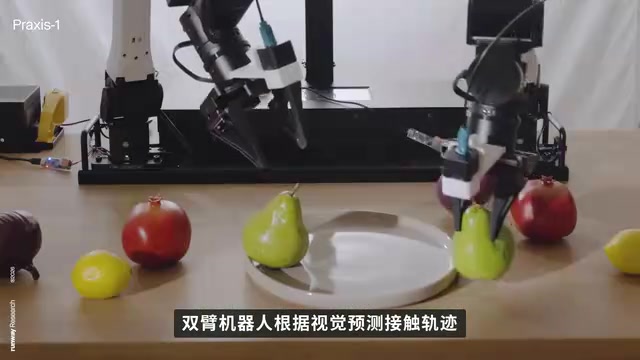
In actual footage, a dual-arm robot predicts contact trajectories from vision to complete delicate operations like wrap-tray placement, flag dropping, and dish loading/unloading. Open-sourcing a robot world model under a permissive license is a substantial boost for the embodied AI research community.
Google and Samsung Co-Branded Smart Glasses
Google and Samsung have opened pre-orders for Gemini smart glasses weighing about 41 grams, with two co-branded models starting at $395 and $449, shipping December 10. Battery life is 9 hours, with support for over 70 languages of translation, automatic blurring of bystanders' faces before processing, and recording that stops when the indicator light is covered. Hardware close-ups show a 12MP ultra-wide camera built into the frame, an indicator light, and open-ear speakers. Privacy design is placed front and center, showing that regulatory pressure in this category has become part of product definition.
NVIDIA Management Shakeup and Industry Briefs
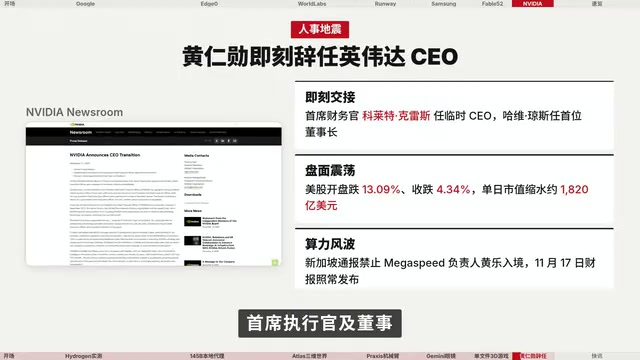
NVIDIA announced that Jensen Huang is stepping down immediately as President, CEO, and director, with Colette Kress as interim CEO and Harvey Jones as the first Chairman. Following the announcement, shares closed down 4.34% per share, with market cap shrinking by about $182 billion; Singapore barred Huang from entry, and the November 17 earnings report will proceed as scheduled. The subsequent impact of this change on the AI compute supply chain is worth continued attention.
Other briefs: OpenAI launched the automated offense-defense suites Daybreak Red Team and Diablo Defense Factory; Anthropic opened the Cloud Meetings beta, integrating real-time whiteboarding into Google Meet; the Microsoft 365 outage expanded, affecting Copilot and enterprise connectors; the U.S. Department of Justice reported that North Korea used FaceStealer deepfakes to steal over $400 million in crypto assets; four public-interest organizations sued five frontier AI companies, requesting a pause on high-risk system deployments.
Trend Watch
Today's information flow shows two clear threads: first, model capabilities are evolving toward "real-time interactivity"—whether generating 3D islands from a single sentence or completing 3D spaces from photos, generated content is shifting from static output to roamable, editable scenes; second, on-device and open-source efforts are advancing in parallel—a 145B model operating Blender offline and a robot world model open-sourced under Apache 2.0 show that capability下沉 and community co-building are moving forward side by side.
One-line Summary
Google released a lightweight model and an on-device large model the same day, while world models and open-source robot models also advanced.
Paragraph Summary
In one day, Google released the lightweight Gemini 4 Hydrogen and the 145-billion-parameter on-device Edge 0: the former generates interactive 3D scenes from a single prompt in real time at 2.5× the speed of its predecessor, and demonstrates cross-modal abilities like spreadsheet animation; the latter autonomously operates Blender offline, building a Manhattan block model in an hour. Fei-Fei Li's Atlas world model is fully open, supporting photo-based 3D space completion and conversion of Gaussian points to solid meshes; Runway open-sourced the 27-billion-parameter robot world model Plexus-E under Apache 2.0. NVIDIA's Jensen Huang stepped down as CEO, shrinking market cap by about $182 billion. The overall trend: generated content moving toward real-time interactivity, with capability下沉 and open source advancing in parallel.
Related articles

OMLX 0.7.1 Integrates Splash: Major Speedup for MLX Model Inference on Mac
OMLX 0.7.1 adds Splash as an external engine, letting standard MLX models (Qwen 3.6 35B) match Splash custom setups at 92.8 tokens/s. Setup, D-Flash2 requirements, and M1/M2 compatibility explained.

Running Uncensored AI Locally on Your Phone: LFM3 Hands-On Test and Guide
Learn how to run Liquid AI's LFM3 1.7B uncensored model locally on iPhone and Android—no GPU or network needed. Includes On Device LLM and Layla steps, speed tests, and privacy benefits.

Claude Launches Collaborative Sheets and Whiteboards, Taking On Microsoft and Google Directly
Anthropic rolls out beta Claude Sheets and Whiteboards to paid users, enabling one-prompt spreadsheets with formulas and turning verbal plans into collaborative boards—taking on Microsoft and Google directly.