Gemini 4 Hydrogen Released: Real-World Performance Tests and Analysis of Google's New Model
Google releases Gemini 4 Hydrogen, focused on speed, coding, and Agent execution, collaborating with Carbon and Argon.
Google officially releases the Gemini 4 series, including Carbon, Argon, and Hydrogen, with Hydrogen positioned as a faster, more efficient execution model for coding, automation, and AI Agent scenarios. On the Artificial Analysis reasoning index, Hydrogen scores slightly above Argon, and the highest thinking tier Castra High can further boost scores at the cost of more tokens; against CloudSonic 5.5 and GPT 6.1 it is competitive but not universally ahead. Google also announced Orchestrator, where Carbon plans and Hydrogen executes, achieving results close to Carbon while cutting quota consumption and speeding execution. In hands-on tests, Hydrogen generated 3D scenes, multi-page presentations, e-commerce landing pages, and expense dashboards from single prompts. The model is currently available only to paid users, with token efficiency better than Argon.
Google has officially released its next-generation model Gemini 4 Hydrogen, focused on speed, coding, and AI Agent task execution. Alongside it, Google unveiled Gemini 4 Carbon and Gemini 4 Argon, each with distinct positioning. This article, based on public demos and hands-on information, reviews Hydrogen's performance, Google's model orchestration approach, and how it performs in real-world tasks.
Google's New Model Matrix: How Carbon, Argon, and Hydrogen Divide the Work
According to the YouTube channel AI in Action, Google has clearly differentiated the Gemini 4 series: Carbon and Argon focus on complex tasks requiring deep reasoning and long-horizon planning, while Hydrogen is designed as a faster, more efficient execution model, particularly targeting coding, automation, and AI Agent scenarios.
This division means Google is no longer pursuing a single model that handles all tasks, but rather offering differentiated choices by task type. For developers, understanding the boundaries between the three is more practically meaningful than simply comparing benchmark scores.

Benchmark Performance: Close to Top Models, But Not Universally Leading
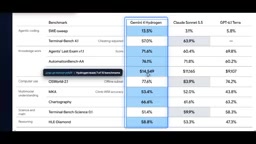
On the reasoning dimension of the Artificial Analysis Intelligence Index, Hydrogen scores slightly higher than Argon. Setting the Thinking Level to the highest tier, Castra High, further improves the score. Note that higher thinking tiers bring stronger capabilities but also consume more tokens.
In head-to-head comparisons, Google placed Hydrogen in the same benchmark group as CloudSonic 5.5 and GPT 6.1. Across tests covering software engineering, automation, Agent tasks, multimodal file understanding, and complex knowledge reasoning, Hydrogen achieved competitive results, leading the comparison models in some categories.
However, the creator also noted that Hydrogen does not come first in every test. In some tests it trails its competitors, though the gaps are not large. This suggests Hydrogen's positioning is that of a strong competitor rather than a universal dominator.
Artificial Analysis Intelligence Index is a comprehensive model capability leaderboard maintained by the independent evaluation firm Artificial Analysis. It normalizes and weights scores from multiple public benchmarks (such as reasoning, coding, math, and knowledge Q&A) into a single index for easy cross-model comparison. The index does not equate to real-world task performance—especially for long-horizon Agent tasks, where coverage is limited—so the industry typically treats it as a reference rather than a conclusion. The "Thinking Level" mentioned in the article refers to a configurable reasoning-depth tier: the higher the tier, the more internal reasoning steps the model performs before giving an answer, and the more tokens it consumes accordingly. This mechanism lets the same model switch between "fast and economical" and "slow and accurate," a common product design for current reasoning models.
Orchestrator: Google's Approach to Multi-Model Collaboration
Google also announced a mechanism called Orchestrator, running within the Anti-Gravity environment. Its core idea: for long tasks, a single model no longer works alone; instead, a "manager" dispatches lower-level models or Subagents based on task type. For example, Carbon handles planning while Hydrogen handles execution.
According to Google, this orchestration approach achieves results close to Carbon while significantly reducing quota consumption and speeding up execution. For team users, this means a better balance between cost and quality.
Subagent refers to an independent model instance dynamically created within the main workflow to handle a specific subtask. Unlike a simple function call, a subagent has its own context and tool permissions and can independently complete a piece of work before returning the result to the main agent. Orchestrator is the upper-level "manager" responsible for decomposing tasks, selecting models, assigning subtasks, and aggregating results. The value of this architecture: planning tasks go to models with strong reasoning, execution tasks go to fast and cheap models, optimizing cost and latency overall. Anti-Gravity is Google's Agent-building and runtime environment for developers, where Orchestrator is provided as a platform capability rather than a framework developers must build themselves.
Hands-On Experience: From 3D Models to Complete Web Pages
The creator ran several hands-on tests in the Task mode of the Gemini web interface. The first was generating a farm 3D scene, with requirements to partition by animal type and present daytime lighting. Hydrogen produced an interactive 3D model within minutes, with animal partitioning meeting the requirements; the details were simple but could be further modified.
The second was creating a presentation about "AI in daily life," giving only the topic and general requirements, with the model designing the layout and color scheme itself. The result was a multi-page slide deck with bilingual Chinese-English content, charts, and voiceover, with the style varying page by page. The creator commented that doing the same work by hand would take much longer.

The third was generating a fashion e-commerce landing page, required to be mobile-friendly and include specified colors. Hydrogen produced a complete page within minutes, including product displays, promotional blocks, reviews, and a footer—the level of completion from a single prompt satisfied the creator.
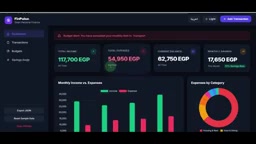
The fourth was a personal expense-tracking dashboard, required to support data entry, income/expense statistics, and categorized budgets. The model automatically generated a bilingual Chinese-English interface, light and dark modes, category charts, and transaction records, with support for real-time updates to summary data when new transactions are added.
Pricing and Availability
Hydrogen is billed by token, with separate pricing for input and output. Currently the model is only available to paid users; users on free credits or free plans may not see it in Anti-Gravity. The creator, having only the Pro version, was unable to test the full Orchestrator experience within Anti-Gravity.
Based on actual usage, after completing the above tasks, quota consumption within the 5-hour window remained at a low level, and the creator considers its token efficiency better than Argon.
Token-based billing is the mainstream pricing method for large model APIs today: input tokens (prompts and context) and output tokens (model-generated content) are priced separately, with output typically costing more. An Agent task often involves multiple rounds of calls and large amounts of context, so actual cost is very sensitive to token efficiency—this is the practical significance of the article's emphasis that Hydrogen's "token efficiency is better than Argon." 5-hour window quota is a common rate-limiting method for subscription products, capping available calls or total tokens within a sliding time window; exceeding it requires waiting for the window to roll or upgrading the plan. This limit design gives users predictable usage under a fixed subscription fee, but also means the practical feasibility of long tasks depends on the token consumption of a single task.
Summary
Gemini 4 Hydrogen has a clear positioning: it does not aim to top every benchmark, but to build advantages in speed, coding, and Agent execution, forming a collaborative system with Carbon and other models through Orchestrator. For users who need to quickly produce prototypes, web pages, or data dashboards in their daily work, it is a new option worth watching.
Related articles

OMLX 0.7.1 Integrates Splash: Major Speedup for MLX Model Inference on Mac
OMLX 0.7.1 adds Splash as an external engine, letting standard MLX models (Qwen 3.6 35B) match Splash custom setups at 92.8 tokens/s. Setup, D-Flash2 requirements, and M1/M2 compatibility explained.

Running Uncensored AI Locally on Your Phone: LFM3 Hands-On Test and Guide
Learn how to run Liquid AI's LFM3 1.7B uncensored model locally on iPhone and Android—no GPU or network needed. Includes On Device LLM and Layla steps, speed tests, and privacy benefits.

Claude Launches Collaborative Sheets and Whiteboards, Taking On Microsoft and Google Directly
Anthropic rolls out beta Claude Sheets and Whiteboards to paid users, enabling one-prompt spreadsheets with formulas and turning verbal plans into collaborative boards—taking on Microsoft and Google directly.