Gemini 4 Krypton Leaked: Near Fable 5.2 Performance at a Lower Price

Google's Krypton approaches top models at a lower price; Claude Code and model selection guide updated.
This AI roundup highlights Google's Gemini 4 model codenamed Krypton, appearing as Gemini 4 Hydrogen on Arena and API, surpassing Opus 5.5 on many tasks and nearing Fable 5.2 in some, reportedly much cheaper; it one-shot generated a CS:GO clone and a pure-JavaScript 3D rocket engine simulation. Anthropic added theme customization and Projects multi-threaded collaboration to Claude Code, with new /btw and /fork commands. Its official guide says Opus 5.5 with medium reasoning effort offers the best value for everyday coding, while Fable 5.2 costs 2.8x more per task. Other news: Google's multi-agent formalized math conjectures, GPT-6.2 and GLM-5.5 leaks, and the AI wallet race.
Google's Next-Gen Model Krypton: Approaching Top-Tier Performance at Lower Cost
According to the weekend AI news roundup by Bilibili creator WorldofAI, Google is testing a new Gemini 4 series model codenamed "Krypton." On the Arena platform and API, it appears under the name "Gemini 4 Hydrogen," and the latest checkpoint shows it surpassing Opus 5.5 on multiple tasks, even approaching Fable 5.2 in some scenarios—reportedly at a significantly lower cost than the latter.
This iteration cadence is worth noting. The previously leaked Krypton A checkpoint had already surpassed Gemini 4 Carbon on nearly all domain tasks, and the new checkpoint takes another big step forward in output quality. In the video, the creator shows a side-by-side comparison of Krypton and Fable 5.2 generating animated motion graphics—each wins on different points, and the gap has narrowed to the point of "depending on personal preference." For the Gemini series, long criticized for "laziness" and "hallucinations," Google appears to be patching these shortcomings one by one.
Code and 3D Simulation Capabilities Tested
In a real-world case, a CS:GO clone game generated by Krypton sparked discussion. The game includes weapon configurations, map textures, enemy health bars, and other details; the creator remarked it "looks like something an Opus model would generate."
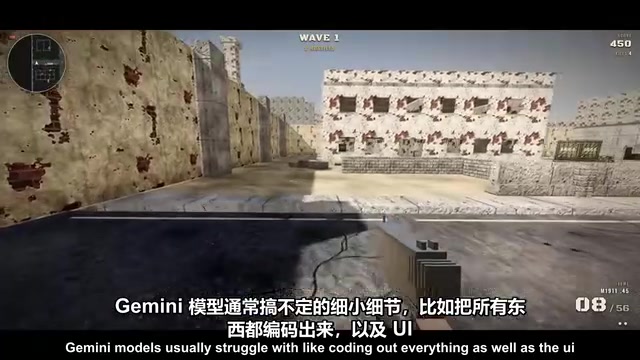
Even more indicative of the model's capability is a 3D rocket engine simulation written in pure JavaScript. The simulation is completed in a single HTML file without any external resources, and the heat flow visualization is excellent. The creator also tested a book page-turning animation, a GTA Vice City-style SVG scene, and SVG drawings of PS4 and GameCube controllers—the controller's size proportions and fidelity of small components were rated as "areas where other models often fail."
The "SVG scene" and "SVG drawing" mentioned in the article refer to Scalable Vector Graphics, an XML-based 2D vector image format. Unlike bitmaps, SVG uses mathematical paths to describe shapes, curves, and gradients, so it scales losslessly and has small file sizes. For language models, generating SVG is a comprehensive test: the model must precisely calculate coordinates, proportions, and layer ordering in text, and any numerical deviation directly manifests as misaligned graphics. The article specifically emphasizes the controller's "size proportions and fidelity of small components" precisely because multi-component SVGs require the model to maintain global spatial consistency—exactly where many models tend to fail.
"A 3D rocket engine simulation written in pure JavaScript" with "a single HTML file, no external resources" means all rendering logic, geometry calculations, and heat flow visualization code were produced by the model in one go and inlined, without relying on external libraries like Three.js or texture files. Success under such constraints shows that the model can not only write code but also autonomously design a complete scheme for numerical simulation and visual expression.
Pricing and Release Date Still Uncertain
Community rumors suggest Krypton may be released soon, positioned as "Fable 5.2-level but cheaper." The creator's own assessment is more cautious: on web development tasks, Krypton is closer to Sonnet 5.5 than to Opus; but in other domains it may indeed surpass Opus 5.5. Early testers have already gained access, which usually signals that a release window is near. If it follows the introductory pricing of other models in the Gemini 4 series, Krypton could become a budget alternative to Anthropic models.
Claude Code Dual Updates: Theme Customization and Multi-Threaded Project Collaboration
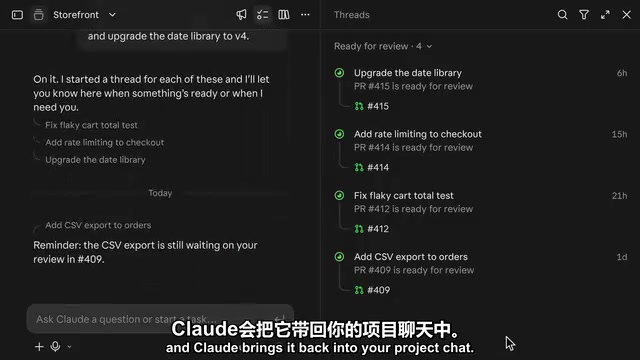
Anthropic pushed two sets of updates to Claude Code during the same period. The smaller one adds custom themes in the desktop app: users can modify the interface appearance via mods, add animated backgrounds, or even tell Claude the desired effect with reference images and let the model generate a theme. Anthropic also provides sample theme plugins for quick onboarding. This feature is currently limited to local sessions; cloud session support will follow later.
The more important update is the Projects feature. The project coordinator can now proactively schedule tasks across multiple parallel threads, answer questions directly in the project group chat, and sync progress across threads. Two new commands are noteworthy: /btw allows asking Claude a question without interrupting the current workflow—the question is handled in a separate thread; /fork branches a new thread from an existing one, making it easy to test different approaches without losing existing progress.
There are also thread reminders, read-only thread sharing (except for threads that access the local computer), and an updated thread panel—sorted by recently opened, updated, and pinned, with thumbnails and artifacts displayed. Projects is currently in public beta for Claude Pro and Max users; those without access can join the waitlist.
Official Model Selection Guide: Expensive Isn't Always Right
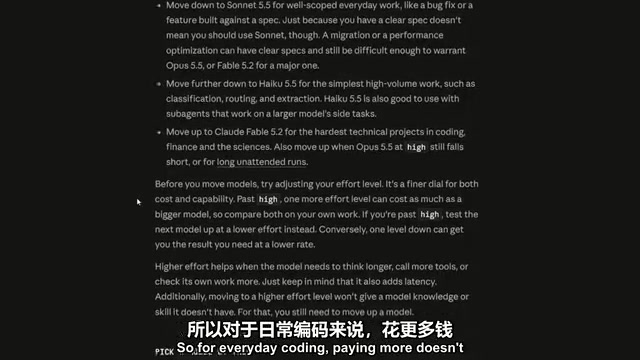
Anthropic's model selection guide may be the most practical information this week. The core conclusion is counterintuitive: for everyday coding tasks, use Opus 5.5 with medium reasoning effort; when encountering difficulties, first increase reasoning effort before considering a more expensive model.
In a comparison of 52 Claude Code coding tasks, Opus 5.5 solved 84.6%, while Fable 5.2 solved 82.7%—and the latter's cost per solved task is 2.8 times that of the former. Fable 5.2's suitable scenarios are large codebase migrations, complex architecture design, deep research, and long-running autonomous workflows. Sonnet 5.5 suits well-defined small tasks—bug fixes and feature development. Lightweight operations such as classification, file search, and sub-agents go to smaller models.
An easily overlooked detail: all four models support a 1 million token context window, so choosing a cheaper model does not sacrifice context length. What you should really do is match model difficulty to task difficulty, rather than defaulting to the most expensive option.
"Reasoning effort" refers to the amount of thinking a model is allowed to invest before giving an answer, usually reflected in chain-of-thought length, number of search branches, or internal iterations. Increasing reasoning effort makes the model spend more tokens deliberating on hard problems, improving accuracy but also increasing latency and cost. The core logic of Anthropic's guide is precisely to first adjust this parameter within the same model, because for most coding tasks medium effort is sufficient; only when task complexity exceeds the model's capability boundary is it worth switching to a stronger model. This also explains why "expensive isn't always right"—the marginal benefit of high-priced models on simple tasks is nearly zero.
"1 million token context window" refers to the upper limit of input length a model can process in a single pass, roughly equivalent to hundreds of thousands of Chinese characters or over a thousand pages of documents. All four models support this limit, indicating that context length is no longer a dimension that differentiates tiers; model selection should focus on task difficulty and unit cost, rather than worrying that a cheaper model can't read a large codebase.
Other Notable Developments
Mathematical Breakthrough: Google used Gemini 4 series models (Argon, Carbon, Hydrogen) combined with a multi-agent system to complete the first machine-verified formalization of the nearly century-old Birkhoff conjecture, and fixed proof gaps spanning over 50 years. It also solved the 20-year-old C1 regularity problem and verified the proof of the 40-year-old Jameson Caterpillar conjecture. Its Teamwork Leap system autonomously formalized the Weil conjecture through 29,000 sub-agents, generating 1.8 million lines of machine-verified Lean code.
GPT-6.2 Preview Leak: Early outputs from OpenAI's new model show it can achieve in a single generation visual effects that previously required multiple iterations, with outstanding performance in web development and generative tasks.
GLM-5.5 Leak: A benchmark chart leaked from an internal ZAI team conversation shows GLM-5.5 surpassing Claude Opus 5.5, but the source is a Chinese team and authenticity is questionable—treat with caution. If true, it would mean the emergence of an Opus-level budget model.
AI Wallet Race: ChatGPT launched a Wallet feature for Pro subscribers (US region), partnering with Amex, Mastercard, and Visa to let AI agents complete purchases without touching card numbers, with security verification required for each transaction. Google followed suit, allowing US Gemini users to connect Google Wallet directly to Gemini.
Anthropic IPO Motivation: In an interview, Dario Amodei confirmed that the main driver for the IPO is to obtain more compute—"the more cash on hand, the thicker the buffer between a low-compute world and a high-compute world."
DeepSeekAd Subscription Signal: DeepSeek opened web search, file processing, link parsing, voice, and other capabilities to developers via API; quota limit prompts appeared in the website code, hinting that a paid subscription may be near.
Muse Spark 1.4 Emerges: The model codename appeared in Meta internal PR, possibly a variant of the previously stealth model Crouton Alpha.

Qwen 4.0 Max Preview Silent Upgrade: New tests show significant improvement in visual consistency; the creator compared the previous and current generations' outputs of "a pelican riding a bicycle."
Fable 5.2 Generates Long Animation: Developer Mr. Tactical used Fable 5.2 for 7 hours and 41 minutes at a cost of $138 to generate a computer assembly animation purely from code; another developer, Jazzy, used it to recreate an anime-style pure-code visualization.
"Formalization" and "machine verification" are key concepts in mathematical AI. Formalization means translating natural-language mathematical propositions and proofs into strict code that proof assistants like Lean can recognize, where every deductive step must be verified line by line by the system, with no skipping or intuitive assertions allowed. Thus "machine-verified formalization" means the credibility of the conclusion does not depend on human review but is guaranteed by computer. The Lean code mentioned in the article refers to such proof scripts.
"Multi-agent system" refers to an architecture where multiple model instances divide labor and collaborate: some break down goals, some write proof fragments, some check and correct, and a coordination layer aggregates. Teamwork Leap formalizing the Weil conjecture with 29,000 sub-agents and producing 1.8 million lines of Lean code exemplifies the scale advantage of such parallel decomposition on ultra-long tasks—a single model struggles to maintain such long-range consistency, while multi-agent systems can slice tasks and cross-validate each other.
One-line Summary
Google's Krypton approaches top-tier models while being cheaper; Claude Code and model selection guide updated simultaneously.
Paragraph Summary
This AI news roundup focuses on Google's new Gemini 4 model codenamed Krypton, which appears as Gemini 4 Hydrogen on Arena and the API, surpassing Opus 5.5 on multiple tasks and approaching Fable 5.2 in some, reportedly at significantly lower cost; in tests it generated a CS:GO clone game and a pure-JavaScript 3D rocket engine simulation in one shot. Anthropic simultaneously added theme customization and Projects multi-threaded collaboration to Claude Code, with new /btw and /fork commands. Its official selection guide notes that for everyday coding, Opus 5.5 with medium reasoning effort offers the best value, with Fable 5.2 costing 2.8 times more per task. Other developments include Google's multi-agent formalization of mathematical conjectures, GPT-6.2 and GLM-5.5 leaks, and the AI wallet race.
Related articles

Gemini 4 Neon Review: Benchmark Scores Rival Carbon, API Pricing and Quota Breakdown
Google Gemini 4 Neon is now live, benchmark scores closely tracking Carbon, API pricing 3/15 at twice Hydrogen's rate. This article compiles Bilibili creator testing: Neon can replace 90% of Carbon scenarios, AntiGravity quota consumption is only one-third of Carbon, plus subscription channel restrictions and 2API ban risks.

Gemini 4 Helium Coming Soon? Signals of Google Loosening Subscription Restrictions
Google team member hints releases will continue; community speculates Gemini 4 Helium (Flash Lite) may be next. Subscription ban controversy gets a response as product lead says "Soon," suggesting restrictions may be lifted. This article covers Gemini developments, OpenAI Coding Agent and risk management, Doubao real-time audio-video API, and compute business dynamics.

AI-Assisted React Development in Practice: Optimizing a Video App and Handling Errors
A 14-year veteran developer demonstrates AI-assisted React video app optimization: compressing video from 80MB to 5MB (~94%) via ImageKit, plus reliable error handling and retry mechanisms. Includes planning, code understanding, and verification methods for working with AI.