Gemini 4 Neon Community in Practice: 9 Case Studies on Scenes, Games, and 3D Animation
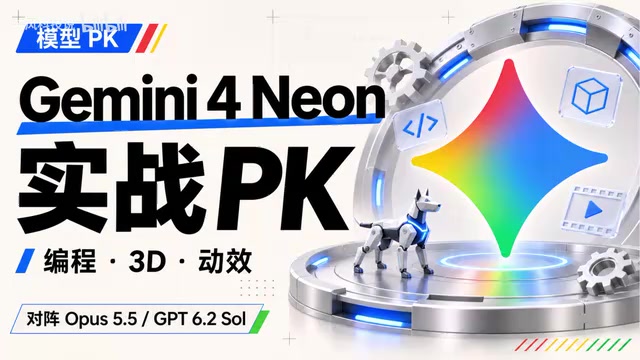
A Bilibili community collection compares Gemini 4 Neon across scenes, games, and 3D animation in 9 cases.
The article introduces a Bilibili community collection on "Gemini 4 Neon," with 9 practice cases covering scene generation, game prototypes, and 3D animation, compared side by side with other models in a "model PK" format. Scene cases test composition, lighting, and style consistency; game prototypes focus on the path from idea to runnable prototype; 3D animation demands the highest temporal consistency. The article argues such collections offer reusable task paradigms rather than conclusions.
Community Practice Overview
Recently, a series of community-created collections centered on "Gemini 4 Neon" has appeared on Bilibili. The author compiled 9 practice cases across different directions, covering themes such as scene generation, game prototypes, and 3D animation. The value of this collection lies in demonstrating how the model is applied in real creative workflows, rather than simply comparing parameters.
The "model PK" in the title suggests that the author intentionally places Gemini 4 Neon alongside other models on the same batch of tasks, using concrete cases to observe differences in performance.
"Model PK" is a common evaluation format in the AI community: multiple models are given the same set of task prompts, each generates results, and the outputs are displayed side by side. Unlike evaluations based on standardized benchmark scores, this kind of lateral comparison is closer to real creative scenarios and can intuitively reveal differences in style, detail, and stability. Its limitations are the small sample size and the highly subjective nature of the tasks, so conclusions are better treated as reference rather than definitive.
Three Types of Cases: Scenes, Games, and 3D Animation
Scene Cases
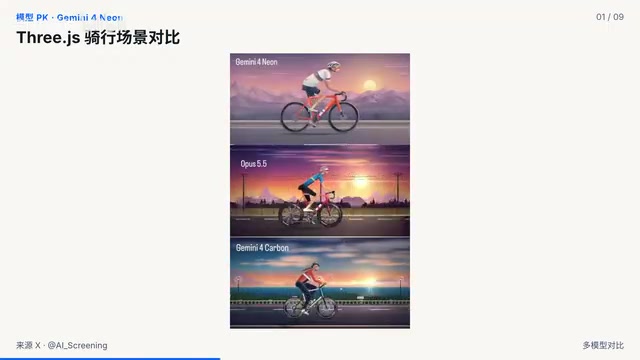
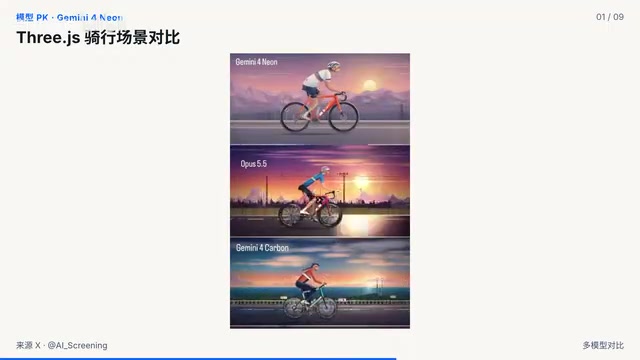
Scene generation is the most common direction in this batch of cases. Community authors typically provide short text descriptions and observe whether the model can consistently output images with spatial depth and atmosphere. This type of task tests the model's grasp of composition, lighting, and stylistic consistency.
Game Prototype Cases
Game-oriented cases focus more on interaction and playability. The author attempts to use the model to generate game assets, level concepts, or simple gameplay logic, observing whether the chain from "idea" to "runnable prototype" flows smoothly.
A game prototype is the smallest runnable version for validating gameplay ideas. It usually does not aim for art completion but focuses on whether the interaction loop works. With generative models, creators can quickly produce concept art, textures, sound effects, and even some logic code, compressing what originally took days of upfront construction into hours. However, the generated results often require manual integration and debugging; the model is more like an accelerator than an end-to-end production tool.
3D Animation Cases
3D animation cases focus on dynamic expression, including camera movement, object animation, and transition effects. Compared with static images, animation places higher demands on temporal consistency, and it is also the part that is harder to reproduce stably in community practice.
Temporal consistency refers to the model's ability to maintain stable object identity, position, lighting, and motion trajectories across consecutive frames or shots. In video and animation generation, high single-frame image quality does not equal overall usability: if adjacent frames show object deformation, flickering, or jumps, the viewing experience deteriorates noticeably. Therefore, when evaluating animation outputs, in addition to the visual quality of the first frame or keyframes, attention should also be paid to whether the motion is coherent and whether camera cuts are natural. This is also an area that current generative models still struggle to tackle reliably.
Observations from a Model PK Perspective
Comparing the 9 cases together makes it clearer how Gemini 4 Neon adapts to different task types. Through side-by-side presentation, the community author lets viewers judge for themselves which scenarios the model excels in and which still require other tools to fill the gap.
Implications for Creators
The significance of such community collections is not in providing conclusions, but in offering reusable task paradigms. Creators can refer to the design approach of these 9 cases to quickly build their own test sets and evaluate model capabilities based on actual outputs rather than subjective impressions.
One-line Summary
A Bilibili community collection uses 9 cases to compare Gemini 4 Neon's performance in scenes, games, and 3D animation side by side.
Paragraph Summary
The article introduces a community-created collection on Bilibili centered on "Gemini 4 Neon." The author compiled 9 practice cases covering three major directions: scene generation, game prototypes, and 3D animation, and compared them side by side with other models in a "model PK" format. Scene cases test composition, lighting, and stylistic consistency; game prototypes focus on the chain from idea to runnable prototype; 3D animation has the highest demands on temporal consistency and is the hardest to reproduce stably. The article argues that the value of such collections lies not in providing conclusions, but in offering reusable task paradigms that help creators build their own test sets and evaluate model capabilities through actual outputs.
Related articles

Gemini 4 Neon vs Carbon Benchmark: How Big Is the Gap in Performance and Cost?
Gemini 4 Neon vs Carbon tested: Neon's default tier hits 59.6, matching the flagship, at double the speed and a quarter cheaper, but Carbon leads research computing by 8.5 points. Carbon is 50% off until end of November; Neon's price edge starts in December.

Gemini 4 Neon Hands-On: Data Visualization Shines, But Can't Beat Opus
Bilibili creator tests Gemini 4 Neon: third on Agent Arena, strong at dynamic data visualization, but lags Opus and Fable in 3D and complex coordination.

Hands-On with Gemini 4 Neon: 8 Scenarios — Can It Really Replace Opus 5.5?
Hands-on with Gemini 4 Neon across 8 scenarios: AEI score 61 (third), Cursor Bench 4.1 at 65.4%, $3/$15 pricing. 95% usable on article-to-video, but Blender 3D modeling fails. More like a fast Kimi K3 than an Opus 5.5 replacement.