Gemini 4 Neon Hands-On: Doubling Down on Speed and Cost—Can It Challenge Opus 5.5?
Gemini 4 Neon ranks third overall, offsetting its non-top intelligence with speed and cost advantages.
Google's Gemini 4 Neon has sparked discussion in the AI community, with creator WorldofAI calling it one of Google's most compelling models this year. It ranks third on the Artificial Intelligence Intelligence Index, first on multiple benchmarks such as legal, tax, finance, and automation, and second globally on Agent Arena. Compared with Gemini 4 Carbon, cost per task drops 17%, completion is about 40% faster, and output speed rises from 57 to about 110 tokens per second. It scores 59 on the coding agent benchmark, comparable to Opus 5.5 and Fable 5.2, yet costs only $6.86 per task—far below competitors. Front-end and SVG generation capabilities have rebounded significantly, and Anti-Gravity's Slash Swarm enables multi-agent parallelism. Still, it trails Fable 5.2 slightly in web development visual detail, and graphical computer control capability needs more real-world testing.
Google's newly released Gemini 4 Neon has sparked quite a bit of discussion in the AI community. After a comprehensive hands-on test, the well-known creator WorldofAI said outright that this is one of Google's most compelling models this year. Not only does it rank near the top of global AI benchmarks, but it also delivers a dual advantage in speed and cost over competitors across multiple dimensions.
Benchmark Performance: Leading in Many Areas, but Not an All-Around Champion
According to the hands-on video by Bilibili creator WorldofAI, Gemini 4 Neon ranks third in the overall Artificial Intelligence Intelligence Index and tops several specialized benchmarks. It scored 70.9% on legal research and tax agent benchmarks, ranking first; it also took the top spot in finance, accounting, and spreadsheet benchmarks, as well as in automation benchmarks.
On Agent Arena, the model ranks second globally, showing a significant upgrade in agent capabilities. However, the creator also noted that this result is closely tied to pairing with the Anti-Gravity framework—which serves as the model's agent runtime framework, helping it break down complex tasks and unlock its capabilities.
One detail worth mentioning: Gemini 4 Neon does not lead in every dimension. In web development tasks, the creator believes Fable 5.2 still has a slight edge in visual quality and detail. But the gap isn't large enough to overlook Gemini 4 Neon's speed and cost advantages—it completes tasks faster at roughly half the cost.
The Artificial Analysis Intelligence Index is a comprehensive model evaluation leaderboard maintained by the independent analytics firm Artificial Analysis. It aggregates scores from multiple public benchmarks (such as MMLU, GPQA, HumanEval, etc.) into a single weighted total, used for cross-comparing the overall capabilities of models from different vendors. The index is not an official standard, but it is widely cited in the industry as a reference point for model capability.
Agent Arena, meanwhile, is an arena-style evaluation platform specifically designed to assess AI agent capabilities, pitting models against each other in scenarios requiring multi-step reasoning, tool calling, and task planning, with results scored and ranked by human or automated judges. Unlike static knowledge Q&A, Agent Arena focuses more on testing a model's engineering ability to "get things done."
Speed and Cost: Per-Task Cost Far Below Competitors
Research results published by Artificial Analysis show that Gemini 4 Neon's efficiency gains are very pronounced. Compared with Gemini 4 Carbon, its cost per task is reduced by 17%, and it completes tasks about 40% faster, with time dropping from 36 minutes to 21 minutes. Output speed nearly doubles, rising from 57 tokens per second to about 110 tokens per second.
On the coding agent benchmark, Neon scores 59, comparable to Cloud Fable 5.2 and Opus 5.5, but at a fraction of the cost. Specifically, Neon costs $6.86 per task, while Opus costs $12.61 and Fable costs $15.41.
In terms of pricing, Neon is listed at $3 per million input tokens and $15 per million output tokens, with a 5% discount on cached input. The creator admitted this isn't especially cheap, but considering the level of intelligence obtained, it's quite affordable. In high-effort mode, it sits on the Pareto frontier in both the Wealth Index and the agent arena, remaining competitive while costing 50% to 80% less per task than competitors.
Front-End and SVG Capabilities Return: Google Reclaims Its Former Strength
The creator particularly emphasized in the hands-on test that Gemini 4 Neon's front-end capabilities have improved a lot, and its design taste has advanced noticeably. This was precisely where previous Gemini models struggled—hallucination issues and failing to actually deliver on user requirements were once its weak spots.
In SVG generation, the creator believes Google is reclaiming its lead in this domain. In an Xbox controller SVG generation comparison test, Neon competed against GPT 6.2 Sol and Gemini 4 Hydrogen, and the best output was Neon, which was superior in structural accuracy, gradient effects, and overall presentation. In a direct comparison with Opus 5.5, Neon's textures were clearer, details richer, and it added more creativity.

The creator used a single prompt to have Neon create a 3D scene of Tokyo in the rain in Anti-Gravity using X-High reasoning mode, which took about 39 minutes to complete, with visual quality that was impressive in lighting, reflections, and overall detail handling. Another case that amazed him was that Neon created an animated short film from just one prompt, inspired by John Keats's 1819 poem "To Autumn," using only native JavaScript with no external libraries.
Agents and Computer Use: Unlocking Potential with Anti-Gravity
Gemini 4 Neon supports a 1-million-token context window and four levels of thinking depth, improves instruction-following ability, and significantly reduces hallucination issues. Google recommends that users use the model directly in Anti-Gravity, because the framework enables multiple AI agents to work in parallel.
The Slash Swarm feature in Anti-Gravity is the biggest highlight of this combination. It can break large tasks into smaller components and distribute them across multiple agents for parallel processing, rather than relying on a single agent to proceed sequentially. The creator used it to create a Call of Duty clone game, and the overall result was good, including details such as a minimap, reload animations, atmospheric lighting, and texture mapping.

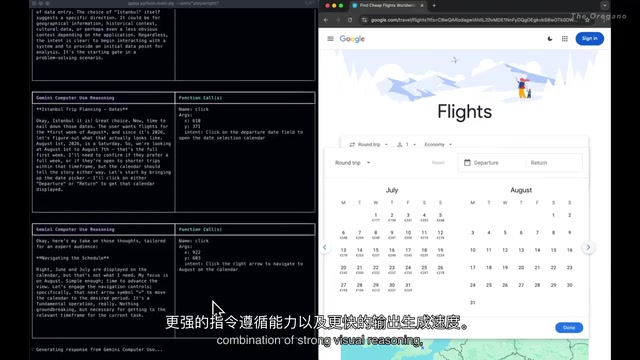
In terms of computer use, Neon combines strong visual reasoning ability, stronger instruction following, and faster output speed—all of which are crucial for computer operation. The model needs to understand what is happening on screen, decide on actions, and recover from them. The creator believes that with lower cost and faster execution, it could become a strong contender for everyday computer-use workflows. But he also cautioned that benchmarks do not directly measure graphical computer control capability, and more real-world application testing is still needed.
Pareto Frontier is a concept from economics and multi-objective optimization: when one metric cannot be improved without sacrificing another, those solutions form the Pareto frontier. In the context of AI model evaluation, it usually refers to the optimal trade-off curve between two dimensions—"intelligence level" and "cost per task." A model on the frontier means it achieves the highest intelligence level for a given cost, or the lowest cost for a given intelligence level, making it the most cost-effective choice.
Context window refers to the maximum number of tokens a model can process in a single pass; 1 million tokens is roughly equivalent to hundreds of thousands of Chinese characters or hundreds of pages of documents, enabling the model to read a long codebase or a large report at once without losing information. Thinking depth (reasoning level) refers to the number of internal reasoning steps or the amount of compute the model is allowed to invest before giving an answer; higher levels usually yield better quality but also higher latency and cost.
An Intriguing Detail: The Description Was Quietly Changed
The creator pointed out that Google modified the description of Gemini 4 Neon before release. It was initially described as "built on Gemini 4 Hydrogen via reinforcement learning," but both references were later removed. This raises some questions: is Neon essentially a Flash-class model marketed differently? Combined with its pricing strategy, these timing details and changes are indeed intriguing. Of course, Google's intentions cannot be confirmed, but this detail is worth noting.
Overall, Gemini 4 Neon is not the smartest model currently available. GPT 6.2 Astra, Cloud Fable 5.2, Opus, and the new Sol model still have their own advantages on more demanding tasks such as reasoning and coding. But the balance Neon strikes among intelligence, speed, and cost is exactly what makes it most attractive—near-frontier performance at a significantly lower price, along with strong multimodal capabilities and an increasingly mature agent ecosystem.
One-line Summary
Gemini 4 Neon ranks third overall, using speed and cost advantages to offset not being the smartest.
Paragraph Summary
Google's Gemini 4 Neon has sparked discussion in the AI community, with creator WorldofAI calling it one of Google's most compelling models this year in a hands-on test. It ranks third overall on the Artificial Intelligence Intelligence Index, first on multiple benchmarks including legal, tax, finance, and automation, and second globally on Agent Arena. Compared with Gemini 4 Carbon, cost per task is reduced by 17%, completion is about 40% faster, and output speed rises from 57 tokens per second to about 110. It scores 59 on the coding agent benchmark, comparable to Opus 5.5 and Fable 5.2, but costs only $6.86 per task, far below competitors. Front-end and SVG generation capabilities have rebounded significantly, and paired with Anti-Gravity's Slash Swarm it enables multi-agent parallelism. However, it still trails Fable 5.2 slightly in visual detail for web development, and its graphical computer control capability awaits more testing.
Related articles

Gemini 4 Neon's Comeback: How Google's 'American Doubao' Shipped Five Models in Two Weeks
Google shipped five models in two weeks. Gemini 4 Neon ranks third globally and first on the coding agent leaderboard, at half the cost of Opus 5.5. A Bilibili creator breaks down the three-layer comeback story: regulatory relief, sparse MoE architecture, and in-house TPUs—plus Carbon promo savings tips and AntiGravity quota rules.

What Is Hermes Agent? An Always-On AI Agent That Grows With You
Hermes Agent is an always-on AI agent running on a VPS, reachable via WhatsApp, Telegram, and Discord. It manages lists, calendars, and scheduled tasks and grows with use.

Building AI Animated Videos with Claude Code: A Hands-On Local Toolchain Guide
A hands-on demo of using Claude Code with local open-source tools like Kokoro and Remotion to generate AI videos with narration, animation, and music in minutes. Workflow, efficiency gains, and limitations analyzed.