Gemini 4 Neon Hands-On: The $20/Month Model That Beats Google's Own Flagship
Google Gemini 4 Neon beats its own flagship Carbon on benchmarks at the $20 tier, but trails Claude and GPT on aesthetics and GUI tools.
Google's new Gemini 4 Neon isn't top-tier, yet scores 65.4 on ModelDial V2, beating flagship Carbon's 65, and costs just $20/month. Gains come from backend (50.5 to 58.5) and usability (59, 8 above Carbon). Text generation scores 91.53 for third; 3D and frontend aesthetics improve over Hydrogen but trail Claude and GPT. Dead-three code earns full marks (93.3), all three problems passed in one round, with third-place token efficiency. For individual developers without high aesthetics demands, it's strong value; if aesthetics and GUI matter, Claude and GPT still lead.
Google has clearly picked up the pace of its model releases lately. Following Gemini Hydrogen, it has now launched a new model codenamed "Neon." Bilibili creator "A Jiang" ran hands-on tests right away, and the results are somewhat surprising: this model, which isn't positioned as the top-tier offering, actually beats Google's own flagship Carbon on several benchmarks—and its barrier to entry is just a $20 subscription tier.
Beating the Flagship on Benchmarks: Value Is the Biggest Selling Point
According to Bilibili creator A Jiang's tests, Gemini 4 Neon scored 65.4 on the ModelDial V2 question set, ranking sixth overall and edging past its own flagship Carbon's 65 points. In a head-to-head comparison of Google's four siblings, Argon scored 56.7, Hydrogen 59.7, Carbon 65, and Neon topped the group with 65.4.
Neon's gains this time came mainly from backend capability, rising from 50.5 to 58.5, and usability, which climbed from 48 to 59—8 points higher than Carbon. In other words, while keeping its low price, this model has shored up its previously weaker areas. For developers willing to pay only $20 a month, being able to use a model that approaches—and in some areas surpasses—the flagship is a very clear value upgrade.
Copywriting Still Strong, but Aesthetics Isn't Its Strongest Suit
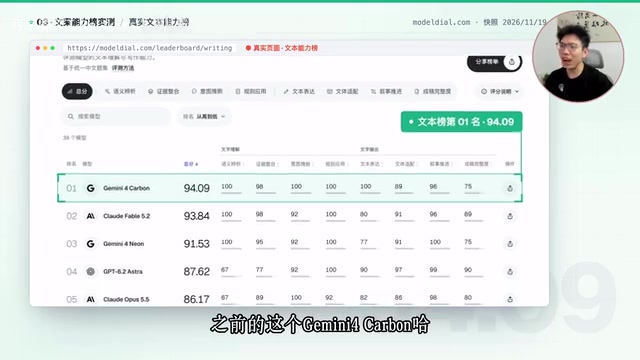
Google models have always had a good reputation for text generation, and Carbon previously ranked first on the text capability leaderboard. The new Neon scored 91.53, placing third, behind only Claude Faber 5.2—though the latter's subscription cost is noticeably higher. The creator noted that Google models' copy has a "very human feel," and Neon continues that trait.
In 3D and frontend aesthetics tests, Neon showed clear improvement over the earlier Hydrogen but still lags behind the flagship. The creator demonstrated with two cases—a wind-power inspection system and an immersive headphone lighting effect. Neon's generated pages had normal interactions and passed frontend aesthetics, but in details like ocean color and sky texture, differences from flagship models such as GPT 6.2 Azure were still visible. Compared with Claude, Neon's aesthetics are also slightly inferior.
The "Dead Three" Code Test: Full Marks on Capability, Third on Token Efficiency
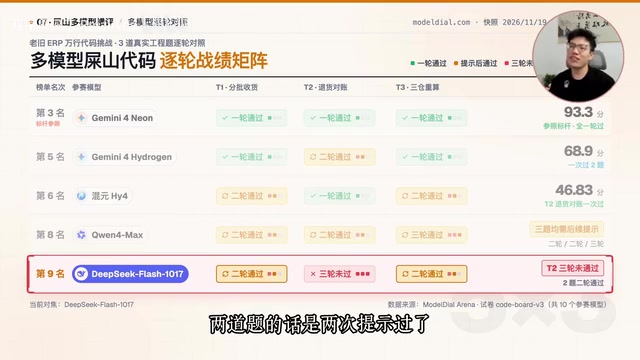
This test used three legacy Patheon ERP frontend problems involving jQuery, Vue, and single files with over ten thousand lines of code. The creator called these the "fairly nasty" dead-three code he could find. Neon scored 93.3 outright, earning full marks on capability, with all three problems passing in a single round—including regression validation, hidden validation, and self-testing—with over 850 tool calls in total and more than three hours of runtime.
By comparison, Hydrogen in the previous test scored only 68, passing two problems on the first try and ranking fifth; the domestic model Huiyuanshi scored 46.83, failing two of the three problems on the first round and only solving them after revising the prompt in a second round; DeepSeekAd was relatively weaker on the backend, and T2 still failed after three prompts.
On efficiency, Neon is not as high as GPT 6.2 Azure and Sora—GPT remains the authority on token efficiency—and Neon ranks third among the 10 models tested so far.

In this article, "dead-three code" is the creator's colloquial term for a class of highly difficult, dirty-work code tasks—not an official term. These problems are usually based on real legacy systems (such as the old Patheon ERP), with mixed tech stacks (jQuery and Vue coexisting), single files running to tens of thousands of lines, and no documentation. They test a model's comprehensive ability in long-context handling, cross-file understanding, regression validation, and hidden test cases. Evaluation looks not only at whether it ultimately runs, but also at whether it passes on the first try, how many rounds of prompt revision are needed, and how often tools are called. Token efficiency is another dimension: the fewer tokens consumed to complete the same task, the more accurately the model "thinks" and the less it wastes—directly relevant to cost in pay-as-you-go API scenarios. So "full marks on capability" and "third on token efficiency" should be viewed separately—the former means it can do the work, the latter means whether it does so economically.
Why Upgrade to the V2 Question Set
The creator explained why the ModelDial question set was upgraded: the old V1 set had been "beaten through" by Faber 5.2 and GPT 6.2, leaving no score separation. V2 raises the difficulty by a notch. Currently the top spot is Faber 5.2 at 72.9, with GPT 6.2 Azure at 72.7. The new set focuses on upgrading backend and frontend engineering aesthetics, and will later add harder questions such as knowledge reasoning. The creator stressed that the site is maintained entirely as a public good, with no ads or sponsorships.
ModelDial is a public-good large-model comparison leaderboard maintained by the community (or an individual developer). Its core mechanism is to run different vendors' models through the same set of questions and the same scoring process, turning "who is stronger" into comparable numbers. The leaderboard usually covers multiple dimensions such as text, code, frontend aesthetics, and backend capability, and gives a weighted total score. After running for a while, the V1 set was pushed close to full marks by a few leading models, with scores highly concentrated at the top, reducing differentiation—this is what the article means by "beaten through." V2's approach is to increase difficulty and broaden question coverage (such as backend engineering and frontend aesthetics), so scores spread out again and better reflect real gaps between models. Note that the questions and scoring rules of such leaderboards are set by the maintainers; scores should be used only as horizontal reference and do not equal performance in real production environments.
Account-Ban Risk and Toolchain Experience
In his summary, the creator raised a practical consideration: Google does not have account bans as strict as Anthropic's. After "struggling for a long time," he temporarily gave up Claude because the bans were "way, way too aggressive." However, he also complained about Google's Anti-Gravity tool, especially the GUI version, which is "so poorly made" and less pleasant to use than Claude's GUI.
Overall, if your workflow doesn't demand extremely high frontend aesthetics, Gemini 4 Neon is worth a try: a $20 subscription, benchmark scores close to the flagship, solid copywriting, full marks on dead-three code, and relatively lenient account policies make it fairly friendly to individual developers. But if aesthetics and GUI tool experience are hard requirements, Claude and GPT still have the edge.
One-line Summary
Google's Gemini 4 Neon beats its own flagship Carbon on benchmarks at the $20 tier, offering outstanding value—though aesthetics and GUI tools still trail Claude and GPT.
Paragraph Summary
Google's new model Gemini 4 Neon isn't positioned as top-tier, yet on the ModelDial V2 set it scores 65.4, beating its own flagship Carbon's 65, and is available with just a $20 subscription. Its gains come mainly from backend capability (50.5 to 58.5) and usability (59, 8 points above Carbon). Text generation scores 91.53 for third place, continuing Google's "human-feeling" copy style; 3D and frontend aesthetics improve over Hydrogen but still trail Claude and GPT flagships. In the dead-three code test, Neon earns full marks on capability with 93.3, passing all three problems in one round, and ranks third in token efficiency among the 10 models tested. Overall, for individual developers without high frontend-aesthetics requirements, Neon is a strong value choice; if aesthetics and GUI experience are hard requirements, Claude and GPT still hold the advantage.
Related articles

Science Units as Jewelry: Who Is This Wave of 'Nerdy Romance' Meant to Move?
From a 10-gram reference mass to a half-second pendulum charm, a set of science-unit jewelry is going viral. We analyze its product design, science-communication value, and the business logic of knowledge merch.
Terry Tao: Deep Connections Between Un…
Terry Tao: Deep Connections Between Unforced Navier-Stokes Singularities and the Generalized Riemann Hypothesis
Terry Tao explores deep connections between unforced Euler singularities, Navier-Stokes singularities, and the Generalized Riemann Hypothesis, analyzing the heuristic value of cross-domain analogies and implications for AI-assisted mathematical research.
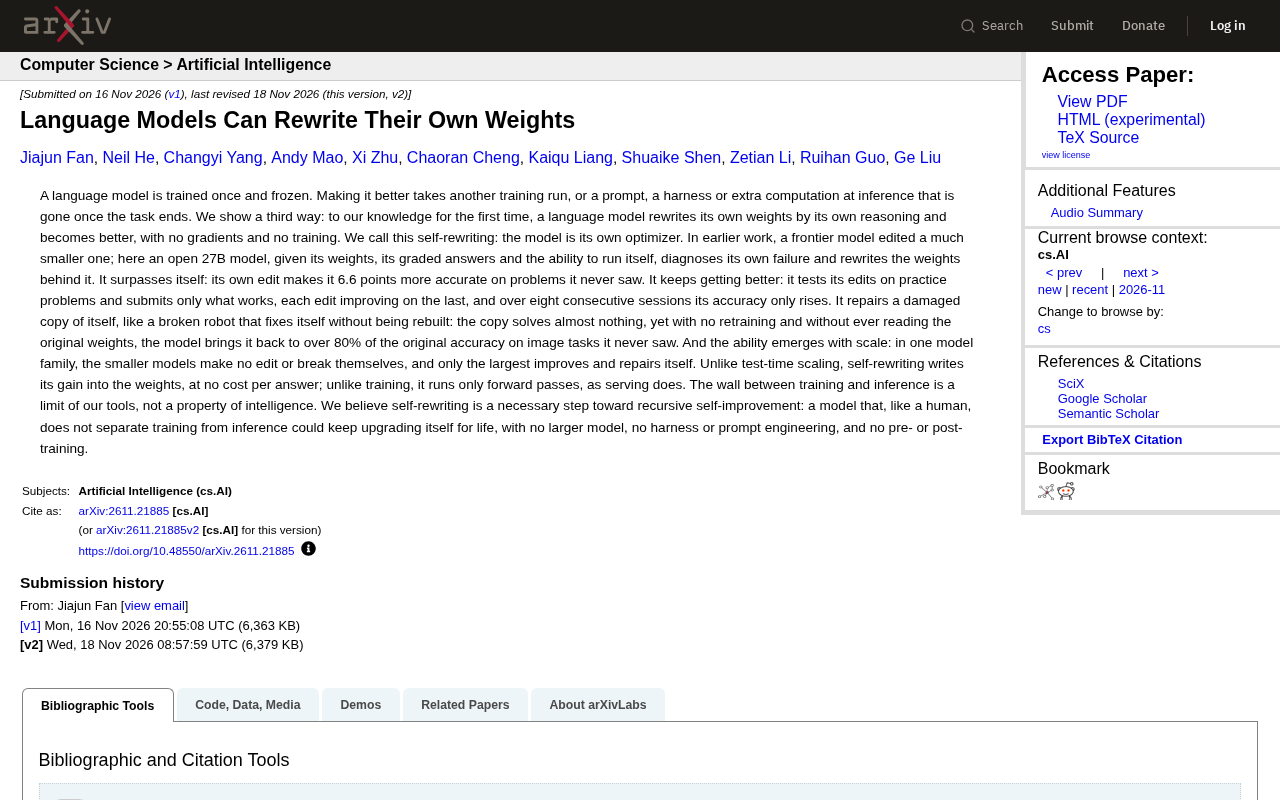
Language Models Can Rewrite Their Own Weights: A New Paradigm for Self-Editing AI
A new paper proposes that language models can directly rewrite their own weights, enabling persistent knowledge updates and behavior correction, distinct from in-context learning and external fine-tuning. Hacker News discusses reversibility, verification, and security boundaries, pointing to new possibilities for continual learning systems.