Gemini 4 Neon Hands-On: Topping the Benchmarks with Impressive Attention to Detail

Google's Gemini 4 Neon tops a creator's custom benchmark at 86 points—low price, high power, but modeling and rendering stability remain weak spots.
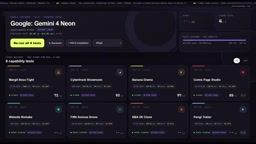
A YouTube tech creator reviewed Google's recently released Carbon, Hydrogen, and Neon models, focusing on Gemini 4 Neon. Priced at $3 input/$15 output per million tokens, Neon sits in the mid-to-high end of Google's lineup. On public benchmarks like the AA index, Cursor bench, and Frontier code 2.0, Neon beats Opus 5.5 and GPT 6.2 Sol, trailing Opus by only about one point on Frontier code 2.0. Across eight custom tests—including an Elden Ring boss fight, Cybertruck 3D showroom, banana animated SVG, comic book app, 3D website remake, Fifth Avenue drone scene, NBA 2K clone, and Unreal Engine repo demo—Neon excelled in attention to detail and playability, but showed clear modeling and rendering issues such as clipping, overexposure, and flickering black frames. Neon ultimately topped the creator's custom leaderboard at 86 points, with the creator calling it "the world's best model," though he stressed the conclusions come from a single source's subjective scoring and have not been third-party verified.
Google has shown a striking pace in model releases recently. According to observations from a YouTube tech creator in his latest video, three frontier models—Carbon, Hydrogen, and Neon—debuted in quick succession within just seven to ten days. The creator ran a live benchmark test of Gemini 4 Neon and reached a rather striking conclusion: this may be the strongest model he has ever tested.
Pricing and Benchmark Performance: Low Price, High Power
The creator first broke down Neon's pricing structure: $3 per million input tokens and $15 per million output tokens. This price point is higher than Sol but noticeably lower than Astra and Fable, and close to Sonic though slightly more expensive. In other words, Neon is positioned in the mid-to-high end of Google's product line rather than the most expensive tier.
On multiple public benchmarks, Neon's performance drew exclamations from the creator. On the AA index, it surpassed Opus 5.5 and GPT 6.2 Sol; on Cursor bench it also beat Opus 5.5; on Frontier code 2.0 it came in about one percentage point below Opus but above GPT 6.2 Sol. The creator specifically noted that on the analysis index, Fable 5.2 led with 65 points, Astra scored 62, and Neon followed closely at 61, with Opus 5.5 behind it. As a detail, Google placed Neon in a replacement slot for models of a similar tier rather than directly including it in the main index ranking, yet its scores remain impressive.
The creator emphasized that these are only individual indices, and coding ability is a separate matter. Because Neon is too new, it has not yet entered the coding index rankings, but Google's official page already showcases its results on Frontier code 2.0, just one point behind Opus 5.5.
The "AA index" (Artificial Analysis Index) mentioned in the article is a comprehensive model capability leaderboard maintained by the independent evaluation organization Artificial Analysis. It aggregates scores from multiple public benchmarks (such as MMLU, HumanEval, GSM8K, etc.) and calculates a weighted result, and is often used in the industry as a quick reference for model capability. The index updates model versions periodically, but new models typically take days to weeks from release to being included in the rankings, which also explains the phenomenon described in the article—"Google placed Neon in a replacement slot for models of a similar tier rather than directly including it in the main index ranking"—as vendors sometimes display results first as a "preview version" or in a "replacement slot," and officially enter the rankings after third-party reproduction.
Gamified Test: Smooth Gameplay but Rough Modeling
The creator's first test was to use Neon to generate the famous Margit boss fight from Elden Ring. The model was not allowed internet access and relied entirely on training data. The results showed that Neon's game was responsive, the hit feedback was "quite good," and the overall gameplay was above average, but character modeling problems were obvious: clipping during rolls, oddly rotating feet, and similar flaws to the earlier Astra. The creator gave this test a score of 72, commenting that it was "fun but aesthetically mediocre."
He also compared OpenAI models on the same test in the video, stating outright that those models far outperformed Neon in modeling, but Neon was not behind in playability.
"Clipping" (穿模) is a common term in 3D graphics and game development, referring to two model surfaces that should not intersect penetrating each other during rendering—for example, a character's arm passing through its torso while rolling, or clothing embedding into the body. It usually stems from a mismatch between the collision mesh and the visual mesh, improper weight distribution in skeletal animation, or a lack of sufficient deformation constraints for the model in extreme poses. For code-generation models, clipping exposes that their understanding of 3D spatial relationships and physical constraints remains at the level of "making it run" rather than truly grasping geometric consistency, which is also a common shortcoming of current LLMs when generating interactive 3D content.
3D Scene and UI Generation: Standout Attention to Detail
In the Cybertruck showroom test, Neon needed to generate an interactive 3D showroom. The creator owns a real Cybertruck, so he was extremely sensitive to details. Neon correctly recreated the basic shape of the frunk, which other models had failed to do; it also added a hidden storage compartment, tailgate, dedicated entry button, square steering wheel, and rear-seat screen, among other elements. However, there were also issues such as panels penetrating the hood and some missing textures. The creator ultimately gave it 9.3 points, calling it "the best Cybertruck model."
The banana animation test required the model to generate an approximately one-minute animated SVG short film, with a plot involving a large banana eating a small banana, meeting a monkey, having its crown stolen, and sadly eating an apple. Neon's output had the creator repeatedly exclaiming that it "had soul": the characters had personality, the swallowing animation and digestion process were extra touches, and the robbery sequence was especially dramatic. He gave it 97 points and said it had become his favorite test result.
In the comic book creation app test, Neon generated multiple comics in different styles, covering templates such as Bronze Age, Silver Age, noir, ink style, classic grid, and cinematic widescreen. The model could click panels to navigate, supported PNG export, and drew all assets autonomously without using MCP. There were flaws such as Batman's misaligned shoulder and improperly positioned speech bubble text, but the creator still gave it 8.5 points, believing that its "thinking went beyond the conventional."
3D Website and Drone Scene: Stunning Rendering but with Flaws
The creator handed his own game company website (fully animated with Three.js) to Neon for a remake, a test that required the model to analyze video and reconstruct a 3D scene. Neon largely recreated elements such as rock aggregation, explosions, and penguin characters, but severe lighting overexposure and flickering black frames appeared. The creator originally wanted to give 78 points, then adjusted it to 82, stating that "without the overexposure issue, it might have been 92."

The Fifth Avenue drone test is the hardest item in the old benchmark. The city scene generated by Neon opened the creator's eyes: landmarks such as the Public Library building, Rockefeller Center, St. Patrick's Cathedral, Trump Tower, and the Plaza Hotel were all presented, the drone flight felt natural, there was even yaw following, and traffic included headlights and buses. The model also labeled street names in the UI. Flaws also existed: some building models were rough, the Plaza Hotel roof was misaligned, and the Tiffany store was not labeled. The creator gave it 90 points, calling it "one of the best I've seen."
"3JS" repeatedly mentioned in the article refers to Three.js, an open-source JavaScript 3D graphics library based on WebGL, widely used for rendering real-time 3D scenes, animations, and interactive web pages in the browser. WebGL itself is a low-level graphics API provided by the browser, and Three.js encapsulates concepts such as scene graphs, cameras, lighting, materials, and shaders on top of it, enabling developers to build 3D content without directly writing GLSL shaders. Lighting overexposure and flickering black frames are typical issues in Three.js projects: the former is mostly caused by improper settings for light intensity, tone mapping, or exposure parameters, while the latter is often related to render loop timing, framebuffer clearing, or asynchronous resource loading.
NBA 2K Clone: Best Gameplay but Insufficient Modeling
The hardest NBA 2K clone test required generating a realistic basketball simulation game. Neon's version included mechanisms such as team selection, fast offense and defense, foul calls, and blocks. The creator couldn't stop playing and even felt its playability exceeded the Opus version, even though the latter had better modeling but severe lighting bugs and insufficient fun. The creator ultimately gave Neon 78 points, calling it "the best result I've seen."

The final test was to put Neon directly into the creator's Unreal Engine game repository and require it to generate an exciting demo. Neon captured assets from within the game and built animation effects from scratch, with the ending animation especially outstanding. The creator gave it 92 points and exclaimed, "Oh my god, this is a good model."
Overall Verdict: The Creator Calls It "the World's Best Model"
At the end of the video, the creator summarized the overall ranking of his self-built benchmark: Neon topped it with 86 points, 3 points higher than Opus, 3 points higher than Fable 5.2, and considerably higher than Hydrogen as well. He took a screenshot on the spot and posted it to X, stating outright that "this is the best model in the world." He also suggested that viewers choosing between OpenAI and Gemini subscriptions might consider switching to Gemini.
A note: the above conclusions come from a single YouTube creator's self-built benchmark and subjective scoring. The testing methodology and scoring criteria have not been verified by third parties, and the sample size is limited. Model capability evaluation should be combined with one's own use cases and multiple references before making a judgment.
Background Supplement
The "Frontier code 2.0" and "Cursor bench" mentioned in the article are both specialized benchmarks oriented toward code-generation capability. The Frontier code series focuses on complex, multi-step programming tasks, emphasizing the model's code understanding and generation quality in real engineering scenarios; Cursor bench is related to the AI coding editor Cursor and is typically used to evaluate model performance in interactive programming scenarios such as IDE assistance, code completion, and refactoring. These benchmarks differ in focus from comprehensive leaderboards such as the AA index: comprehensive leaderboards measure general capability, while code-specific benchmarks are closer to developers' actual usage experience. Therefore, the creator's emphasis in the article that "these are only individual indices, and coding ability is a separate matter" makes sense—a model's strengths and weaknesses across different dimensions are not always synchronized.
Related articles

Gemini 4 Neon's Comeback: How Google's 'American Doubao' Shipped Five Models in Two Weeks
Google shipped five models in two weeks. Gemini 4 Neon ranks third globally and first on the coding agent leaderboard, at half the cost of Opus 5.5. A Bilibili creator breaks down the three-layer comeback story: regulatory relief, sparse MoE architecture, and in-house TPUs—plus Carbon promo savings tips and AntiGravity quota rules.

What Is Hermes Agent? An Always-On AI Agent That Grows With You
Hermes Agent is an always-on AI agent running on a VPS, reachable via WhatsApp, Telegram, and Discord. It manages lists, calendars, and scheduled tasks and grows with use.

Building AI Animated Videos with Claude Code: A Hands-On Local Toolchain Guide
A hands-on demo of using Claude Code with local open-source tools like Kokoro and Remotion to generate AI videos with narration, animation, and music in minutes. Workflow, efficiency gains, and limitations analyzed.