Gemini 4 Neon In-Depth Hands-On: Four Demos and Benchmark Scores Fully Analyzed
Google launches Gemini 4 Neon for the mid-range market, balancing performance and cost.
Google released Gemini 4 Neon, the fourth model in the series, positioned between lightweight Hydrogen and flagship Carbon with "frontier-level intelligence at lower cost." Benchmarks show Neon leads in most scenarios but ranks third on the Artificial Analysis index at 61 points. It supports 1M token context and multimodal input, priced at $3/$15 per million input/output tokens. Four demos validated its end-to-end capabilities in game generation, education simulators, sales data analysis, and AI Studio templates.
Google Adds Another Member to the Gemini 4 Family
In just two months, Google has released the fourth model in its Gemini 4 series — Neon — joining the earlier Oxygen, Carbon, and Hydrogen to form a complete product matrix. Such a rapid release cadence is rare in the AI industry and reflects Google's acceleration of its segment-specific market strategy.
Neon's positioning needs to be understood within the family. A simple analogy: Hydrogen is a daily commuter scooter — fast and cheap; Carbon is a heavy SUV — most capable but resource-hungry; Neon is the sedan in between, balancing performance and efficiency. Google's official description of Neon's goal is "frontier-level intelligence with faster time and lower cost."
Benchmarks: Leading in Most Scenarios, But Not a Sweeping Victory
Benchmark results show Neon outperforming competitors across multiple dimensions including capability index, Agentic Coding, and Knowledge Work. Google CEO Sundar Pichai positions Neon as "frontier-level intelligence that enables rapid end-to-end task completion in complex software engineering, knowledge work, and scientific workflows."
But objectively, in specific tests such as Rack Terminal Bench and Frontier Code, Claude Opus 5.5 and GPT 6.2 still lead in their respective areas. On the Artificial Analysis composite index, Neon ranks third with 61 points, GPT 6.2 follows closely, and Claude Favor 5.2 takes the top spot. This shows Neon's competitiveness is structural — leading in most scenarios, but not first in every metric.
The Artificial Analysis composite index is a model capability leaderboard maintained by the independent evaluation firm Artificial Analysis. It aggregates scores from multiple public benchmarks (such as MMLU, HumanEval, GPQA, etc.) and computes a weighted composite score for cross-vendor model comparison. The index is widely cited in the AI community, but note that its weighting design may favor certain task types, so a single score cannot fully represent a model's performance across all scenarios.
Agentic Coding refers to a model's ability to complete programming tasks in agent mode — that is, the model can not only generate code snippets but also autonomously plan, call tools, debug, and iterate to ultimately deliver a runnable program. Such evaluations typically simulate real development workflows and assess the model's multi-step reasoning and error recovery capabilities.
Knowledge Work covers white-collar tasks such as document processing, information retrieval, and data analysis, evaluating a model's knowledge application and output quality in non-programming scenarios.
Capability Specs and Access
One of Neon's core selling points is multimodal input capability, supporting text, PDF, images, tables, audio, and video, which can be mixed within the same conversation. The 1 million token context window means an entire textbook or long report can be processed in one go — particularly useful for scenarios requiring extensive document analysis.
In terms of access, Neon is available through Google AI Pro and Ultra subscriptions via three entry points: Gemini App, Google AI Studio, and Anti-Gravity. API pricing is $3 per million input tokens and $15 per million output tokens — a pricing strategy clearly lower than the Carbon-tier flagship model, consistent with its "efficiency-first" positioning.
Context window refers to the maximum number of tokens (including input and output) a model can process in a single conversation. 1 million tokens is roughly equivalent to 750,000 English words or 1.5 million Chinese characters — enough to hold the entire Three-Body trilogy. Note, however, that the effective context may be limited by the model's attention mechanism over long texts; not all information receives equal attention.
Multimodal input means the model can simultaneously understand data in different formats — text, images, audio, video — and process them together within the same conversation. For example, a user can upload a chart and an audio clip and ask the model to combine both into an analysis report. This expands the model's application scenarios but also places higher demands on its cross-modal alignment capabilities.
Demo 1: Game Generation in Anti-Gravity
The first demo was completed on the Anti-Gravity platform, selecting Gemini 4 Neon in High mode. After entering a complete prompt, the model generated a directly runnable racing game. From the actual run, the game's completeness was quite high — even the demonstrator admitted, "I'm not much of a gamer, but I can tell it's very solidly built." For users familiar with game development, this generation quality is already a meaningful reference.
The significance of this demo lies in validating Neon's end-to-end capability in code generation tasks: from prompt to runnable product, with no human intervention in between.
Demo 2: Interactive Physics Teaching Simulator
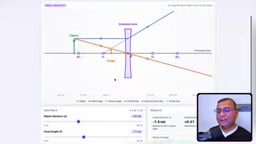
The second demo targets education, with a prompt requesting "an interactive lens ray diagram simulator for CBSE Grade 10 students, single-page web app." Neon delivered a finished product with complete optical simulation features: dragging the object to change object distance updates focal length and image distance in real time, concave and convex lens modes can be switched, and formulas plus a "Quiz Me" quiz feature are included at the bottom.
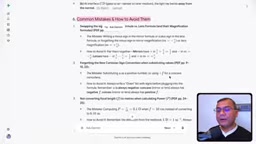
In further testing within the Gemini App, a PDF of the CBSE Grade 10 science textbook chapter "Light: Reflection and Refraction" was uploaded, with a request to generate a chapter summary, key terms, formula cheat sheet, a 25-mark mock exam with grading scheme, and a common mistakes list. Neon output a complete study kit. A follow-up instruction to translate the summary and formula cheat sheet into Hindi was also accurately completed.
Demo 3: Sales Data Analysis in the Field
The third demo targets the workplace: uploading a CSV file containing 12 months of sales data and requesting data interpretation from the perspective of a business analyst. Neon's output included an executive summary, key figures (each with calculation formulas), product analysis, monthly trend charts, category breakdown, city comparison, data quality audit, and next-quarter recommendations.
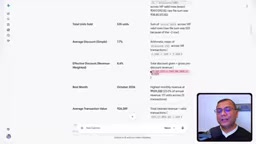
The demonstrator particularly emphasized the value of the instruction "require the calculation formula for every number" — Neon indeed annotated each metric with the formula used, making the analysis traceable and verifiable. Judging from conclusions in the summary such as "5 products contribute nearly three-quarters of revenue," "October and November are the make-or-break period," and "Delhi is clearly the number one market," the analytical business insight reached a practical level.
Demo 4: AI Studio Template Ecosystem
The fourth demo showcased the Neon entry point in Google AI Studio. The model already appears at the top of the model list, and the platform provides templates for scenarios including finance and story creation, as well as CSV/Excel data processing templates and an audio storybook generator template. This means developers don't need to build prompts from scratch and can quickly launch projects based on templates.
Overall Assessment: The Real Value of the Middle Path
Neon's positioning strategy is worth noting. At a time when AI models are increasingly polarizing into "lightweight and fast" versus "heavyweight flagship," Google chose to invest a frontier-level model in the middle ground, targeting users who need both high-quality output and sensitivity to latency and cost.
Across the four demos, Neon demonstrated near-flagship completeness in three directions — code generation, educational content creation, and data analysis — while maintaining a clear price advantage. For developers who need to call APIs frequently and enterprise users who need an efficient model within a subscription system, Neon offers an attractive option. However, the benchmarks also remind us that on specific professional tasks, competitors still have irreplaceable advantages, and model selection still needs to be evaluated by scenario.
One-line Summary
Google launches Gemini 4 Neon targeting the mid-range market, balancing performance and cost — leading in most benchmarks but not a sweeping victory.
Paragraph Summary
Google released the fourth model in the Gemini 4 series, Neon, within two months, positioned between the lightweight Hydrogen and flagship Carbon, touting "frontier-level intelligence at lower cost." Benchmarks show Neon leads in most scenarios, but ranks third on the Artificial Analysis composite index with 61 points, behind Claude Favor 5.2 and GPT 6.2. Neon supports 1 million token context and multimodal input, with API pricing at $3 per million input tokens and $15 per million output tokens. Four demos validated its end-to-end capability in game generation, educational simulators, sales data analysis, and the AI Studio template ecosystem. The overall assessment concludes that Neon offers an attractive middle option for users who need high-quality output and are cost-sensitive, but competitors still hold advantages on specific professional tasks.
Related articles

Gemini 4 Neon's Comeback: How Google's 'American Doubao' Shipped Five Models in Two Weeks
Google shipped five models in two weeks. Gemini 4 Neon ranks third globally and first on the coding agent leaderboard, at half the cost of Opus 5.5. A Bilibili creator breaks down the three-layer comeback story: regulatory relief, sparse MoE architecture, and in-house TPUs—plus Carbon promo savings tips and AntiGravity quota rules.

What Is Hermes Agent? An Always-On AI Agent That Grows With You
Hermes Agent is an always-on AI agent running on a VPS, reachable via WhatsApp, Telegram, and Discord. It manages lists, calendars, and scheduled tasks and grows with use.

Building AI Animated Videos with Claude Code: A Hands-On Local Toolchain Guide
A hands-on demo of using Claude Code with local open-source tools like Kokoro and Remotion to generate AI videos with narration, animation, and music in minutes. Workflow, efficiency gains, and limitations analyzed.