Gemini Accused of Ongoing 'Dumbing Down': The AI Model Degradation Controversy and User Trust Crisis

Gemini users allege ongoing model degradation, raising questions about AI version transparency and trust.
Reddit users accuse Google Gemini of becoming 'dumber' after updates, failing even at navigating Workspace documents. This article examines the technical causes of perceived AI model degradation—silent tuning, safety alignment, and rising expectations—and argues that vendors need transparent version management to maintain fragile user trust.
An Accusation of 'Dumbing Down' from Users
Recently, a Reddit user posted bluntly: "This may be the biggest downgrade since the AI boom." The target of this criticism was Google's Gemini model. The post quickly sparked heated community discussion, as it touched on an increasingly sensitive topic in the current large language model (LLM) space—does a model's actual capability quietly degrade with each version iteration?
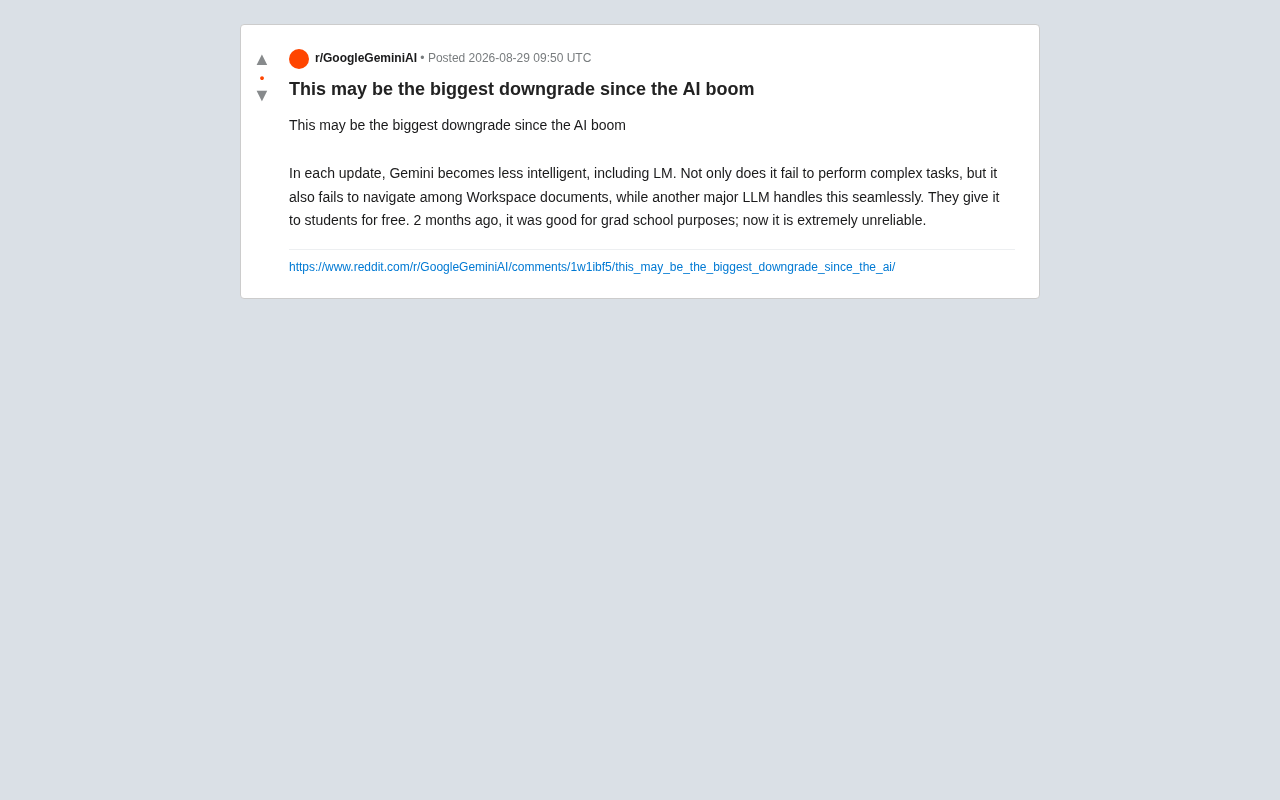
The user's core complaints centered on several points: Gemini seemed to get "dumber" after each update, not only struggling to complete complex tasks but even repeatedly making mistakes when navigating between Google's own Workspace documents—while another mainstream LLM could handle the same work with ease. Even more ironically, all this happened against the backdrop of Google offering Gemini free to students. As the user put it, "Two months ago it was good enough for graduate-level study, but now it's extremely unreliable."
Is 'Dumbing Down' Real or Just a Subjective Illusion?
Model degradation is a recurring point of contention in the AI community. Similar complaints previously emerged on a large scale among GPT-4 users—many claimed the model became "lazy" or "perfunctory" after a certain period.
From a technical standpoint, the decline in AI model capability perceived by users can stem from several levels:
1. Silent Adjustments to the Model Itself
To lower inference costs, improve response speed, or strengthen safety alignment, vendors may apply quantization, distillation, or parameter tuning to their online models. While these optimizations improve efficiency, they may sacrifice some complex reasoning capabilities. When the actual model behind the same product name (such as "Gemini") is silently swapped out or adjusted, users intuitively feel that it has "gotten dumber."
2. Capability Loss from Safety Alignment
As regulatory and compliance pressures increase, vendors often strengthen content filtering and refusal mechanisms. Excessive safety alignment can cause a model to become conservative and evasive even on normal tasks, manifesting as being "unwilling to think deeply" or "giving irrelevant answers."
3. Continuously Rising Subjective Expectations
You may not have noticed, but users' judgments are also subject to subjective bias. Once people get used to a model's peak performance, any fluctuation can be amplified into "degradation." Moreover, differences in task difficulty and prompt quality can also significantly affect output results.
The Shortcomings Exposed by Workspace Integration
A particularly noteworthy specific complaint in this post is: Gemini's failure to navigate between Google Workspace documents.
This should have been one of Google's core strengths. As the developer of productivity tools like Docs, Sheets, and Gmail, Google has placed high hopes on the deep integration of Gemini with Workspace—a key differentiator that sets it apart from competitors like ChatGPT. If it can't even reliably handle document retrieval and cross-document operations within its own ecosystem, then the actual value of this "moat" becomes questionable.
The user mentioned that "another mainstream LLM handles it seamlessly." While unnamed, this hints that a competitor may perform more consistently in document comprehension and context management. For Google, this is a signal that needs to be taken seriously—the depth of ecosystem integration ultimately still relies on the underlying model's capability to deliver.
The Hidden Concerns Behind the Free Strategy
Google offering Gemini free to students is a classic market penetration strategy: cultivating user habits by lowering the barrier to entry and capturing the mindshare of the next generation of knowledge workers.
However, free is also a double-edged sword. When free users begin to question a product's reliability, negative word-of-mouth spreads just as quickly. For groups like graduate students and researchers who demand extremely high accuracy, a tool that was "useful two months ago but unreliable now" may actually accelerate their switch to other solutions.
This also reveals a deeper logic in the current AI product competition: user loyalty is extremely fragile. In a market where multiple high-quality LLMs coexist, switching costs are low, and any noticeable decline in experience can lead to irreversible user churn.
Vendors Need More Transparent Version Management
The real lesson from this controversy may lie in the fact that AI products generally lack transparent version communication mechanisms.
Every update to traditional software comes with a clear version number and changelog, so users know exactly what they're using and what has changed. But many AI products silently swap out underlying models or adjust parameters under the same name—users can neither trace the change history nor roll back to a version they trust. This kind of "black-box iteration" is the root of user distrust.
For a giant like Google, if it hopes to retain users amid fierce competition, it needs not only to continuously improve model capabilities but also to make real improvements in version transparency, capability stability, and the user feedback loop. Otherwise, accusations like "this is the biggest downgrade since the AI boom" will only become more frequent.
Conclusion
A single user's complaint may not represent Gemini's overall quality, and it may be mixed with subjective factors. But the problem it reflects is real and widespread: in the AI arms race, how can vendors pursue efficiency and safety while holding the line on user experience? When "updates" no longer equate to "improvements," how can user trust be maintained? These questions about AI model degradation and version management deserve serious attention from the entire industry.
Related articles

Frontend to AI Agent Development: A Frontline Architect Explains Career Paths and Opportunities
A frontline AI architect explains the industry changes and practical paths for frontend developers transitioning to AI Agent development: why pure frontend jobs are disappearing, why Agent + full-stack has become mainstream in hiring, and three transformation routes—Agent development engineer, FDE, and remote contracting—along with corresponding learning strategies.

How to Choose an AI Agent Development Course: Five Pitfall-Avoidance Guidelines
A mechanical-engineering career changer's two-year pitfall-tested checklist for screening AI Agent development courses: complete delivery pipeline, resume-worthy projects, real development perspective, update frequency, and coaching feedback—with concrete judgment methods and pitfall-avoidance tips.

Coze AI Agent Building for Beginners: A Zero-Code AI Agent Development Guide
Coze, ByteDance's one-stop AI application development platform, supports zero-code drag-and-drop AI agent building. This article outlines Coze's core concepts, three advantages, differences between the domestic and international versions, and the distinction between agents and apps, helping beginners quickly get started with AI Agent development.