Gemini for Home Integrates with AT&T Security Systems, Shifting the Smart Home AI Landscape
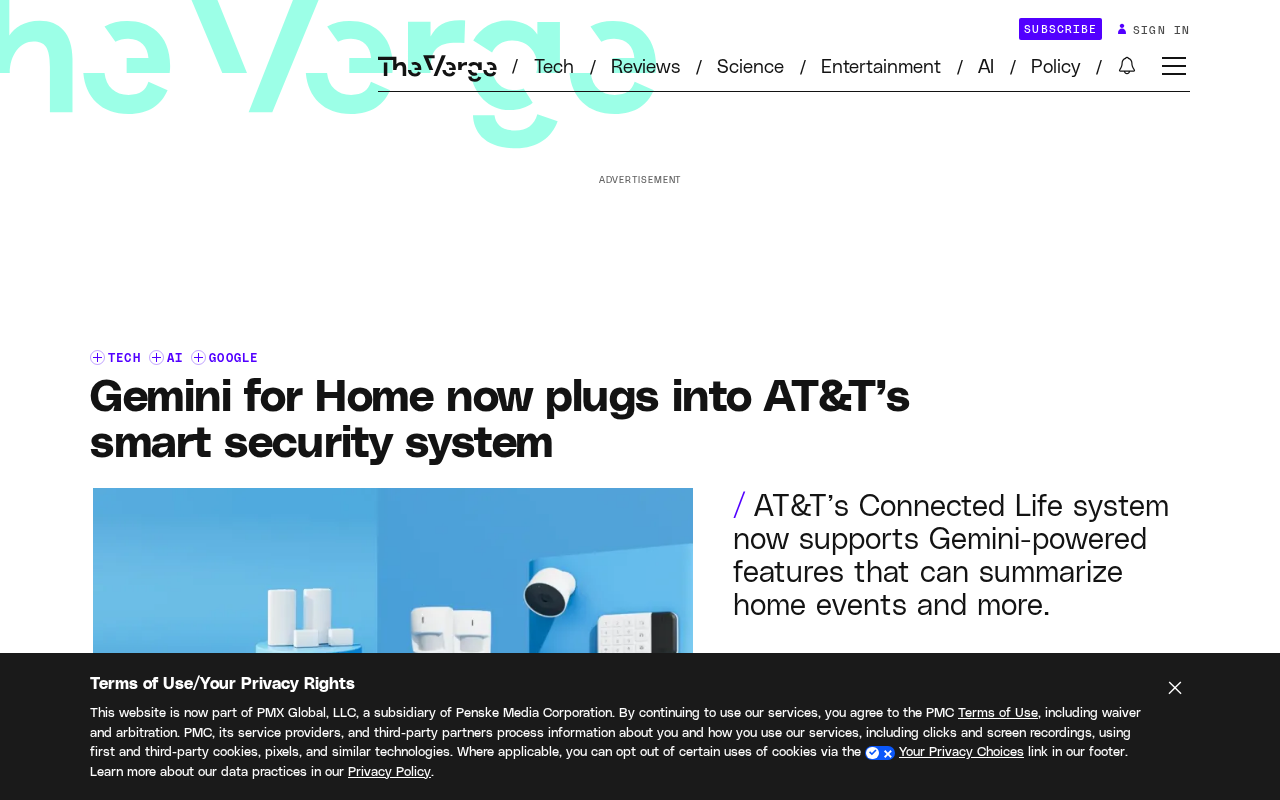
AT&T security systems integrate with Gemini for Home, as AI assistants move from general entry points to specialized security scenarios.
AT&T's Connected Life becomes the first home security product to integrate Google Home Premium, with Gemini for Home bringing event summarization and video history search capabilities, shifting security cameras from passive recording to natural language instant Q&A. The article notes that security, with its high data density, is the primary scenario for AI, and Google is taking a platform approach via carriers to promote Gemini, pressuring Ring and ADT on AI capabilities. Pricing, regions, privacy, and data responsibility details remain unclear, with both benefits and risks amplified.
Smart home AI is evolving from voice assistants toward system-level integration. According to an RSS source, AT&T's Connected Life smart security system now integrates with Gemini for Home, becoming the first home security product to integrate with Google Home Premium. This partnership embeds Gemini's AI capabilities directly into security hardware, no longer confined to speakers or screens.
The Core of the Partnership: Security Systems Gain AI Summaries and Video Search
AT&T claims that Connected Life is the "first" home security product to integrate Google Home Premium. With this integration, Gemini for Home can summarize home events, search users' video history, and provide more AI-driven features.
This means security cameras are no longer just passive recorders. Users can ask in natural language, "Did anyone come into the yard this afternoon?" and Gemini can retrieve and summarize from video history. This interaction model pushes security from "after-the-fact review" to "instant Q&A."
Security scenarios demand extremely high AI accuracy, as the cost of false positives and missed detections far exceeds that of ordinary smart home commands. Whether Gemini for Home can remain reliable in summaries and search will determine users' trust in this integration.
Gemini for Home is Google's branded product system for bringing its large model capabilities into the home, typically tied to a Google Home Premium subscription. Unlike the earlier Google Assistant, which only handled voice commands, it emphasizes understanding and generative summarization of multimodal data (video, audio, sensor events). In security scenarios, Gemini for Home calls on camera history clips and event metadata to return results in natural language Q&A form—essentially layering an AI retrieval and summarization layer on top of traditional security system video playback.
Why Security, Not Lighting or Thermostats
In the smart home AI race, security is the scenario with the highest data density. Cameras continuously generate video streams, and sensors record door and window openings—data naturally suited for large model processing. Gemini's video understanding capabilities align closely with security needs.
From a business perspective, AT&T's Connected Life is a subscription service, and Google Home Premium is also a paid tier. The integration creates a cross-selling opportunity: security users may upgrade to Premium, and Premium users may consider AT&T's hardware.
Previously, smart home AI features were mostly concentrated at the voice control level, with few cases of true integration into vertical systems (such as security). This partnership can be seen as a signal of AI assistants moving from "general entry points" down to "specialized scenarios."
Video Understanding refers to a model's ability to perform temporal analysis, object recognition, and event localization on continuous video frames. Unlike single-image recognition, video understanding must handle correlations across the time dimension—for example, determining the continuous action of "someone walking from the door to the yard" rather than merely recognizing a human figure in a single frame. The video streams generated by security cameras provide exactly the high-density, time-stamped training and inference material for such models, so Gemini's video understanding capabilities naturally match security event summarization and history search needs.
Potential Impact on the Industry Landscape
Google's choice to partner with a carrier like AT&T rather than relying solely on its own Nest hardware shows that its Gemini for Home strategy follows a platform approach. Carriers have existing security user bases and installation service networks that Google would struggle to build on its own in the short term.
For players like Amazon (Ring) and ADT, this means the competitive dimension shifts from hardware specs to AI capability integration. If Gemini's summarization and search experience in security scenarios is good enough, users' loyalty to branded hardware may weaken.
Currently disclosed features remain focused on event summaries and video search, not yet involving AI judgment for real-time alerts. But the direction is clear: security systems are becoming sensor networks for AI assistants, and AI assistants are becoming the interaction layer for security systems.
Platform approach here refers to Google not relying solely on its own Nest hardware but positioning Gemini for Home as an AI layer embeddable in third-party hardware, reaching users through carriers, security vendors, and other channels. This model resembles the role of an operating system or middleware: hardware partners handle devices and installation services, while Google provides AI capabilities and subscription entry points. Its advantages are rapid expansion and broad scenario coverage; the challenges lie in experience consistency, data responsibility division, and commercial revenue-sharing mechanisms with partners.
Implementation Details to Watch
Specific pricing, available regions, and launch timing of the partnership are not yet clear from available information. Whether Gemini for Home's security features will be available to all Connected Life users or require an additional subscription tier will directly affect actual penetration rates.
Another key point is privacy. Handing home video history to Gemini for search means data must be processed within Google's AI systems. How AT&T and Google divide data responsibility and whether users can opt out of AI processing are unavoidable questions for such integrations.
Security is the most sensitive scenario in smart homes, where both the benefits and risks of AI adoption are amplified. This partnership is a sample worth tracking.
One-line Summary
AT&T's security systems integrate with Gemini for Home, as AI assistants move from general entry points down to specialized security scenarios.
Paragraph Summary
AT&T's Connected Life becomes the first home security product to integrate Google Home Premium, with Gemini for Home bringing event summarization and video history search capabilities, shifting security cameras from passive recording to natural language instant Q&A. The article analyzes that security, with its high density of video streams and sensor data, is the primary scenario for AI deployment; Google is taking a platform approach, leveraging carriers' existing user bases to promote Gemini, creating competitive pressure on players like Ring and ADT in the AI capability dimension. Meanwhile, pricing, available regions, privacy, and data responsibility division remain to be clarified, with both benefits and risks of security AI amplified.
Related articles

How Do Cursor, Devin, TRAE, and Copilot Compare on Price? Calculate Your Credits Before You Compare Monthly Fees
Side-by-side comparison of individual and team pricing for Cursor, Devin Desktop, TRAE, and Copilot, breaking down credit rules, third-party model inclusion, overage billing, and practical methods for measuring usage before paying, setting spending caps, and choosing the right tool.
Copilot Retires Three Models: Pro Users Left With Only One Alternative
GitHub Copilot retires Claude Opus 4.8, Claude Opus 5, and GPT-5.6 Tera on Nov 16 across Chat, code completion, and Agent mode. Pro users have only GPT-6 Luna left; Legacy annual plans miss Opus 5.5; admins must enable replacements manually.
Gemini 4 Carbon Arrives: The LLM Race Enters the Era of Million-Token Context and Trillion-Parameter Open Source
Google launches Gemini 4 Carbon and multi-agent tool Swarm; Anthropic debuts million-context Fable 5.2 and Mythos 5.2; OpenAI releases security-focused GPT-6 Cyber; Mistral and Kimi open-source trillion-parameter models — the LLM race accelerates across the board.