Gemini Hits 1 Billion MAU, Gemma Hits 1 Billion Downloads: Google AI's Two-Front Counteroffensive

Google hits double-billion milestones with Gemini's 1B MAU and Gemma's 1B downloads, signaling a full AI counteroffensive.
Google announced that Gemini has surpassed 1 billion monthly active users while its open-source model family Gemma has crossed 1 billion downloads. Gemini's growth is driven by deep integration across Android, Chrome, and Workspace, leveraging Google's unmatched distribution channels. Gemma competes directly with Meta's Llama in the open-source arena. Together, these milestones reveal Google's dual-track strategy — closed-source for commercial power, open-source for ecosystem reach — marking a decisive counteroffensive in the generative AI race.
Google AI's Double-Billion Milestone: One Signal, Two Battlefronts
Google recently announced two blockbuster figures: the Gemini app has surpassed 1 billion monthly active users, and the open-source Gemma model family has also crossed 1 billion cumulative downloads. These two seemingly parallel numbers actually outline Google's complete strategy for the generative AI era — consumer applications in one hand, developer ecosystem in the other.
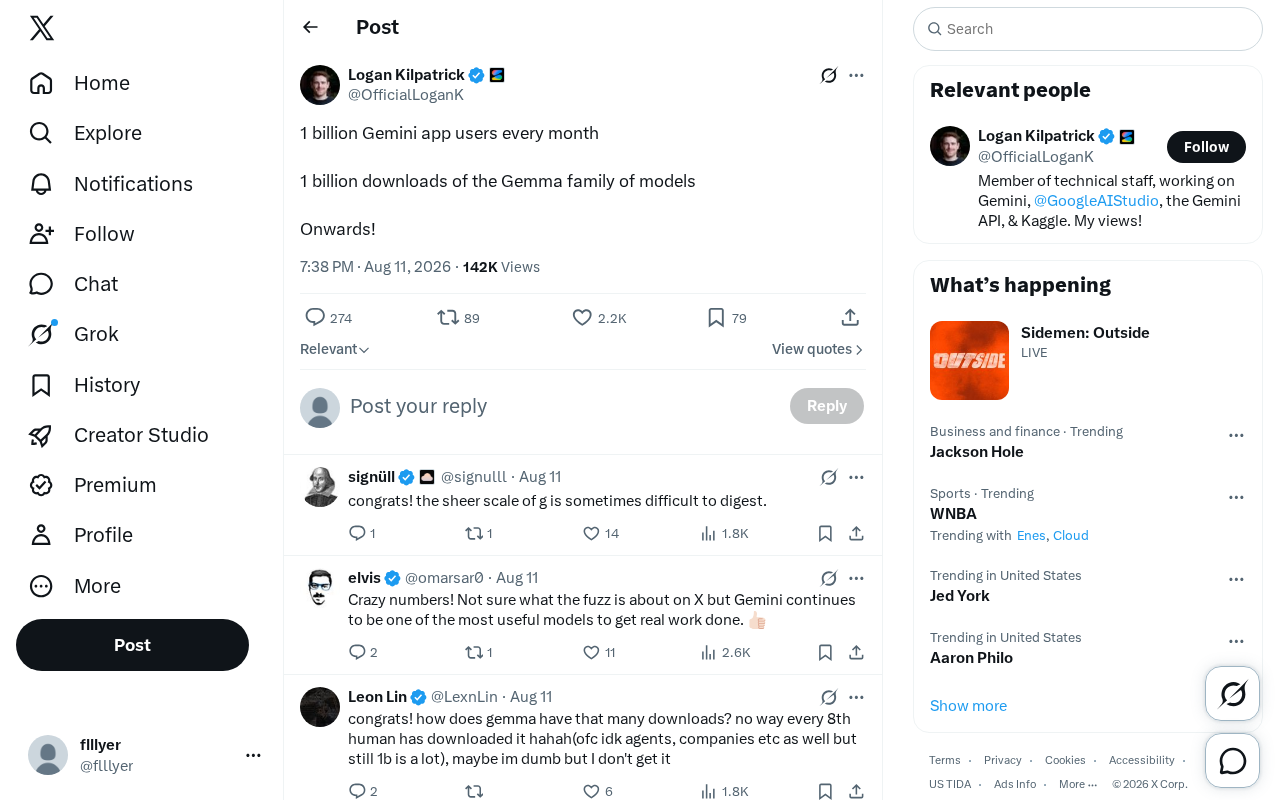
At a time when ChatGPT still dominates public perception, Gemini reaching the 1 billion MAU mark signals that Google has successfully leveraged its massive product distribution channels (Android, Chrome, Workspace, Search, etc.) to push AI capabilities to users worldwide. Meanwhile, Gemma's 1 billion downloads demonstrate that Google has also earned widespread recognition from developers in the open-source camp.
Consumer Market: The Distribution Advantage Behind Gemini's 1 Billion MAU
Ecosystem Integration Is the Key Moat
The core driver behind Gemini crossing 1 billion MAU isn't simply its standalone app — it's the result of Google deeply embedding AI into its existing product matrix. From system-level assistants on Android phones to smart features in Chrome, Gmail, and Google Docs, Google possesses a natural distribution channel that other AI companies simply cannot replicate.
This integration advantage means users often become Gemini users without even realizing it. For a generative AI product, reaching 1 billion users requires more than just model capability — it demands channels that can deliver that capability to users' fingertips. Google holds a near-monopolistic position on exactly this front.
The Significance and Limitations of the MAU Metric
It's worth noting that "monthly active users" is a relatively loose metric. It reflects reach and breadth, but doesn't fully equate to user stickiness or willingness to pay. Google's choice to publicize this number serves a dual purpose: on one hand, it showcases scale advantage against OpenAI and Anthropic; on the other, it signals to the market that "AI has become standard across Google products."
The real challenge lies in converting these 1 billion MAU into high-frequency, deep-engagement, commercially viable use cases — rather than merely passive feature exposure.
Developer Ecosystem: What Gemma's 1 Billion Downloads Really Mean
An Open Strategy Directly Competing with Meta Llama
As Google's lightweight open-source model family, Gemma's 1 billion downloads put it in direct competition with Meta's Llama series. In the large model race, open source has become a critical battlefield for winning developer mindshare. Whoever gets more developers building on their models gains the upper hand in the long-term ecosystem.
Gemma is positioned as a small, efficient model that can run on consumer-grade hardware, making it particularly suitable for local deployment, edge computing, and resource-constrained scenarios. The 1 billion download count proves this strategy has successfully attracted a large number of developers and enterprises looking to run AI in private environments.
A Dual-Track Strategy: Open Source and Closed Source in Parallel
Google's strategy is quite clever: the flagship Gemini follows a closed-source path, offering top-tier capabilities and commercial APIs, while Gemma takes the open-source route, capturing the developer community and long-tail market. This dual-track approach protects core commercial interests while not giving up the brand influence and technical feedback that open-source ecosystems provide.
For developers, this means they can flexibly choose within the same technology family based on their needs — call the Gemini API when maximum capability is required, or deploy Gemma models when autonomous control is the priority.
AI Competitive Landscape: Google's Full-Scale Counteroffensive Signal
Looking back over the past two years, Google appeared reactive under the impact of ChatGPT and even faced skepticism due to early demo mishaps. But these two "billion" figures show that Google, leveraging its deep technical expertise and unparalleled distribution capabilities, is rapidly catching up and even surpassing competitors on certain dimensions.
Google wrapped up these achievements with a single word: "Onwards!" — revealing a clear offensive posture. For the industry as a whole, this means the generative AI competition has evolved from a single dimension of "whose model is stronger" to a comprehensive contest of "model capability × distribution channels × ecosystem building."
Conclusion
Two billions represent two pillars of Google's AI strategy: scaled reach in the consumer market and open expansion in the developer ecosystem. In this never-ending AI race, what Google has demonstrated is not just technical prowess, but a systematic ability to convert technology into scale advantages. The key going forward will be how to transform this massive user base and developer ecosystem into real commercial value and sustained innovation momentum.
Related articles

Cursor AI Programming in Practice: Build a Student Management System from Scratch in 30 Minutes
A Bilibili creator demonstrates Cursor AI programming: generating a student management system in 30 minutes with natural language. Details on Agent mode, Claude selection, prompt techniques, and thresholds.

Top 20 AI Coding Tools Ranking: From Rock-Solid to Lackluster, a Scored Matrix
Bilibili creator releases top 20 AI coding tools ranking, tiered T0–T4 from rock-solid to lackluster, with Claude Code and Codex tied at T0. This article details the scoring dimensions (capability, reliability, robustness, durability, cost, domestic availability) and tool performances to help developers choose the right AI coding assistant.

Vibe Coding Systematic Tutorial: Master AI-Assisted Programming from Zero
A three-month Vibe Coding tutorial from a Bilibili creator covering Codex, ClaudeCode, and Cursor, from core logic to commercial project practice for beginners.