Gemini Live API Major Update: Frontier-Level Reasoning Comes to Native Audio for the First Time
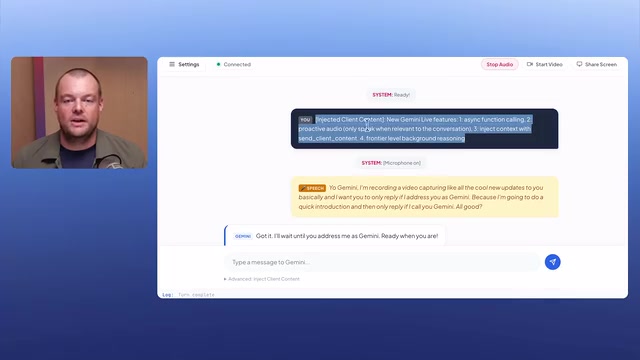
Gemini Live API adds proactive audio, context injection, async function calling, and higher reasoning to native audio.
Google has delivered four major updates to the Gemini Live API targeting core weaknesses in voice interaction. Proactive Audio teaches the model to speak only under specific conditions; context injection lets developers silently pass background information mid-conversation; async function calling decouples time-consuming tool execution from real-time dialogue; and most breakthrough of all, higher reasoning has been integrated into native audio for the first time, allowing complex tasks to run in the background while the model stays instantly responsive. All features are now available in the Gemini Live API.
Google's Gemini Live API has received a major wave of updates, finally delivering several long-requested features. In a creative twist, the Google team had Gemini Live introduce these new capabilities itself — demonstrating each feature through a live human-AI conversation. Here's a breakdown of the key highlights from this update, based on the official demo.
Proactive Audio: Teaching AI When to Speak
The most immediately noticeable change is Proactive Audio. In traditional voice interactions, models tend to respond to every utterance, which feels clunky in multi-person conversations or scenarios that require contextual setup. Now, developers can use prompts to instruct agents to speak only at "relevant moments."
In the demo, the host explicitly told Gemini to respond only when addressed by name. After the introduction, the model waited silently — and only chimed in when called upon. This capability brings voice agents much closer to natural conversational rhythm: knowing when to speak and when to stay quiet.
For developers building voice assistants, meeting transcription tools, or multi-turn dialogue applications, this feature significantly reduces unnecessary interruptions and creates a more natural interaction experience.
Context Injection: Passing Information Without Disrupting the Conversation
Another practical addition is the ability to inject context via send client content without forcing a new conversation turn. In plain terms, developers can silently feed information to the model mid-conversation without requiring an immediate voice response.
This is extremely useful in scenarios where data needs to flow through a "background channel" — such as real-time inventory updates, user identity information, or system status. These can be silently injected into the conversation context, and the model will leverage them at the appropriate moment without interrupting the current flow of dialogue.
Async Function Calling: Long Tasks Run in the Background, Conversations Stay Smooth
Async Function Calling addresses a long-standing pain point: when a tool call takes a long time to return results, the entire conversation no longer has to grind to a halt.
In the demo, the host asked Gemini to look up the shipping status for order number 1234XYZ. While executing the query in the background, the model continued engaging with the user in real time, ultimately returning the result: "Your order has shipped, with an estimated arrival time." This means time-consuming tools — such as database queries or external API calls — can run in the background while the agent continues conversing smoothly.
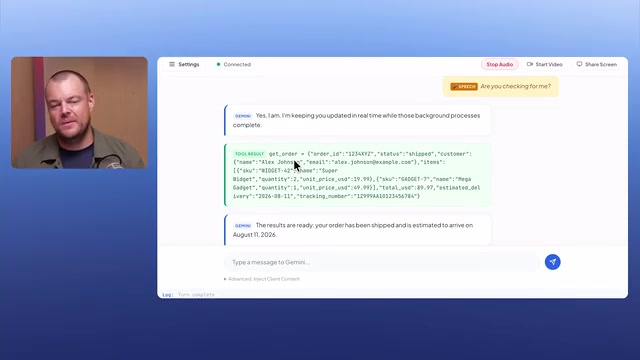
For e-commerce customer service, order tracking, and data retrieval applications, this capability lets voice agents handle complex backend logic without sacrificing conversational fluency.
In the traditional synchronous function calling model, the model must wait for a tool call to return before continuing to generate a response. This causes noticeable "stuttering" under network latency or complex computation scenarios, significantly degrading the user experience. The core mechanism of async function calling is decoupling tool execution from conversational reasoning: after initiating a call, the model immediately frees up its reasoning resources to continue processing user input, and merges the tool result into context once it's ready. This design closely mirrors the async/await pattern in modern backend development — essentially turning blocking I/O into non-blocking I/O. For real-time voice scenarios, even if a background query takes several seconds, the perceived conversational latency remains near zero, maintaining the immediacy of voice interaction while ensuring task completeness.
Frontier-Level Reasoning Comes to Native Audio for the First Time
The most groundbreaking part of this update is the first-ever integration of higher reasoning and background reasoning into Gemini Live, bringing frontier-level reasoning capabilities to the native audio experience.
The demo used a classic test task: asking the model to draw an SVG of a pelican riding a bicycle. The standard native audio model produced a fairly rough result. The host then switched to the max higher reasoning model and tried the same task — the improvement was striking: the generated SVG included a helmet, a flowing scarf, and a richly detailed bicycle structure.
Crucially, this complex drawing task ran in the background and took considerable time — yet the model remained responsive throughout. The host could continue chatting with it, and it answered other questions normally. This is precisely where "background reasoning" and "real-time interaction" work in tandem: offload heavy tasks to the background while keeping the conversation instantly responsive.
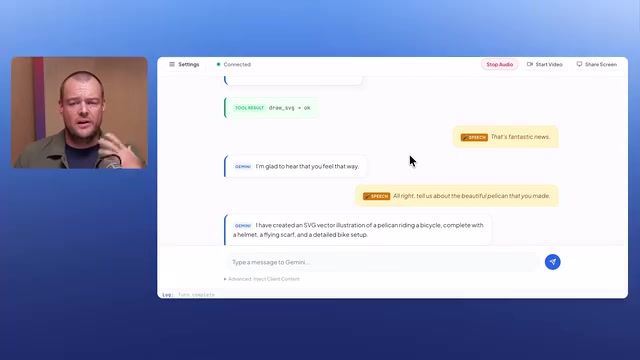
Combining complex reasoning with real-time voice interaction is what truly makes this update "groundbreaking." Previous native audio models were known for fluency but limited reasoning depth. Now, both coexist — opening up new possibilities for voice applications.
Native Audio models differ fundamentally from traditional text-to-speech (TTS) pipelines. A TTS pipeline works by having a text model generate a written response, then passing it to a separate speech synthesis module to convert text to audio — two stages in sequence. Native audio models, by contrast, generate audio tokens end-to-end, eliminating the intermediate text bridging layer. This results in lower latency and more natural intonation, pauses, and emotional expression. However, the trade-off is limited reasoning depth — the model's compute resources are consumed by audio generation, making it difficult to simultaneously perform chain-of-thought reasoning. Introducing "background reasoning" into native audio essentially opens a separate "thinking channel" for the model: complex tasks are completed in the background using text-based reasoning, and the final result is then delivered as native audio output — effectively bypassing the inherent reasoning depth limitations of the native audio architecture.
What These Updates Mean
Taken together, these four features — Proactive Audio, Context Injection, Async Function Calling, and Higher Reasoning — each target a different weakness in voice interaction: timing, information delivery, long-running task handling, and reasoning depth. Most of them are features the community has repeatedly requested since the launch of Gemini Flash Live.
For developers, this means being able to build voice agents that more closely mirror the logic of human conversation: knowing when to speak, silently handling complex tasks in the background, and possessing the reasoning ability to tackle difficult problems. These capabilities are now available in the Gemini Live API, and interested developers can start experimenting right away.
(This article is based on the official Google demo video. Actual feature behavior is subject to the official API documentation.)
Related articles

Can AI Truly Have Emotions? The Blurry Line Between Simulated and Real Experience
Can AI truly feel? Exploring the philosophical boundary between simulated and real emotion in AI — and whether we could ever tell the difference.

Trump Proposes Rebranding AI and Claims He's Creating an 'AI Force'
Trump proposes rebranding AI, claims he's creating an 'AI Force,' and calls public AI concerns a 'Democrat hoax.' We examine the political context and governance implications.

Are AI Safety Incidents Being Overhyped? The Marketing Controversy Around OpenAI and Anthropic
Are OpenAI and Anthropic overhyping AI safety incidents for marketing? This article examines why leading AI companies have incentives to inflate safety narratives and how to distinguish genuine research from PR spin.