Gemini Live Integrates Nano Banana: A Complete Guide to Real-Time Camera, Image Generation, and Maps Integration

Gemini Live integrates Nano Banana image generation and Connected Apps for free real-time visual planning worldwide.
Google's Gemini Live now integrates the Nano Banana image generation model and Connected Apps like Google Maps, enabling users to visualize ideas from real-time camera scenes and find local resources through conversation alone. Free worldwide, it combines multimodal understanding, lightweight diffusion, and Function Calling for a seamless perception-generation-action loop.
Gemini Live Gets a Real-Time Visual Capability Upgrade
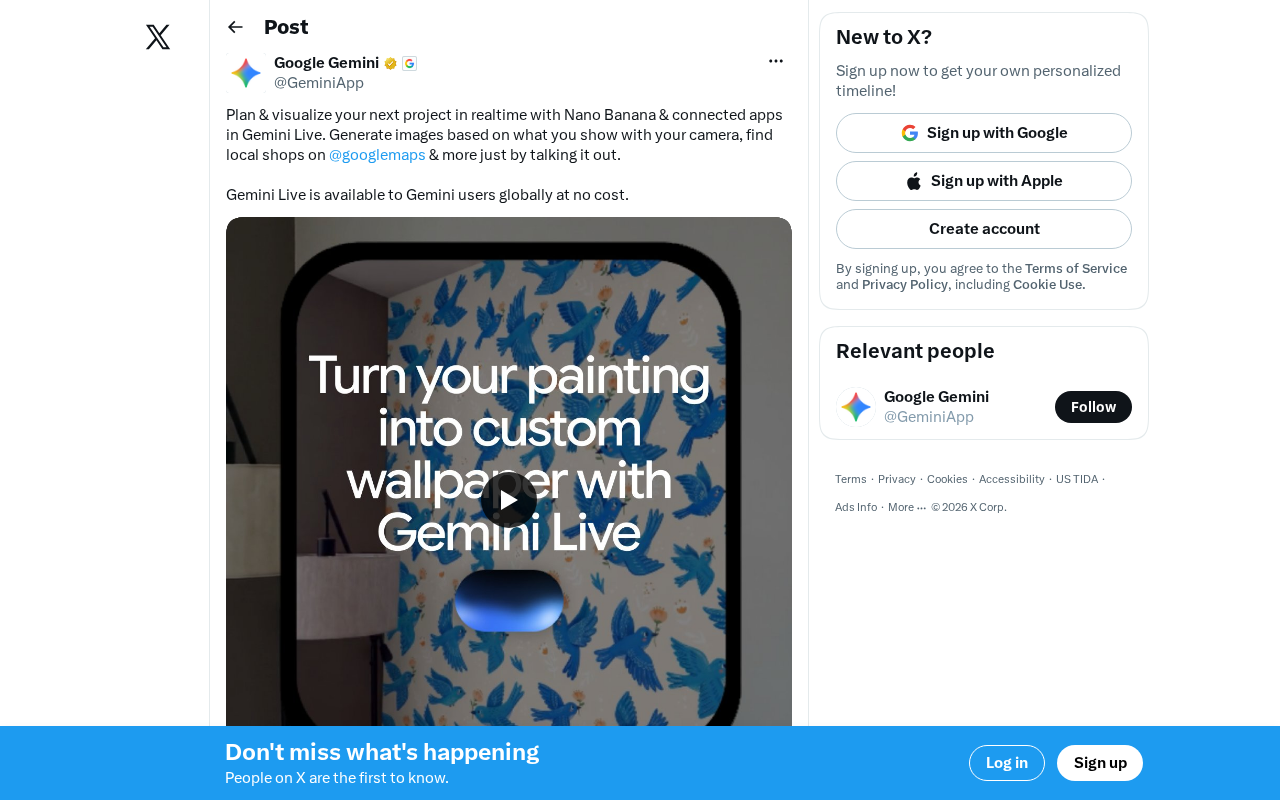
Google recently announced that Gemini Live now officially integrates the Nano Banana image generation model along with a suite of Connected Apps, delivering a brand-new real-time visual planning experience. The core breakthrough of this update is that users are no longer confined to text-only conversations. Instead, they can present real-world scenes in real time through their camera, letting the AI instantly generate images, offer suggestions, and even link to third-party services like Maps based on what it sees—all in one seamless flow.
Notably, Google has explicitly stated that Gemini Live is available for free to all Gemini users worldwide. This imaginative multimodal interaction capability is now within reach, rather than locked away in a lab or behind a paid subscription tier.
Nano Banana: Turning Planning from Imagination into Reality
A Complete Loop from Camera to Generated Image
Nano Banana is Google's image generation and editing model, renowned for being fast, lightweight, and high quality. From a technical standpoint, it belongs to the lightweight branch of Google's Imagen family of image generation models—the "Nano" naming convention in Google's AI product lineup denotes a streamlined version optimized for edge and mobile devices, similar to how Gemini Nano relates to Gemini Pro/Ultra.
Since the Imagen series was first released in 2022, it has achieved progressive super-resolution generation from 64×64 to 1024×1024 through a Cascaded Diffusion architecture, surpassing contemporaries like DALL-E 2 and Stable Diffusion on human evaluation benchmarks—particularly building deep technical advantages in lighting realism, text rendering accuracy, and consistency of human proportions.
Technical Background: Cascaded Diffusion Architecture Cascaded Diffusion is a staged image generation strategy: the first-stage model generates a semantic sketch at an extremely low resolution (such as 64×64), and subsequent super-resolution diffusion models progressively upscale it to the target size. The core advantage of this design lies in decoupling "semantic generation" from "detail restoration"—the low-resolution stage focuses on composition and semantic consistency, while the high-resolution stage focuses on texture and detail, and the model size for each stage can be optimized independently. Compared with single-stage direct high-resolution generation, the cascaded architecture significantly reduces the parameter count and memory footprint of each step while maintaining semantic accuracy. It also allows each stage to undergo knowledge distillation independently, providing a natural structural foundation for the existence of lightweight derivatives like Nano Banana.
As its lightweight branch, Nano Banana inherits these core capabilities while trading inference speed by reducing the number of denoising steps (compressing from a typical 50 steps to 4-8) and lowering the intermediate layer dimensions of the U-Net. This shares common ground with the acceleration approaches of Consistency Models and Latent Consistency Models, but Google's implementation focuses more on end-to-end joint optimization with video frame understanding modules.
Lightweight models compress parameter scale through techniques such as model distillation and quantization, trading a slight sacrifice in the generation ceiling for lower inference latency and smaller compute requirements—thereby supporting real-time interactive scenarios. Cloud round-trip latency significantly disrupts the continuity of the user experience in visual conversations, which is precisely the core value of lightweight design.
In terms of concrete implementation, Nano Banana is adapted for mobile devices based on the Diffusion Model technology stack.
Technical Background: Diffusion Models and Lightweight Approaches The Diffusion Model is the mainstream paradigm for image generation today. Its core idea is to "progressively restore an image from noise": during training, Gaussian noise is progressively added to real images so the model learns each denoising step; during inference, it starts from pure random noise and repeatedly performs denoising steps to finally generate an image. This design naturally supports high-quality, highly diverse generation, but the computational overhead of multi-step inference (typically 20-50 steps) is the main barrier to mobile deployment. To address this, the research community has developed two main acceleration approaches: one is based on Consistency Distillation (such as Consistency Model and LCM), which trains the model to directly map any noise level to the final image, compressing the number of steps to 1-4; the other is based on Flow Matching, which uses a straighter generation trajectory to replace the traditional diffusion path, likewise substantially reducing inference steps. Nano Banana's approach is closer to the former, additionally combining INT8 quantization and Channel Pruning to compress the model size to a scale suitable for edge device deployment while retaining Imagen's visual quality. This "knowledge transfer from large models to small models" distillation approach is becoming a standard engineering technique for consumer-grade AI products.
Google transfers the capabilities of a large teacher model to a lightweight student model through Knowledge Distillation, combined with INT8/INT4 quantization techniques to compress weight precision, reducing the parameter count to a fraction of the original model while retaining visual quality. This approach is similar in concept to mobile-side optimization solutions for Stable Diffusion, but Google goes a step further by deeply coupling it with real-time video stream understanding, enabling image generation to be driven by scene anchors rather than pure text prompts—this is the key difference at the technical implementation level that truly sets it apart from existing products.
After integration with Gemini Live, its biggest highlight is the ability to generate corresponding images based on real scenes captured by the camera in real time.
Take home renovation as an example: when you want to rearrange your living room, simply point your phone's camera at the existing space, then describe your ideas in natural language—"What would this wall look like painted dark green?" or "Help me design a bookshelf in this corner." Gemini Live understands your physical environment in real time and leverages Nano Banana to generate the corresponding visualization. This "what you see is what you get" interaction dramatically lowers the barrier to creative planning.
Multimodal Architecture: The Foundation for Understanding What Is "Seen" and "Said"
This experience is made possible thanks to Gemini's native multimodal architecture. The development of multimodal AI has gone through three typical stages: the first stage was cross-modal alignment pretraining represented by CLIP, which used contrastive learning to embed images and text into a shared vector space but lacked generative capability; the second stage was the "vision encoder + language model" concatenation approach represented by LLaVA and MiniGPT-4, where visual information is processed by a separate Vision Encoder and then injected into the LLM as soft prompts—essentially still a serial connection of modalities rather than fusion; the third stage is native multimodal architectures like Gemini, which jointly train Transformers on mixed multimodal data from the pretraining stage, processing tokens from different modalities together in the same sequence, allowing the model to freely switch and associate between modalities during inference.
Technical Background: The Representational Advantage of Native Multimodal Architectures Understanding the difference between "native multimodal" and "concatenated multimodal" requires examining it at the token representation level. In concatenation approaches like LLaVA, a vision encoder (usually a pretrained CLIP ViT) converts images into a set of visual tokens, which are then mapped into the language model's embedding space through a linear projection layer—the pretraining objectives, training data distributions, and internal representation structures of the two modules are completely independent, coupled only through "soft prompt concatenation" at inference time. This causes the model to suffer from broken cross-modal reasoning chains when handling tasks requiring fine-grained visual-language reasoning (such as "Is the third object from the left in the image the same color as the material you just mentioned?"). In contrast, Gemini's native architecture performs attention computation on mixed-modal token sequences from the very first Transformer layer, allowing image patch tokens and text tokens to directly correlate within the self-attention matrix, enabling the model to build truly cross-modal causal chains. This property is critical in Gemini Live's complete pipeline of "camera image → speech understanding → image generation → tool invocation"—each step's input depends on precise understanding of the preceding multimodal context, rather than simple single-modal signal conversion.
This architectural difference determines that Gemini has a natural advantage that the previous two generations of approaches struggle to match when handling tasks requiring deep cross-modal reasoning like "camera image + voice command → image generation + map invocation." It also enables the model to form deep associations with the user's language instructions when understanding camera imagery, rather than superficial step-by-step translation.
The Experiential Leap Brought by Real-Time Capability
Real-time camera understanding is not an easy technical breakthrough—it faces three core challenges: latency control (the model must complete frame-level understanding at the millisecond level while maintaining conversational coherence), temporal consistency (understanding results between consecutive frames must remain logically coherent to avoid "hallucination drift"), and privacy sensitivity (uploading camera data in real time involves highly sensitive information such as home environments).
In terms of frame-level sampling strategy, not every frame requires full model inference. Google's engineering implementation employs an event-driven adaptive sampling mechanism: it uses a lightweight Optical Flow algorithm to detect the magnitude of scene changes, triggering the full visual understanding process only when the frame content changes significantly, while reusing the semantic representations of prior frames for static scenes. This strategy reduces the effective computational load to 15%-30% of the theoretical peak, and is a key engineering technique for achieving smooth real-time experiences on mobile devices—it shares the same philosophy as Apple Vision Pro's foveated rendering technology, both concentrating limited compute on the regions where perceived information changes most dramatically.
Technical Background: Optical Flow Algorithms and Adaptive Sampling Optical Flow is a classic method in computer vision for describing the motion trajectory of image pixels along the temporal dimension, first proposed by Horn and Schunck in 1981. Traditional dense optical flow algorithms (such as the Farnebäck algorithm) estimate motion vectors pixel by pixel, with computational cost proportional to resolution; modern lightweight implementations (such as PWC-Net and the mobile-optimized version of RAFT) compress the computation to a level that can run in real time on the CPU through pyramid feature matching. In Gemini Live's engineering implementation, optical flow computation plays the role of a "scene change detector"—it doesn't need to precisely estimate the motion direction of every pixel, only the overall inter-frame motion magnitude (global motion energy, i.e., the mean L2 norm of optical flow vectors). It triggers the subsequent full neural network inference chain only when this metric exceeds a threshold. This two-stage pipeline design of "cheap pre-screening + expensive precise inference" is an extremely common engineering optimization pattern in real-time AI systems, also appearing in fields such as autonomous driving perception systems and real-time video compression encoding.
In terms of overall engineering architecture, running a standard video stream at 30fps means frame-level understanding must be completed every 33 milliseconds, and while maintaining conversational context coherence, the model must also maintain semantic state across frames. Google's solution combines on-device Gemini Nano for frame-level visual preprocessing and privacy-sensitive content filtering, and cloud-based Gemini Pro for complex reasoning and generation tasks, achieving a balance between latency and quality through a hierarchical computing architecture. This "edge-cloud" collaborative inference model is also the mainstream engineering paradigm for handling real-time multimodal AI tasks in the industry today—Apple Intelligence's Private Cloud Compute adopts a similar approach, though with differences in privacy protection mechanism design. Google offloading part of the inference tasks to on-device processing also explains why Pixel series devices often get priority access to such features.
In the past, AI image generation typically required users to step out of the real scene, switch to a standalone app, and repeatedly adjust prompts to get satisfactory results. Gemini Live's real-time capability connects the complete "observe—describe—generate" loop: you can walk around, converse, and watch the AI offer solutions in real time all at once. The whole process feels more like a face-to-face conversation with a professional designer than operating a tool.
This instant feedback is especially prominent in scenarios requiring spatial imagination such as renovation, gardening, and event setup—even without a professional design background, you can quickly validate the feasibility of your ideas.
Connected Apps: More Than Just Image Generation
Deep Integration with Google Maps
Beyond image generation, Gemini Live also integrates several Connected Apps, including Google Maps. The essence of this capability is the concrete realization of AI Agent Tool Use / Function Calling.
The Function Calling mechanism extends the language model from "predicting the next token" to "planning and executing action sequences." In engineering implementation, developers predefine a set of structured function signatures (including function names, parameter types, and descriptions), and during inference the model outputs a JSON call request conforming to that signature format, which the host program actually executes as an API call and injects the results back into the conversation context. This mechanism was first formally introduced by OpenAI in the GPT-3.5/4 update in June 2023, and subsequently rapidly became the standard paradigm for LLM application development.
Technical Background: The Engineering Evolution and Limitations of Function Calling The core engineering challenge of Function Calling lies in two dimensions: the "reliability of tool selection" and the "accuracy of parameter filling." Early implementations relied on appending tool descriptions to the System Prompt, with the model outputting call intent through text generation, then having post-processing logic parse it—which led to problems such as unstable call formats and high parameter omission rates. The formal Function Calling API introduced by OpenAI in 2023 added a dedicated structured output decoding head to the inference process, forcing the model to generate call parameters under JSON Schema constraints, substantially improving reliability. Google subsequently introduced a functionally equivalent implementation in the Gemini API, and further supported Parallel Function Calling—allowing the model to plan multiple tool calls in a single inference (such as "query the map and search product prices simultaneously"), with an asynchronous execution framework issuing requests concurrently, compressing the total latency of multi-step serial operations to the response time of the single slowest tool. This feature is crucial in Gemini Live's multi-service integration scenarios and is one of the underlying engineering guarantees of the "seamless" user experience. Another challenge after scaling the number of tools is tool retrieval: when there are more than dozens of available tools, stuffing all descriptions into the context severely consumes the token budget and introduces interference. The industry is exploring dynamic tool selection mechanisms based on vector retrieval, injecting only a small number of tools relevant to the current intent into the context—architecturally highly similar to the RAG (Retrieval-Augmented Generation) approach.
Google's implementation additionally introduces an implicit intent recognition layer on top of this—before deciding whether to invoke a tool, the model first evaluates the task completeness and information sufficiency in the user's expression, thereby avoiding experience fragmentation caused by over-invocation or poor timing. This mechanism is especially important in Maps integration scenarios: when a user says "where nearby can I buy this material," the model must simultaneously complete the coordinated orchestration of three subtasks—visual content recognition, product category mapping, and geographic query—rather than simply triggering a single API. This "implicit tool invocation" capability shifts the cognitive burden of tool use from the user side to the model side, which is precisely the engineering foundation of Gemini Live's "seamless" feel.
Users can complete tasks such as finding local stores through conversation alone, without manually switching apps. This means the AI can not only help you visualize the final effect but also further help you find the resources needed to implement the solution. For example, after designing a living room layout, you can directly ask "where nearby can I buy a similar bookshelf," and Gemini Live will invoke the map service to provide information on nearby merchants. From creative conception to resource acquisition, a single conversation covers the entire process.
The Imagination Space of Multi-App Coordination
In its announcement, Google merely hinted at "& more," suggesting the connected apps go far beyond just Maps. Notably, this strategy reflects the current divergence in AI Agent infrastructure approaches: the Model Context Protocol (MCP) launched by Anthropic in late 2024 adopts a standardized client-server architecture, allowing any third-party service to connect to any compatible model via a unified protocol, and has gained support from mainstream development tools such as Cursor, Zed, and Replit; OpenAI's GPT Actions describes external services through the OpenAPI specification, attracting developers to build tool chains through the CustomGPT ecosystem; in contrast, Google prioritizes a closed ecosystem approach that connects its own services (Maps, Gmail, Calendar), which offers stronger short-term controllability but faces the ecosystem attractiveness limitations brought by a "walled garden."
Industry Background: The Battle Over AI Agent Protocol Standards The standardization competition for AI Agent infrastructure is essentially a battle over the right to define the "interface between models and the external world," with an importance no less than the early struggle over the HTTP standard by browsers. The three main current approaches each have their trade-offs: MCP (Model Context Protocol) has the advantage of protocol neutrality—a service provider only needs to implement an MCP Server once to be callable by any compatible model, with significant ecosystem network effects; its challenge is that the standard is still evolving rapidly, and security auditing and permission control mechanisms are not yet mature. GPT Actions reuses the OpenAPI specification familiar to developers, lowering the barrier to integration, but is bound to the OpenAI ecosystem, and third-party models cannot directly reuse existing Action definitions. Google's closed integration approach fully leverages its data advantages in services like Maps, Search, and Gmail, allowing deep optimization of cross-service intent passing (such as directly injecting map POI data into the conversation context rather than through standard API calls), but at the cost of limited participation from the external developer ecosystem. As enterprise users' demand for AI Agent capabilities upgrades from "invoking a few tools" to "managing complex workflows," the outcome of this protocol standards battle will largely determine the landscape of the AI application ecosystem over the next five years.
As more of Google's own and third-party services join in succession, Gemini Live is poised to become a unified multimodal entry point—users can mobilize services such as maps, shopping, and calendar through a single conversation, forming a true "digital life assistant."
The Competitive Considerations Behind the Free Strategy
Google's choice to make this capability freely available worldwide sends a clear market signal. Competition in the multimodal AI assistant space is fierce, with OpenAI's ChatGPT Advanced Voice Mode and various vision-capable assistants all vying for user attention. Leveraging its natural advantages in the Search, Maps, and Android ecosystems, Google's free strategy to rapidly build a user base is a pragmatic move.
Behind this strategy lies a deeper data flywheel logic: users' real camera imagery in real-world scenarios, language instructions, and feedback behaviors are "golden data" difficult to obtain by scraping public data, containing genuine spatial context, user preferences, and task completion logic. The free strategy can rapidly aggregate massive samples of real interactions, forming a positive cycle of "more users → more real data → better models → attracting more users"—identical to Google's early business logic of accumulating user behavior data through free search to optimize advertising algorithms, only with the data type upgraded from click behavior to multimodal scene data.
Industry Background: The Scarcity and Strategic Value of Embodied Scene Data The training data for current large language and vision models mainly comes from three sources: web-scraped text, image-text paired datasets (such as LAION-5B), and human-annotated data. All three sources share a common gap: a lack of task execution data in real physical scenes. Research in the field of Embodied AI shows that the spatial reasoning ability required for a model to execute tasks in real environments (such as "find the blue cup on the table and estimate its distance to the window") is very difficult to learn from static image-text data alone. The data generated by Gemini Live users naturally includes: three-dimensional spatial information captured by the camera (lighting, occlusion, viewpoint), users' genuine intent expressions (far more natural than annotated datasets), and success/failure feedback on task execution (whether the user follows up or abandons the conversation). The combination of these three is extremely valuable for training models that can reliably reason in real-world scenarios. The deep collaboration between Google DeepMind's robotics research department (which developed embodied models like RT-2) and the Gemini team hints that the value of such scene data may far exceed the consumer-grade assistant itself, pointing to a longer-term general agent research strategy.
It is worth noting that the data generated by real-time camera scenarios is especially scarce in terms of training value: it simultaneously contains spatial geometric information, users' genuine intent, and task execution feedback—a combination that barely exists in current public datasets, and of irreplaceable value for improving the model's reasoning ability in embodied scenarios.
For ordinary users, experiencing the complete capabilities of real-time visual conversation, image generation, and local service integration at zero cost is highly attractive in itself. For Google, a massive free user base can not only accumulate real interaction data but also lay the groundwork for future monetization and ecosystem lock-in.
Conclusion: Multimodal AI Is Moving Toward True Practicality
Gemini Live's integration of Nano Banana and connected apps marks the evolution of AI assistants from "able to converse" to "understanding scenes and able to act." The combination of real-time camera understanding, instant image generation, and local service integration allows AI to deeply participate in users' actual planning processes for the first time in a way close to a human assistant.
From the perspective of technological evolution, this update represents the first large-scale convergence at the product level of three technical approaches: native multimodal architecture (solving the understanding problem), lightweight diffusion models (solving the generation latency problem), and Function Calling standardization (solving the action execution problem). None of these is new on its own, but integrating all three into a real-time interactive scenario freely available to the general public is a first at the commercial product level. The convergence of these three technical approaches is no accident: native multimodal architecture solves the representational bottleneck of deep cross-modal understanding, lightweight diffusion models break through the mobile latency threshold of generation tasks, and Function Calling standardization extends AI from a closed conversational system into an action agent capable of controlling real-world services—the three precisely correspond to the complete "perception-generation-action" loop of an intelligent agent, and the absence of any one would make today's fluid end-to-end experience impossible.
Of course, response speed, generation quality, and the smoothness of cross-app coordination still await validation after large-scale user adoption. But this direction undoubtedly represents the prototype of the next generation of AI interaction—when planning a project no longer requires repeatedly switching between multiple apps but only "looking and speaking", the practical value of AI assistants truly begins to be realized.
Related articles

Apple HomeView Hands-On Review: Is the $300 Smart Home Hub Worth It?
Apple HomeView hands-on: a $300 smart home hub with facial recognition for quick account switching, but no App Store or voice recognition. Is the wall-mounted version worth it? Should you buy the first generation?

Meta Muse Wonder Launch: What It Means for Meta's Return to the Frontier AI Race
Meta releases Muse Wonder and WonderFull, benchmarks reach the frontier, community feedback is polarized. An in-depth look at Meta's return to the frontier AI race, its personal agent strategy, and Zuckerberg's different path.

Apple Home Smart Home Lineup Leaked: LG and Schneider Team Up, UWB Door Lock on Board
Apple Home ecosystem gains new LG and Schneider devices: UWB smart lock with proximity unlock, 2.5K dual-camera doorbell, privacy indoor camera, and AirPods-like seamless pairing.