Gemini Responses Starting with "Sff": When AI's Internal Reasoning Accidentally Leaks

Google Gemini's "Sff" bug reveals hidden chain-of-thought reasoning leaking into user-facing responses.
A Reddit user discovered that Google Gemini responses were prefixed with "Sff" followed by internal reasoning text like "The user wants to know..." This article explains the technical causes behind this anomaly, including chain-of-thought token leakage, delimiter parsing failures, model version mismatches during canary releases, and context accumulation effects in long conversations, while offering practical solutions for affected users.
An Accidentally Exposed AI "Inner Monologue"
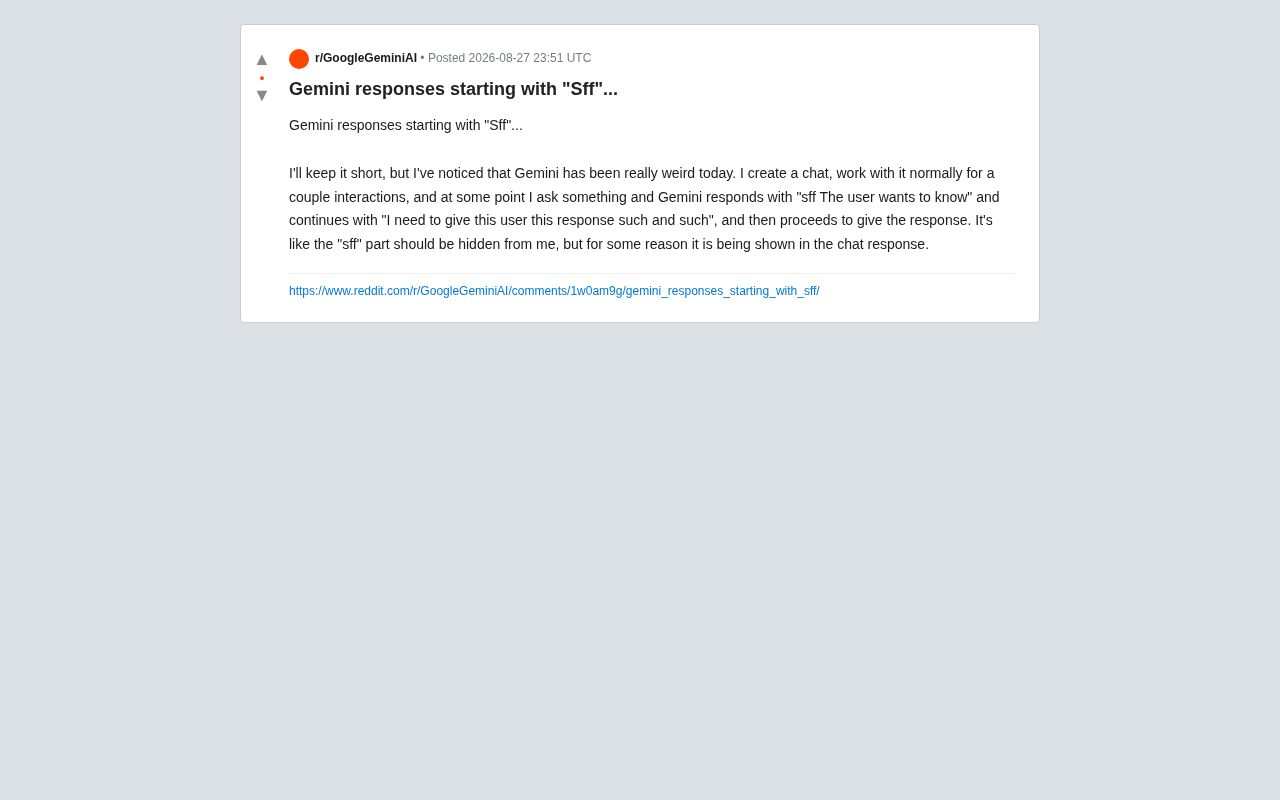
Recently, a Reddit user reported a strange behavior from Google Gemini: after several normal rounds of conversation, the model suddenly started prefixing its responses with "sff," followed by text like "The user wants to know..." and "I need to give this user this response..." — content that clearly belongs to an internal reasoning process — before finally delivering the actual answer.
The user astutely noted: "It's as if the 'sff' part was supposed to be hidden from me, but for some reason, it was displayed in the chat response." This observation was remarkably accurate — it reveals a critical component of modern large language model (LLM) architecture that users normally never see.
What Is a Model's "Internal Reasoning"?
Chain-of-Thought and Hidden Tokens
To understand this phenomenon, you first need to understand how modern AI models work. Reasoning-oriented models like Gemini and the GPT series typically perform a "thinking" step (reasoning) before producing a final answer — known as Chain-of-Thought (CoT).
The concept of Chain-of-Thought was formally introduced in a 2022 research paper by Jason Wei and colleagues at Google Research. The core idea is to have the model generate a series of intermediate reasoning steps before outputting the final answer. Research has shown that this approach significantly improves model performance on mathematical reasoning, logical judgment, and multi-step problems. Later, OpenAI's o1 series and Google's Gemini 2.5 series further internalized CoT as default model behavior — models are taught during training to automatically perform internal reasoning without users needing to explicitly request it in their prompts. This mechanism, known as "implicit reasoning," consumes additional tokens during inference, but these tokens are typically marked as invisible and not presented to end users.
This thinking process analyzes the user's true intent, plans the response structure, checks potential constraints, and more. Under normal circumstances, this content is tagged as "internal reasoning" and separated from the user-facing response through special delimiters or control tokens. The front-end interface only renders the final answer, while the reasoning process is collapsed or completely hidden.
In actual LLM deployments, the model's raw output stream contains various special tokens used to distinguish different functional blocks. For example, OpenAI's models use <|im_start|> and <|im_end|> to demarcate message boundaries, while reasoning models additionally introduce tags like <thinking> and </thinking> to wrap internal reasoning content. These control tokens are embedded in the vocabulary during model training, and the front-end rendering engine uses them to determine which content to display to users and which to hide. If the token format deviates even slightly — say, the model generates an incomplete or truncated delimiter — the parser may fail to correctly identify block boundaries, causing content that should be hidden to appear directly in the user interface.
The "sff" that users saw was very likely a fragment of such a control token that should have been recognized and filtered by the system. When the parsing logic malfunctions, these tokens — originally serving as "technical scaffolding" — accidentally leak into user-visible output.
Why Does Internal Reasoning "Leak Out"?
This type of issue typically stems from several possible causes:
- Delimiter parsing failure: Structured markers in the model's output are not correctly recognized by the front end, causing the reasoning portion and the response portion to blend together.
- Model version or backend updates: Google may have pushed new model weights or reasoning strategies that day, and mismatches between training and deployment caused format anomalies. The deployment architecture of large-scale AI services typically involves multiple layers: the underlying model inference cluster, an intermediate API gateway and output post-processing layer, and the user-facing front-end rendering layer. When Google pushes model updates, these layers often aren't upgraded atomically — model weights may already be updated to the new version, but the post-processing module responsible for parsing output formats may still be running old logic. This version mismatch is particularly common during canary releases (gradually shifting traffic to the new version), where only some users hit the new version. This also explains why some users experience issues during the same period while others see everything working fine.
- Context accumulation effects: The user mentioned that the issue only appeared "after several normal rounds of interaction," suggesting it may be related to context state or token budget management in long conversations. Modern LLMs have fixed context window limits — for example, Gemini 2.5 Pro supports up to 1 million tokens of context. However, as conversation turns increase, the total token count the model needs to process keeps accumulating, and the system must balance retaining conversation history with reserving space for generation. Common strategies include sliding window truncation (discarding the earliest conversation turns), summary compression (condensing conversation history into brief summaries), and dynamic token budget allocation. When reasoning token consumption exceeds the expected budget, or when context truncation happens to cut through a control token, format anomalies can be triggered. The detail in user reports that the problem appeared "after several normal rounds of interaction" closely matches this pattern of boundary conditions being triggered by accumulated context state.
The Technical Significance of This Phenomenon
A Window into the AI "Black Box"
Although this is clearly a bug, it inadvertently provided ordinary users with a rare perspective — a glimpse into the AI's actual "thinking trajectory" when generating responses. Self-talk like "The user wants to know" is precisely the behavioral pattern formed through alignment training — the model has been trained to act as an "assistant" that first clarifies the task, then executes.
Alignment training is a critical technical process for ensuring AI model behavior conforms to human intent and safety standards, and it typically involves multiple stages. First comes Supervised Fine-Tuning (SFT), which uses human-annotated high-quality conversation data to teach the model to play the role of a helpful assistant. Then comes Reinforcement Learning from Human Feedback (RLHF) or Direct Preference Optimization (DPO), which further adjusts the model's behavioral tendencies through human evaluators' preference rankings. During this process, the model is trained into a specific "role cognition" pattern — first understand user needs, evaluate response strategies, check safety constraints, then generate the final reply. This is why leaked reasoning text contains self-talk like "The user wants to know" — it's a direct manifestation of the internal behavioral paradigm shaped by alignment training. When the model "thinks," it's essentially executing an internal protocol optimized through reinforcement learning.
This also confirms an industry consensus: AI responses are not one-step intuitive outputs, but rather the result of multi-step internal planning. These reasoning processes, which are deliberately hidden during normal operation, are precisely where model capability and safety alignment reside.
Impact on Product Experience
For ordinary users, this type of leak causes obvious confusion and degrades the experience — users expect clean, direct answers, not technical text full of "meta-instructions." It also reminds us that even a top-tier AI team like Google's faces fragile points in coordinating front-end rendering with back-end output during rapid model iteration.
It's worth noting that this isn't the first time an AI product has experienced a similar "internal leak" incident. Previously, Bing Chat (now Microsoft Copilot) was also prompted by users during early testing to reveal its internal codename "Sydney" and system-level instructions, sparking widespread discussion about AI system transparency and security boundaries. These incidents collectively reveal a deep product design challenge: how to ensure the user interface presentation remains clean and controllable while empowering models with complex internal reasoning capabilities.
What to Do If Gemini Displays "Sff"
If you encounter a similar situation, try the following approaches:
- Start a new conversation: In most cases, starting a new session will restore normal behavior, because the issue is often tied to the context state of a specific session. A new session means clearing accumulated context history, thereby bypassing the state that may have caused the format anomaly.
- Refresh or retry: Since these bugs are often related to temporary backend deployments, waiting a moment and trying again usually resolves the issue. During canary releases, different requests may be routed to different model instance versions, and retrying gives you a chance to hit a fixed version.
- Report to the official team: Gemini's interface provides feedback channels, and reporting such anomalies helps Google quickly identify and fix them. Specifically, click the "thumbs down" button next to the problematic response and add a brief description — this feedback data is used by engineering teams to monitor model output quality.
It's important to note that these issues are typically temporary. Once a vendor discovers reasoning token leakage, they usually fix it through backend updates within hours to days, requiring no action on the user's end.
Conclusion
The "Sff" incident may be minor, but it vividly demonstrates the internal complexity of modern AI systems. Behind the clean conversational interface we use daily lies a sophisticated pipeline encompassing reasoning planning, format control, and safety filtering. When any part of that pipeline falters, the AI's "inner monologue" is unexpectedly thrust into the spotlight.
For those who follow AI technology, these occasional "glitches" are actually valuable material for understanding how models operate — they show us that those fluent, natural responses are built atop layer upon layer of invisible technical architecture. As reasoning models become the mainstream industry trend, how to elegantly manage the boundary between "thinking process" and "final output" will remain an ongoing engineering challenge for all AI product teams.
Related articles

Free Unlimited Claude Code Solution: Agnes AI + CC Switch Setup Guide
No paid subscription needed — pair the free AI platform Agnes AI with the open-source tool CC Switch to provide a backend for Claude Code, enabling unlimited free calls to text, image, and video models. This guide covers the full setup, test results, and usage boundaries.

A Complete Zero-Cost Guide to Getting Started with Claude Code for Beginners in China
A beginner's guide to Claude Code for users in China: two installation methods (command line and IDE plugin), full configuration steps for replacing the official API with the free domestic LongCat model, and a hands-on demo of building a small tool with natural language, plus tips.

When the NSA Gets Involved: The AI Supply Chain Crisis Behind Open-Source CVEs and API Key Hijacking
Multiple open-source projects disclosed severe CVEs in one day, PHP flaws alarmed the FBI, and Railway and OpenCode were breached with API keys stolen. This article breaks down the vulnerability window, AI-accelerated exploitation, and the AI supply chain crisis behind the API key black market, with a developer defense checklist.