Gemini Robotics 2 Explained: Three Core Breakthroughs in Google's Universal Robot AI

Google's Gemini Robotics 2 aims to be one universal AI brain that drives any robot with full-body intelligence.
Google's Gemini Robotics 2 introduces a Physical AI system designed to power any robot with a single intelligent core. Its three breakthrough capabilities—full body intelligence for humanoids, advanced dexterous manipulation, and multi-robot teamwork—represent major steps toward universal robot intelligence that could reshape the industry's development model.
One Brain for Any Robot
Google has officially released Gemini Robotics 2, its next-generation AI system designed for the physical world. Unlike the traditional approach of developing custom control algorithms for specific robot hardware, Gemini Robotics 2 carries the tagline "One brain. For any robot," aiming to power robots of vastly different forms with a single unified intelligent core.
This paradigm shift carries profound implications. In the past, robot development often fell into the trap of tight hardware-software coupling: every time you switched to a different robot platform, you'd need to re-tune or even rewrite large amounts of control logic. Specifically, each robot has a different number of degrees of freedom, joint types (revolute vs. prismatic), sensor configurations, and dynamic characteristics. An inverse kinematics solver and PID control parameters carefully tuned for a six-axis industrial arm cannot be directly transferred to a quadruped walking robot or a dual-arm collaborative platform. Developers must rebuild dynamics models, calibrate physical parameters, and design control strategies for each piece of hardware—a process that typically consumes months or even years of engineering effort. This fragmented development model has severely constrained the scalable deployment of robot intelligence. The universality emphasized by Gemini Robotics 2 means that the same AI brain can transfer across different robot morphologies, dramatically lowering the development barrier for robot intelligence.
What is Physical AI?
Google positions Gemini Robotics 2 as a Physical AI system. Compared to the generative AI we're familiar with—which primarily processes text, images, and code—the core challenge of Physical AI lies in enabling models to understand and manipulate the real three-dimensional physical world, including spatial perception, motion planning, joint control, and real-time adaptation to changes in dynamic environments.
Understanding the fundamental difference between Physical AI and generative AI is crucial. Generative AI (such as ChatGPT, Midjourney) primarily operates in digital space, where both inputs and outputs are information—text, images, or code. Even if the model produces incorrect output, the cost is usually limited to informational inconvenience. But Physical AI must interact with the real world, and any decision error can lead to actual physical consequences: a robotic arm colliding with valuable objects, a robot losing balance and falling, or even injuring nearby people. Furthermore, the physical world presents continuous dynamic constraints, unpredictable friction, object deformation, visual occlusion, and other complex factors that cannot be easily learned from massive text data like language tasks. Physical AI must also meet strict real-time requirements—robot control loops typically need to complete the full sense-decide-act cycle at millisecond timescales (100Hz–1000Hz), far more demanding than the latency tolerance of text generation.
This type of AI requires deep integration of large language models' reasoning capabilities, visual understanding abilities, and motor control capabilities, making it one of the most challenging frontiers for deploying AI on hardware devices.


Three Core Capability Upgrades in Gemini Robotics 2
Based on the official release information, Gemini Robotics 2 delivers the following key capability improvements:
Full Body Intelligence: Empowering Humanoid Robots
The new version brings Full Body Intelligence to humanoid robots. This means robots are no longer limited to controlling just their arms or end effectors—they can coordinate the head, torso, and limbs for unified motion planning.
Full body intelligence involves the unification of high-dimensional motion planning and dynamic balance control, representing one of the most challenging problems in robotics. A typical humanoid robot has 30 to 50 degrees of freedom, with each joint's motion coupled to the others—for example, when an arm reaches forward to grasp an object, the torso needs to correspondingly shift its center of gravity backward to prevent the whole body from tipping forward. Traditional methods typically decompose the problem into separate modules for gait planning, arm motion planning, and balance control, which communicate through predefined interfaces. However, this layered architecture often falls short when facing complex tasks requiring whole-body coordination (such as walking while carrying heavy objects). Full body intelligence pursues end-to-end unified control strategies, allowing the model to map directly from high-level semantic instructions to coordinated motion across all joints without artificial module boundaries.
For humanoid robots, whole-body coordination is the key to achieving human-like behavior. Whether bending down to pick up objects, maintaining walking balance, or adjusting posture in confined spaces, intelligent coordination across all body parts is required. Classic challenges in this field include motion generation under Zero Moment Point (ZMP) constraints, prediction and utilization of contact forces, and adaptive balance recovery when subjected to external disturbances in unstructured environments. This capability breakthrough is an important step in the transition of humanoid robots from "being able to move" to "being able to perform useful work."
Advanced Dexterous Manipulation
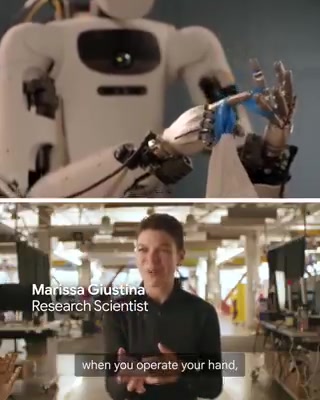
Gemini Robotics 2 highlights Advanced Dexterity. Dexterous manipulation has long been a "holy grail" challenge in robotics—humans can effortlessly tie shoelaces, twist bottle caps, and fold clothes, but for robots, these tasks involving fine force control and multi-finger coordination are extremely difficult.
Dexterous manipulation is called the "holy grail" because it simultaneously involves multiple extremely difficult sub-problems. First is tactile perception: human fingertips contain approximately 2,000 tactile receptors (Merkel cells, Meissner's corpuscles, etc.) capable of sensing sub-millimeter texture differences and sub-Newton force changes, while the most advanced tactile sensors today (such as GelSight, BioTac) still fall far short of human hands in resolution and sensitivity. Second is multi-finger coordination: a five-fingered dexterous hand has over 20 degrees of freedom, and combined with dynamic changes in object contact points and slip risk, the combinatorial complexity of the control space explodes exponentially. Third is force-position hybrid control: many everyday manipulation tasks (such as inserting a key into a lock or loosening a screw) require the robot to precisely control position in certain directions while compliantly controlling force in others—this dynamic mode switching places extremely high demands on controller design. Additionally, the enormous diversity of object materials (smooth, soft, fragile), shapes, and weights in the real world makes universal grasping and manipulation strategies extremely difficult to achieve.
Stronger dexterity means robots can complete more refined and complex grasping and manipulation tasks, directly expanding the practical boundaries of robots in manufacturing, logistics, home services, and other scenarios.
Multi-Robot Collaborative Operations
The third major highlight is Multi-Robot Teamwork. This indicates that Gemini Robotics 2 focuses not only on individual robot intelligence but also on coordination among multiple robots.
Multi-robot collaboration involves multiple layers of technical challenges including distributed planning, dynamic task allocation, motion conflict avoidance, and real-time communication coordination. In traditional approaches, multi-robot systems typically rely on central schedulers or predefined cooperation protocols (such as auction-based task allocation, potential field-based collision avoidance), offering limited flexibility and scalability. Large model-based collaborative approaches hold promise for more natural and flexible task division—for example, describing the overall task goal in natural language, allowing the AI to automatically understand the task structure, decompose subtasks, and intelligently assign them to different robots while dynamically coordinating their motion trajectories to avoid collisions and resource contention. The core difficulty of this approach lies in: how to maintain global efficiency optimization while allowing each robot to retain local autonomous decision-making capability, and how to gracefully handle coordination failures caused by communication latency, bandwidth limitations, and information asymmetry.
In practical application scenarios such as warehouse sorting, assembly lines, or complex task division, multiple robots working collaboratively can significantly improve efficiency. Enabling multiple robots to achieve team collaboration while sharing the same intelligent core is an essential capability for scalable robot deployment.
Industry Significance of Universal Robot Intelligence
Google's latest release continues its sustained investment in Embodied AI. Embodied AI is a core branch of artificial intelligence whose theoretical foundation traces back to the "embodied cognition" hypothesis proposed by MIT Professor Rodney Brooks in the 1980s—that true intelligence must emerge through continuous bodily interaction with the environment, rather than through abstract symbolic reasoning alone. In recent years, as large models have demonstrated powerful world knowledge and reasoning capabilities, the academic community has actively explored "downloading" these capabilities into physical robots. Representative works include Google's previously released RT-1/RT-2 (Robotics Transformer models), Stanford University's Mobile ALOHA (a low-cost bimanual teleoperation learning system), and Toyota Research Institute's Diffusion Policy (applying diffusion models to robot action generation).
The core approach of the Gemini Robotics series is to extend the multimodal understanding and reasoning capabilities Google has accumulated through its Gemini large models into physical-world robot control.
From a broader industry perspective, the vision of "one brain driving any robot" is becoming a major trend in robotics. There are several main technical paths to achieving this vision: The first is decoupling high-level planning from low-level control—the large model handles task semantics understanding and high-level action plan generation (e.g., "pick up the cup and place it on the table"), while hardware-specific low-level controllers translate the plan into concrete joint torque commands. The second is using a unified action representation space (such as normalized joint angles or six-DoF end-effector poses) to smooth over the physical differences between different hardware. The third leverages high-fidelity simulation environments to generate training data at scale for multiple robot morphologies, exposing the model to diverse hardware configurations during training to achieve generalization capability. Each path has its limitations: complete decoupling may sacrifice end-to-end fine-grained control capability; unified representations struggle to cover all hardware-specific constraints; and Sim-to-Real Transfer faces the "Reality Gap"—physics simulation in virtual environments can never perfectly reproduce every detail of the real world.
If a universal AI model can adapt to robots of different manufacturers and forms, the robotics industry could potentially replicate the scale advantages of the software industry—hardware manufacturers focus on body manufacturing, AI companies provide a unified "intelligent operating system," and decoupling the two would greatly accelerate the maturation of the entire ecosystem.
Deployment Challenges and Questions to Be Validated
Judging from the release information, Google's announcement still leans toward vision and capability demonstration. The real-world deployment of Physical AI still faces numerous challenges: robustness in real environments (stable performance when facing interference from lighting changes, object occlusion, and unexpected collisions), safety (ensuring robots don't cause harm when working around humans), real-time response speed (whether large model inference latency can meet high-frequency control requirements), and adaptation costs during cross-hardware transfer (whether extensive fine-tuning is needed for each new hardware platform)—all of which need validation through more real-world deployments.
Furthermore, the actual practical level achieved by these three capabilities—full body intelligence, dexterous manipulation, and multi-robot collaboration—still awaits more detailed technical papers and third-party evaluations for substantiation.
Conclusion
The release of Gemini Robotics 2 marks another solid step by Google in the field of universal robot intelligence. From custom control for single hardware platforms to the universal intelligence paradigm of "one brain for any robot," exploration in this direction has the potential to reshape the development model of the robotics industry.
As large model capabilities extend into the physical world, competition among AI giants in embodied intelligence is intensifying. Google, Tesla (Optimus humanoid robot), and numerous robotics startups—such as Figure AI (a humanoid robot company backed by Microsoft and NVIDIA), 1X Technologies (a Norwegian robotics company supported by OpenAI), and Agility Robotics (known for its bipedal robot Digit)—are all accelerating their efforts on this track. Whether Physical AI can become the next AI breakthrough point is well worth continued attention.
Related articles

Getting Started with Ollama: The Go-To Tool for Running Open-Source LLMs Locally
Ollama is a free, open-source tool for managing and deploying open-source LLMs like DeepSeek locally. Learn what it is, its cross-platform support, CPU/GPU features, and key use cases.

LM Studio vs Ollama vs vLLM: A Deep Dive into Local LLM Deployment Tools
LM Studio, Ollama, and vLLM compared: ease of use, performance, and ideal use cases. Beginners pick LM Studio, developers use Ollama, enterprises go with vLLM.

Getting Started with Ollama: The Essential Tool for Local Open-Source LLM Deployment
Learn what Ollama is and why it matters: a free, open-source tool for deploying LLMs like DeepSeek locally, with GPU/CPU support, cross-platform compatibility, and API access for private AI apps.