Generative Models Break the Sample Bottleneck in Change Point Detection
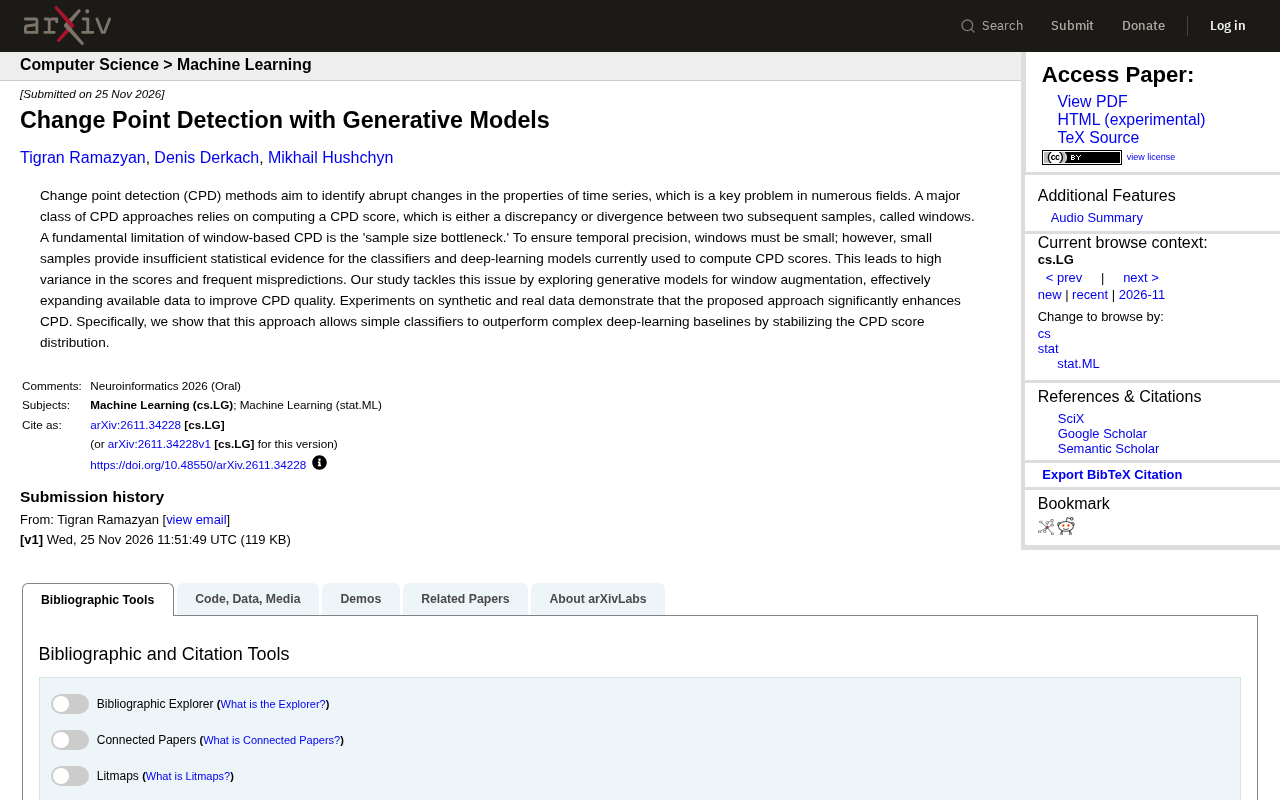
Generative models augment samples via synthetic windows, stabilizing CPD score distributions and enabling simple classifiers to outperform complex baselines.
The article explores the sample size bottleneck in window-based change point detection: small windows ensure temporal localization precision but insufficient samples cause high CPD score variance and frequent false alarms. A recent study proposes using generative models to learn within-window data distributions and generate synthetic windows, providing more statistical evidence for score computation without increasing actual observation time. Experiments on synthetic and real data show that this generative window augmentation significantly improves CPD quality, enabling simple classifiers to outperform complex deep learning baselines—the key being stabilized score distributions and reduced false alarm rates. The method is model-agnostic and expected to reduce online detection's dependence on large-scale labeled data, though generative model training costs and generation quality under distribution shift remain open questions.
Change Point Detection (CPD) aims to identify moments in time series when statistical properties change abruptly, with wide applications in financial risk control, industrial monitoring, bioinformatics, and other fields. Traditional methods typically compute CPD scores by comparing the difference between two adjacent windows, but there is a fundamental tension between window size and statistical evidence: smaller windows provide more precise temporal localization, but insufficient sample sizes lead to high score variance and frequent false alarms. A recent study proposes using generative models for window augmentation, offering a new approach to this bottleneck.
The Sample Size Bottleneck of Window-Based Methods
The core of window-based CPD methods is computing the difference or divergence between two consecutive windows as evidence of a change point. To ensure temporal precision, windows must be sufficiently small; however, small samples cannot provide enough statistical evidence for classifiers or deep learning models, causing CPD scores to fluctuate wildly and predictions to fail frequently. This "sample size bottleneck" limits the performance of window-based methods in low-latency, high-precision scenarios.

The study points out that current classifiers and deep models used for computing CPD scores are highly sensitive to sample size, and unstable score distributions under small windows are the main source of misjudgments.
Relationship between CPD scores and statistical evidence: A CPD score is essentially a hypothesis test statistic for the distributional difference between two windows. In classical methods (such as CUSUM or sliding window t-tests), the score magnitude is directly related to the effective sample size within the window: more samples yield more reliable estimates of mean/variance, and smaller fluctuations in the score when no change point exists. Under small windows, limited samples cause empirical distributions to deviate from true distributions, making scores exhibit heavy tails or high variance under the null hypothesis, thereby raising the false alarm rate. This phenomenon is known in nonparametric testing as the trade-off between "low power" and "size distortion." The idea behind generative model augmentation is essentially to approximate large-sample asymptotic properties by adding synthetic samples, thereby restoring test stability without extending the observation window.
How Generative Models Augment Windows
This study explores the application of generative models in window augmentation, effectively expanding available samples by generating synthetic data. Specifically, generative models learn the distribution of data within windows and produce additional synthetic windows, thereby providing more statistical evidence for CPD score computation without increasing actual observation time. This approach alleviates the high-variance problem caused by small samples at the data level.
Experiments on both synthetic and real data validate the effectiveness of this method. Results show that generative window augmentation can significantly improve CPD quality and enables simple classifiers to outperform complex deep learning baselines. The researchers believe the key to performance improvement lies in generative models stabilizing the CPD score distribution and reducing the false alarm rate.
Common forms of generative models for time series window augmentation: In the time series domain, generative models commonly used for window augmentation include Variational Autoencoders (VAEs), Generative Adversarial Networks (GANs), and diffusion models. VAEs model the joint distribution of windows through latent variables, offering convenient sampling but potentially over-smoothing; GANs can generate sharper samples but suffer from unstable training; diffusion models produce high-quality samples but incur high sampling costs. For CPD augmentation, the key requirement is that generated samples must preserve the temporal dependency structure within windows and not introduce spurious cross-window correlations. In research, the distribution of windows is typically learned conditionally or unconditionally, and samples are then drawn to supplement each window, providing classifiers or score computations with more "virtual observations." This process does not alter the real timeline, so it does not introduce temporal leakage.
Implications for CPD Practice
The significance of this work lies in providing a model-agnostic augmentation strategy: rather than designing more complex classifiers, it supplements data through generative models, allowing existing simple models to perform better. For online change point detection scenarios requiring high temporal precision, this approach is expected to reduce dependence on large-scale labeled data while maintaining low computational overhead.
However, generative models themselves require training, and their generation quality directly affects augmentation effectiveness. The study does not discuss in detail the performance of generative models under distribution shift or high-dimensional data, which may be a direction worth exploring in the future.
Model-agnostic augmentation and computational overhead of online detection: Model-agnostic means the augmentation strategy does not depend on a specific CPD score calculator or classifier architecture; generative models can be embedded as a preprocessing module into existing pipelines. In online scenarios, computational overhead mainly comes from the inference cost of generative models: if large numbers of synthetic samples are generated in real time for each sliding window, the low-latency advantage may be offset. Therefore, practical deployment requires balancing the number of generated samples with inference frequency—for example, triggering augmentation only when scores approach the decision boundary, or using lightweight generators (such as small VAEs) pre-trained offline for fast online sampling. Additionally, there is a lack of unified metrics for evaluating generation quality; under distribution shift, generated samples may deviate from the true distribution and instead amplify score bias—a risk point that requires monitoring in practice.
Conclusion
Generative models offer a data augmentation-level solution to the sample size bottleneck in change point detection. By generating synthetic windows, CPD score distributions become more stable, and simple classifiers can outperform complex deep learning baselines. This method has been validated on both synthetic and real data, providing a new technical pathway for the time series analysis community.
Related articles

GLM-5.4 Released: How a 750B Model Achieves Stronger Reasoning
Zhipu AI releases GLM-5.4, a 750B model that boosts reasoning by running the middle 28 layers twice. GPQA Diamond rises from 47.58 to 56.26, with 1M token context and weights to be open-sourced after safety hardening.

Understanding GLM 5.4 in 8 Minutes: How Loop Transformer Makes AI Smarter Without More Parameters
GLM 5.4 didn't grow its parameters yet got smarter. Using the memorizer-vs-reasoner analogy, this article explains how Loop Transformer runs the middle 28 steps twice, how gated progressive update and two other techniques stabilize the second pass, and how generalized Coding uses code to command 3D, mechanical design, and game development — with official comparison data and open questions.
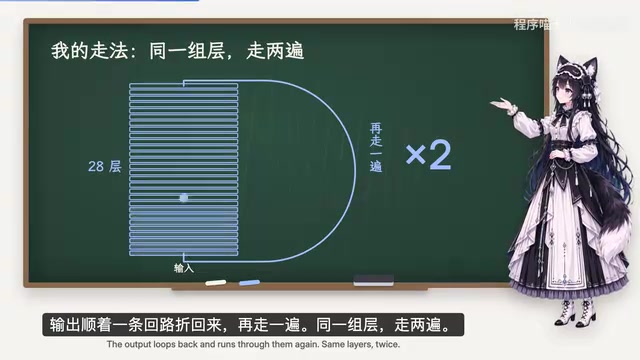
GLM-5.4 Released: An In-Depth Look at Zhipu's First Loop Transformer Flagship Model
Zhipu releases GLM-5.4, its first Loop Transformer flagship. Built on GLM-5 with 28 layers looped twice—no extra params, ~10% more compute, stronger math and long-context reasoning.