Genesis AI Raises $500M Series A to Accelerate Glove-Based Robot Deployment
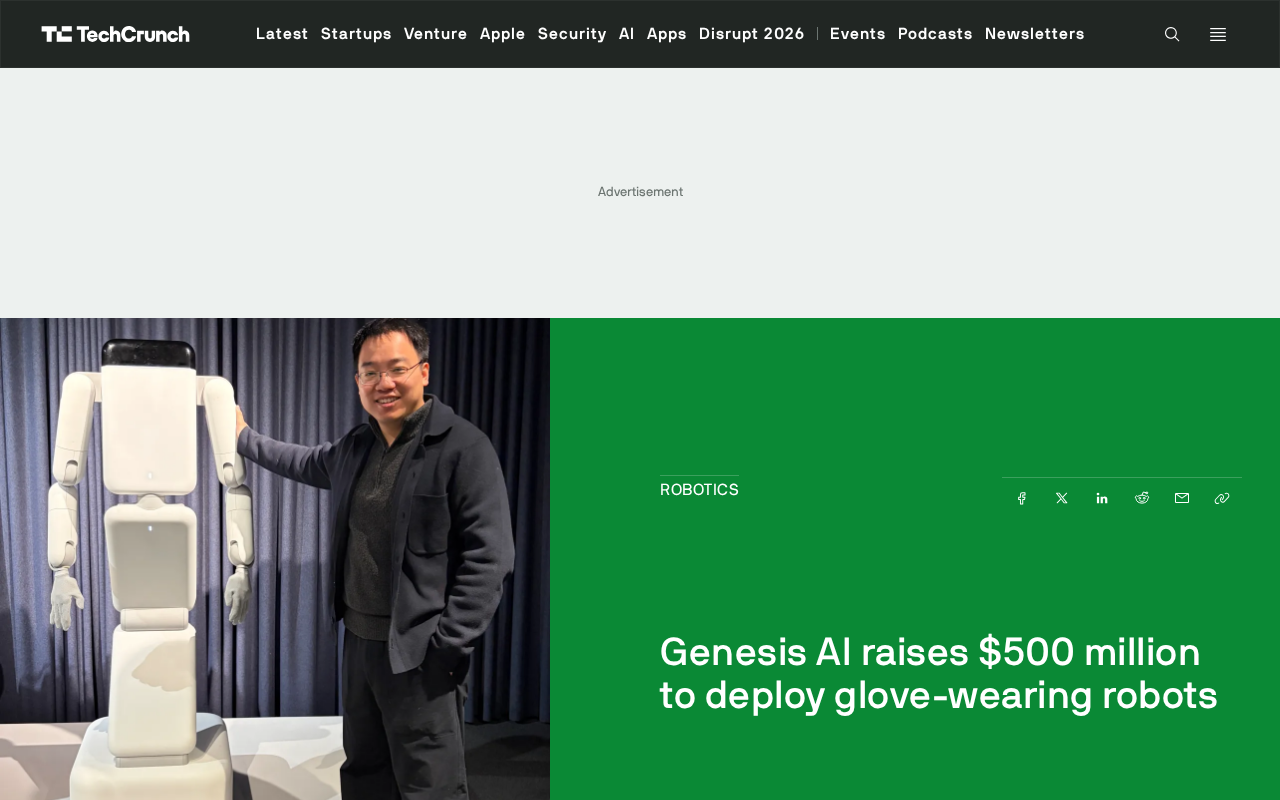
Genesis AI bets $500M Series A on glove-based data collection to train dexterous robots.
Genesis AI has closed a $500 million Series A—far larger than typical robotics startups at this stage—to deploy dexterous robots that wear gloves. Its core technology uses wearable gloves to directly capture human hand motion data for training dexterous manipulation, potentially bypassing the inefficiency of teleoperation and the physical distortion of sim-to-real transfer. The article notes that dexterous manipulation is the key threshold for general-purpose robots to enter real jobs, but product details and deployment plans remain undisclosed.
A Rare Series A Round
According to an RSS source, Genesis AI has closed a $500 million Series A round. This figure is highly unusual for the Series A stage—most robotics startups raise in the tens to low hundreds of millions at this point. $500 million signals that the capital markets are placing an extremely high premium on both the company's technical approach and its deployment prospects.
The use of funds is clear: deploying dexterous robots that wear gloves. The original headline explicitly calls out "glove-wearing robots," which are not consumer toys but embodied AI hardware built for fine manipulation tasks.
Core Technical Logic: How Gloves Change Dexterous Training
A Differentiated Path Starting from Training Data
The original article summarizes Genesis AI's methodology as a "novel approach to training dexterous robots." Dexterous manipulation has long been one of robotics' toughest challenges—the human hand has over twenty degrees of freedom, and actions like grasping, rotating, and pressing demand far more from force control and perception than locomotion does.
The glove design suggests the training pipeline may sidestep the traditional difficulties of teleoperation or sim-to-real transfer, instead using a wearable device to directly capture human hand motion data and map it to the robot's execution side. The value of this approach lies in data collection efficiency: everyday human manipulation naturally generates large volumes of high-quality demonstration data, which is closer to the real physical world than building purely simulated environments.
Teleoperation refers to an operator remotely controlling a robot through master-slave devices to complete actions, with the motion data recorded as training demonstrations. This method is precise but inefficient and costly to collect, and operators require professional training. Sim-to-Real transfer trains policies in virtual environments and then deploys them to physical robots; it offers large data volumes at low cost but suffers from the "reality gap"—simulations struggle to accurately model physical details like contact forces, friction, and deformation, causing policies to degrade in the real world. Genesis AI's glove approach represents a third path: using wearable devices to directly capture human hand motion in real environments, bypassing both the inefficiency of teleoperation and the physical distortion of sim-to-real transfer—essentially acquiring both "real physics" and "scale" at the data source.
Why Investors Are Willing to Bet Big
Dexterous manipulation is the last piece of the general-purpose robot puzzle. Mobile bases and robotic arms are relatively mature, but the capability of the "hand" determines whether robots can enter real jobs like assembly, sorting, and laboratory operations. Genesis AI securing $500 million indicates that investors believe its training method has the potential for scalable replication—not just laboratory demos.
Dexterous manipulation is fundamentally different from the common pick-and-place task: the latter typically requires only a parallel gripper and preset trajectories, while the former demands multi-finger coordination, hybrid force-position control, and adaptation to unknown objects. The human hand has about 21 degrees of freedom (excluding the wrist), whereas most commercial robotic hands have only 6–12, creating two challenges: first, kinematic mapping—how to compress high-dimensional human motion into a low-dimensional execution end; second, the lack of tactile feedback—dexterous tasks rely heavily on contact force perception, and existing tactile sensors remain immature in durability and cost. As a result, dexterous manipulation is seen as the watershed between robots that "can move" and robots that "can work," and it is the core reason capital is willing to pay a high premium.
Embodied AI refers to agents that learn and perform tasks by interacting with the environment through a physical body, as distinct from purely software-level language models. Its core challenge lies in the coupling of "data–model–hardware": models need massive amounts of real interaction data, and real data depends on hardware platforms for collection. The current mainstream paradigm in embodied AI includes Vision-Language-Action (VLA) models, which unify perception, language instructions, and action outputs into a single model. Genesis AI's funding should be understood against this backdrop—what capital is betting on is not just a robot, but a closed-loop system that can continuously generate high-quality manipulation data and feed it back into model iteration.
What to View with Caution
Funding amount does not equal deployment capability. The original article provides limited information—it does not disclose the robot's specific form factor, mass production plans, customer list, or technical metrics. How $500 million translates into deployment scale remains to be seen. The dexterous robotics赛道 (track) is fiercely competitive, and hardware cost, reliability, and data loops are all hard barriers.
For teams focused on embodied AI, Genesis AI's funding is a signal: the combination of glove-based data collection and dexterous manipulation is gaining capital recognition, and this technical path is worth continued tracking.
Implications for the Industry
A single Series A round won't change the industry landscape, but it reveals a trend—robot training is shifting from "building smarter algorithms" to "acquiring higher-quality human demonstration data." Genesis AI's entry via gloves is essentially about building moats at the data source. Whether this approach can succeed will influence the funding narratives of a wave of embodied AI startups to follow.
For developers and researchers, the key question is whether its data collection solution will be open-sourced or form an ecosystem—this will determine whether the path can be reused by a broader set of teams.
One-line Summary
Genesis AI bets $500M Series A on glove-based data collection to train dexterous robots.
Paragraph Summary
Genesis AI has closed a $500 million Series A—far larger than typical robotics startups at this stage—to deploy dexterous robots that wear gloves. Its core technology uses wearable gloves to directly capture human hand motion data for training dexterous manipulation, potentially bypassing the inefficiency of teleoperation and the physical distortion of sim-to-real transfer, building a moat at the data source. The article notes that dexterous manipulation is the key threshold for general-purpose robots to enter real jobs like assembly, sorting, and lab operations, which is why capital is willing to bet big. However, the original article does not disclose product form factor, mass production plans, or customer information, and whether $500 million can translate into deployment scale remains to be seen.
Related articles

Gemini 4 Neon Review: Benchmark Scores Rival Carbon, API Pricing and Quota Breakdown
Google Gemini 4 Neon is now live, benchmark scores closely tracking Carbon, API pricing 3/15 at twice Hydrogen's rate. This article compiles Bilibili creator testing: Neon can replace 90% of Carbon scenarios, AntiGravity quota consumption is only one-third of Carbon, plus subscription channel restrictions and 2API ban risks.

Gemini 4 Helium Coming Soon? Signals of Google Loosening Subscription Restrictions
Google team member hints releases will continue; community speculates Gemini 4 Helium (Flash Lite) may be next. Subscription ban controversy gets a response as product lead says "Soon," suggesting restrictions may be lifted. This article covers Gemini developments, OpenAI Coding Agent and risk management, Doubao real-time audio-video API, and compute business dynamics.

AI-Assisted React Development in Practice: Optimizing a Video App and Handling Errors
A 14-year veteran developer demonstrates AI-assisted React video app optimization: compressing video from 80MB to 5MB (~94%) via ImageKit, plus reliable error handling and retry mechanisms. Includes planning, code understanding, and verification methods for working with AI.