Genie 4 Lets You Modify the World While Playing, ChatGPT Dots Opens for Testing
Google Genie 4 supports modifying generated worlds while playing, ChatGPT Dots opens Plus testing, and WeChat tightens AI short drama review.
This AI daily covers four updates. Google Genie 4 turns generative worlds into debuggable tools where users can move forward and modify conditions like weather via text, with official 720p/24fps specs and developer access through Gemini Interactions API and Google AI Studio. ChatGPT Plus users get Dots testing, and Gemini launches tool retrieval preview to save context by reading tool definitions on demand. On compute, Google plans to launch computing satellites with Blue Origin in 2029. On content, WeChat requires AI short dramas to submit production proof videos starting December 1, sets a one-minute minimum per episode, and makes process documentation mandatory.
Genie 4 Lets You Modify the World While Playing, ChatGPT Dots Opens for Testing
Today's AI daily brings a few notable updates: Google's Genie 4 makes generated worlds modifiable in real time, ChatGPT Plus users get access to Dots testing, Gemini continues to strengthen tool retrieval and desktop operations, and WeChat tightens review rules for AI short dramas.
Genie 4: Generated Worlds Can Be Modified While Playing
The most obvious change in Google's Genie 4 demo is that generated scenes are no longer one-off static results. On screen, you can press a key to walk forward, and if you want to change the weather halfway through, you can type a sentence to modify it—and the scene can also include sounds synchronized with the visuals.
Genie 4 supports generating continuous scenes using text, reference images, or a combination of both. What's new this time is the developer entry point: it can now be called through Gemini's Interactions API and Google AI Studio, with official visual specs of 720p at 24 frames per second.
What's interesting is that you can test conditions within the same scene: first walk into a street, then input a command for rain, and continue looking ahead along the same route. When prototyping scenes, you can use this approach to test movement, sightlines, and atmosphere before deciding which formal assets to produce. This "modify while walking" interaction turns generative worlds from showpieces into debuggable creative tools.
Generative world models are a class of models that directly simulate environment dynamics using neural networks. Unlike game engines that rely on hand-written physics rules and art assets, they learn "what the next frame looks like" from large amounts of video or interaction data. DeepMind's Genie series, released in 2024, is a representative of this direction: Genie 1 generated playable 2D platform games from a single image, and Genie 2 expanded to interactive 3D scenes, typically maintaining coherence for only tens of seconds. The core challenges for such models are long-horizon consistency and real-time inference speed, so "modify while playing" means the model must maintain the visual and spatial coherence of the already-explored path after the user inputs a new command, rather than regenerating an unrelated segment.
ChatGPT Dots Opens Plus Testing, Gemini Tool Retrieval Follows
ChatGPT Plus users now have a new testing entry point for Dots. The original material contains repeated paragraphs about Dots, and specific feature details are limited, but judging from the rollout pace, it is a gradual test aimed at paying users.
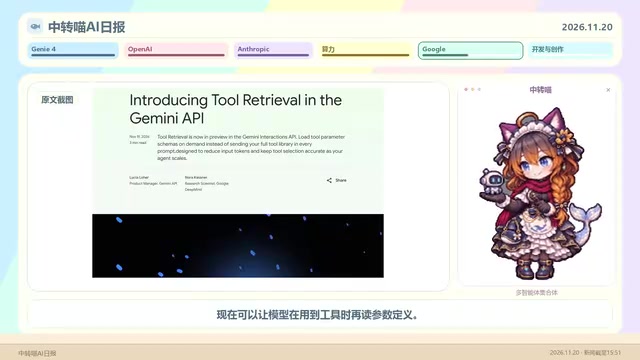
On the Gemini side, developers can try the tool retrieval preview. Previously, when there were many tools, you might stuff a full set of tool descriptions into every request; now you can let the model read parameter definitions only when it uses a tool. This feature supports Gemini 3.6 and newer models. Definitions that have already been loaded are still billed as input, and how much you save depends on how many tools are actually used each time.
Google has also added computer operation capabilities to Gemini on Mac. You specify which apps it is allowed to access, and it can handle files, desktop applications, and websites in the background; you can view its steps, pause it, and approve key operations. It is initially rolling out in batches to English-speaking users in the United States.
Tool retrieval solves the context bloat problem in large-model function calling. When an application integrates dozens or hundreds of tools, stuffing all tool names, descriptions, and JSON Schemas into the prompt at once consumes a large number of tokens, dilutes the model's attention, and makes it easy to select the wrong tool. Tool retrieval works by first storing tool definitions in a searchable index, then recalling only the few most relevant definitions based on user intent in each request before handing them to the model for decision-making. This shares the same idea as RAG, except that the retrieval target changes from document fragments to tool interfaces. The cost is an extra retrieval call and the possibility of missing long-tail tools, so the balance between recall rate and latency needs to be evaluated.
Google's Compute Layout: From Cloud Machines to Orbital Satellites
The former affects which machines you can choose in the cloud, and the latter affects which models you can choose during development—this is a summary of Google's recent adjustments. That said, Google announced plans to partner with Blue Origin to send computing satellites into sun-synchronous orbit, with a target launch time in the first quarter of 2029.
Google describes the computing capacity of a single satellite as roughly one data center rack; what has been published at this stage is the launch plan and open-source documentation. Moving compute into orbit looks more like a long-term layout in the short term, and actual implementation will have to wait for the launch window.

Sun-synchronous orbit is a near-polar orbit in which the local solar time when a satellite passes the same latitude is roughly the same each time, so lighting conditions are stable, solar power supply is predictable, and the shadow angles in captured images remain consistent. This makes it a common orbit for remote sensing satellites and also explains why computing satellites are placed there—energy supply is relatively controllable. But space data centers also face obvious constraints: heat can only be dissipated by radiation, and convection cooling is impossible in a vacuum, so the higher the power of a single rack, the larger the radiator area required; there are also challenges such as radiation hardening, launch costs, and in-orbit maintenance. What Google has announced is only the launch plan and open-source documentation, and there are still multiple technical milestones before commercial operation.
Two Updates on Developer Tools and Content Rules
The parsing tool Dockling has added the ability to read more PowerPoint chart types, including waterfall charts and tree diagrams, and can also extract event information from calendar invitations in emails. When building a knowledge base, you can take a presentation with complex charts and see whether the extracted structure is sufficient.
What creators should pay attention to is the change in WeChat's rules. According to a WeChat short drama content center announcement cited by IT之家, starting December 1, when AI-generated content is submitted for review as a collection, a production proof video must be submitted. Teams preparing to release episodes can preserve asset lists, prompts, and part of the generation process in advance. On the same day, the minimum duration per episode will be adjusted to one minute.

For teams making AI short dramas, this means that documenting the generation process and managing assets are no longer optional but part of the review process. Organizing prompts, generation processes, and asset lists in advance is more reliable than scrambling to supplement materials later.
Content provenance and production documentation are becoming standard thresholds for generative content entering distribution channels. In addition to WeChat requiring submission of production proof videos, the international C2PA standard records the generation and editing history of content through cryptographic signatures, and the EU AI Act also requires labeling of deep synthesis content. For short drama teams, prompts, seeds, generation batches, and post-production editing records together form a verifiable chain, which is used both for platform review and to prove originality in copyright disputes. Incorporating such metadata into regular production workflows is more reliable than adding it after the fact.
Trends Worth Watching
From Genie 4's interactive worlds to Gemini's tool retrieval, Google is actually doing the same thing: bringing model capabilities closer to actual workflows. Genie 4 turns generated scenes into debuggable prototyping tools, while tool retrieval reduces redundant input in each request.
Tighter rules on the content side are also happening in parallel. As AI-generated content enters formal distribution channels, transparency and traceability are becoming hard requirements. For creators, the stronger the tools, the more valuable process records become.
One-line Summary
Google Genie 4 supports modifying generated worlds while playing, ChatGPT Dots opens Plus testing, and WeChat tightens review for AI short dramas.
Paragraph Summary
This AI daily focuses on four developments. Google Genie 4 turns generative worlds from static displays into debuggable tools, allowing users to move forward in the same scene and modify conditions such as weather with text; official specs are 720p/24fps, and the developer entry point is now available through the Gemini Interactions API and Google AI Studio. ChatGPT Plus users get Dots testing, while Gemini launches a tool retrieval preview that lets the model read tool parameter definitions on demand to save context. On the compute side, Google plans to partner with Blue Origin to launch computing satellites in 2029. On the content side, WeChat requires AI short dramas submitted for review starting December 1 to include production proof videos, adjusts the minimum duration per episode to one minute, and makes documenting the generation process a hard requirement.
Related articles
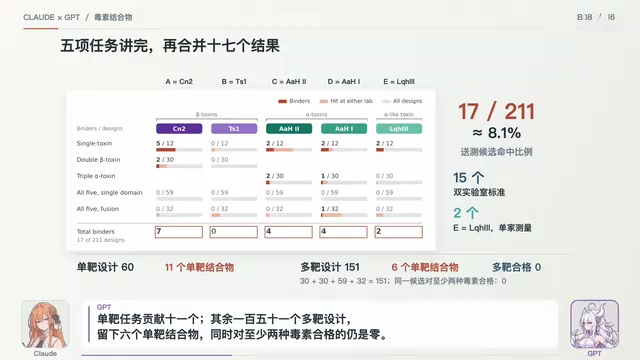
Claude Designs Scorpion Venom-Neutralizing Proteins: With 17 Binders, How Far Are We From an Antidote?
Anthropic's Claude helped design scorpion venom-neutralizing proteins: only 17 of 211 candidates passed, multi-target coverage failed, and channel function and animal testing remain absent.
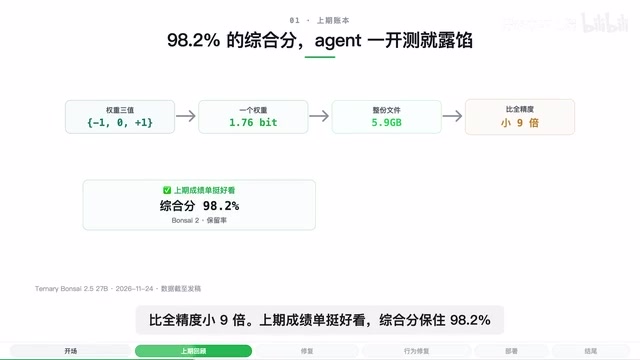
Fitting a 27B Model into 5.9GB: Ternary Bonsai 2.5 Fixes Its Agent Weaknesses
Prism ML releases Ternary Bonsai 2.5: a 27B model in just 5.9GB, with ternary quantization compressing weights to 1.76 bits. The new version focuses on fixing Agent capabilities, raising Tao3Bench Verify to 75.6 and Upworld from 51.2 to 90.5, hitting 291 tokens/s on a single A700, open-sourced under Apache 2.0.

GPT-6-Designed Proteins Validated in Lab; ERNIE 5.5 Preview Open-Sourced
GPT-6 designed proteins using reasoning and code alone, with lab binding evidence across five targets; Baidu open-sourced ERNIE 5.5 Flash Preview under Apache 2.0 with 280B parameters and 1M context.