Genie Benchmark: The Business Context Battle Behind 91% Pass Rate on Enterprise Data Tasks
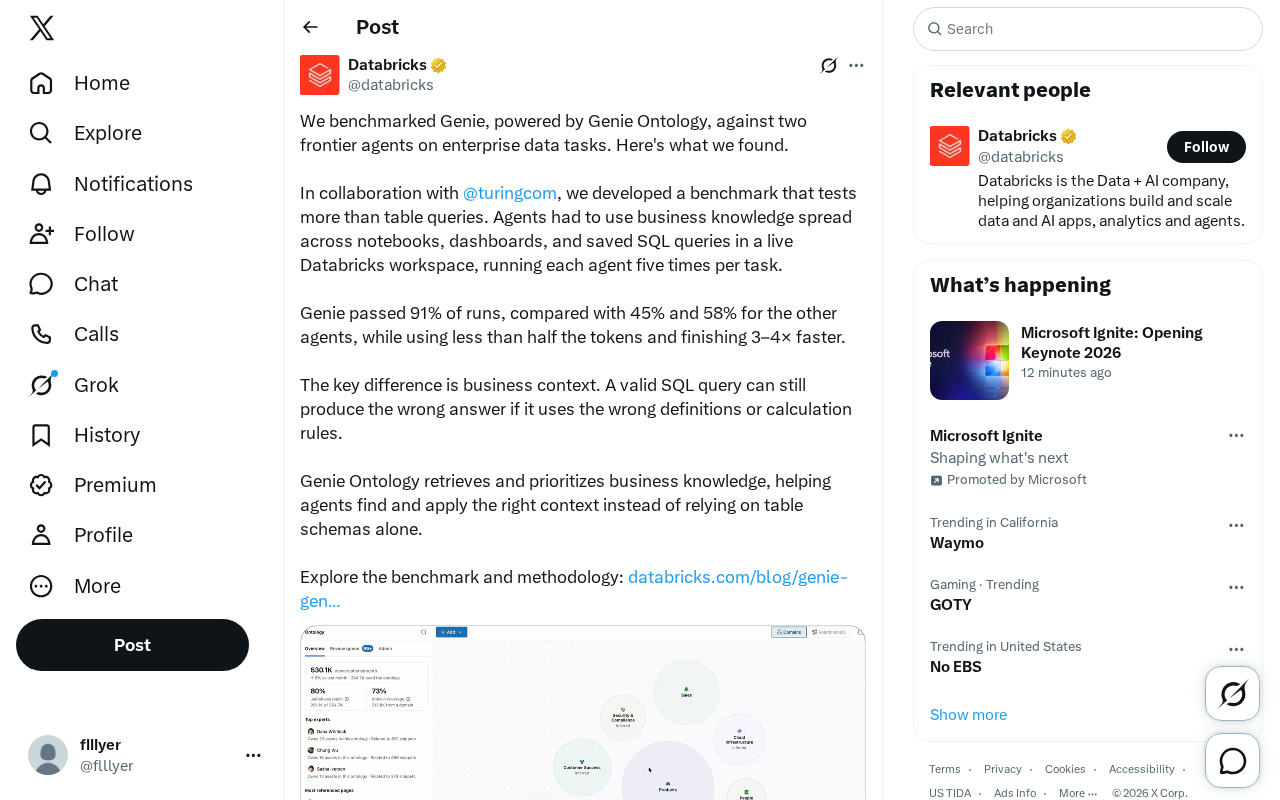
Genie team's benchmark shows enterprise data agents need business context retrieval, not just SQL generation, with Genie passing 91% vs. far lower competitor rates.
The Genie team, in collaboration with @turingcom, designed an enterprise data task benchmark testing agents' ability to use business knowledge from notebooks, dashboards, and saved SQL in a Databricks workspace. Genie, powered by Genie Ontology, passed 91% of runs vs. 45% and 58% for two frontier agents, using less than half the tokens and running 3–4x faster. The core difference is business context retrieval and prioritization, not SQL syntax—valid queries with wrong definitions still yield wrong answers. The vendor-led benchmark needs independent validation but offers a key selection reference.
Title
Genie Benchmark: The Business Context Battle Behind 91% Pass Rate on Enterprise Data Tasks
Meta Description
Genie vs. two frontier agents on an enterprise data task benchmark: Genie passes 91% vs. 45% and 58%, using less than half the tokens and running 3–4x faster. The key difference is business context retrieval, not SQL syntax.
Article Content
Can enterprise data agents really be trusted? A common misconception is that as long as the generated SQL is syntactically correct and the table and column names line up, the answer is correct. But in real enterprise environments, business definitions, calculation rules, and metric definitions are often scattered across notebooks, dashboards, and saved SQL queries—and a query that "looks reasonable" can easily lead to the wrong conclusion. Recently, the Genie team partnered with @turingcom to design an enterprise data task benchmark targeting exactly this pain point, comparing Genie (powered by Genie Ontology) against two frontier agents. The results deserve a close read from anyone focused on putting data agents into production.
Benchmark Design: More Than Just Table Queries
This benchmark doesn't just test whether an agent can write a correct table query. The test environment is a running Databricks workspace, where agents must leverage business knowledge scattered across notebooks, dashboards, and saved SQL queries to complete tasks—not just rely on table schemas. Each task is run five times per agent to reduce the impact of one-off randomness.
This design targets the real difficulty of enterprise data scenarios: fragmented business semantics. Table schemas tell you "what fields exist," but not "how this metric should be calculated" or "whether this definition complies with financial standards." An agent that only sees the schema is like someone handed a dictionary without annotations—it knows every word but may still misread the sentence.
The Databricks workspace is the core collaborative environment of the Databricks data intelligence platform, integrating notebooks, the SQL editor, dashboards, job scheduling, and model training. As a test environment for evaluating data agents, it is representative: first, it recreates a real enterprise data toolchain, where agents must interact with multiple asset types (tables, notebooks, dashboards, etc.); second, a Databricks workspace typically preserves the business knowledge assets that enterprise data teams accumulate over long-term collaboration—exploratory analysis notebooks, metric dashboards, and ad-hoc saved SQL queries. These assets often contain "implicit knowledge" not captured in the data dictionary, such as the calculation logic for specific metrics, data filter conditions, or business rules. Testing agents in this environment therefore allows for a more comprehensive assessment of their ability to extract and apply business context from fragmented knowledge, rather than merely testing their SQL syntax generation.
Results Comparison: A Comprehensive Gap in Pass Rate, Tokens, and Speed
In terms of run results, Genie passed 91% of runs, while the other two frontier agents passed 45% and 58% respectively. At the same time, Genie used less than half the tokens of its competitors and completed tasks 3–4 times faster.
These numbers send two signals. First, the pass-rate gap is not a marginal improvement but a near-doubling difference in magnitude. Second, the efficiency advantage is equally significant—fewer tokens mean lower inference costs and shorter response chains, while faster completion directly affects the interaction experience. For enterprise users who need to execute data tasks frequently, these two metrics matter as much as accuracy.
It should be noted that this is a benchmark developed by the Genie team in collaboration with @turingcom, making it a vendor-led evaluation. The results themselves are worth referencing, but broader validation through independent third-party reproduction is still needed to confirm generalizability across platforms and data stacks.
The Key Difference: Business Context, Not SQL Syntax
The Genie team's explanation is direct: the core difference lies in business context. A syntactically valid SQL query that uses the wrong definitions or calculation rules will still produce wrong answers.
This touches on a structural weakness in current data agents. Most agent workflows are "understand the question → match the table schema → generate SQL," with business knowledge either crammed in via prompts or guessed from the model's parametric common sense. Genie Ontology, by contrast, is positioned to retrieve and rank business knowledge, helping agents find and apply the right context instead of relying solely on table schemas. In other words, it tries to make "definitions" and "rules" first-class, retrievable citizens.
From an engineering perspective, the hard part of this path isn't retrieval itself but the organization and prioritization of business knowledge—which notebook snippets are authoritative, which dashboard definitions are outdated, which saved SQL is legacy. Ontology plays the role of knowledge governance here, not just a vector retrieval layer.
Business knowledge retrieval and ranking is a key step for data agents to achieve accurate question answering. Enterprise business knowledge is typically scattered across notebook comments, dashboard metric definitions, saved SQL query logic, and the daily communications of data teams. Agents need to identify the snippets relevant to the current question from these unstructured or semi-structured sources and judge their authority and timeliness—for example, a particular dashboard may be outdated, while a recently updated notebook is more reliable. This process involves information retrieval, relevance ranking, and conflict resolution. Unlike generic vector retrieval, business knowledge retrieval must also account for domain constraints: financial metrics must comply with accounting standards, and operational metrics must conform to internal statistical definitions. Therefore, an effective retrieval mechanism requires not only embedding models but also rule engines or knowledge graphs to assist with prioritization, ensuring the agent applies the "correct" rather than merely "relevant" context.
Implications for Enterprise Selection
If these benchmark results can be reproduced in a broader range of environments, the checklist enterprises use when evaluating data agents should be adjusted. Looking only at "can it generate correct SQL" is no longer enough; it's more important to assess whether the agent can connect to and correctly use the business knowledge assets the enterprise already has.
Specifically, three questions are worth asking: does the agent support extracting business rules from notebooks, dashboards, and historical queries; is there a mechanism for prioritizing conflicting business definitions; and when definitions change, can the knowledge layer be updated in sync? These three points determine whether an agent is a "toy" or a "tool" for enterprise data tasks.
The Genie team has published the benchmark and methodology for further review. For technical teams currently selecting data agents, this material is worth using as a starting point for an evaluation framework—not the endpoint.
One-line Summary
Genie team's benchmark shows enterprise data agents need business context retrieval, not just SQL generation, with Genie passing 91% vs. far lower competitor rates.
Paragraph Summary
The Genie team, in collaboration with @turingcom, designed an enterprise data task benchmark that tests agents' ability to complete tasks in a Databricks workspace using business knowledge from notebooks, dashboards, and saved SQL. Results show Genie, powered by Genie Ontology, passed 91% of runs, while two frontier agents passed only 45% and 58%; Genie also used less than half the tokens and ran 3–4x faster. The article notes the core difference lies in retrieving and prioritizing business context, not SQL syntax—syntactically valid queries using wrong definitions still produce wrong answers. The benchmark is vendor-led and needs independent validation for generalizability, but offers an important reference for enterprise selection: evaluate data agents on their ability to connect to and correctly use business knowledge assets.
Related articles

Gemini 4 Neon Review: Benchmark Scores Rival Carbon, API Pricing and Quota Breakdown
Google Gemini 4 Neon is now live, benchmark scores closely tracking Carbon, API pricing 3/15 at twice Hydrogen's rate. This article compiles Bilibili creator testing: Neon can replace 90% of Carbon scenarios, AntiGravity quota consumption is only one-third of Carbon, plus subscription channel restrictions and 2API ban risks.

Gemini 4 Helium Coming Soon? Signals of Google Loosening Subscription Restrictions
Google team member hints releases will continue; community speculates Gemini 4 Helium (Flash Lite) may be next. Subscription ban controversy gets a response as product lead says "Soon," suggesting restrictions may be lifted. This article covers Gemini developments, OpenAI Coding Agent and risk management, Doubao real-time audio-video API, and compute business dynamics.

AI-Assisted React Development in Practice: Optimizing a Video App and Handling Errors
A 14-year veteran developer demonstrates AI-assisted React video app optimization: compressing video from 80MB to 5MB (~94%) via ImageKit, plus reliable error handling and retry mechanisms. Includes planning, code understanding, and verification methods for working with AI.