Get DeepSeek's Little Whale into a QQ Group in Three Minutes? Step-by-Step Tutorial and a Sober Analysis

Breaking down the three-layer toolchain for connecting DeepSeek to a QQ group in a Bilibili meme video, plus its risk and cost boundaries.
Using a Bilibili meme video as an entry point, the article breaks down the technical path for connecting DeepSeek to a QQ group: Snowroom injects into the QQ process and captures messages, QQBridge runs a local web service for relay and Token authentication, and DSH is the model client with an API Key. It notes that the video is extremely compressed, with the real difficulty in injection and Token integration rather than getting a Key, and highlights three risks: QQ updates breaking injection, account bans, and Token leaks from exposed local services. Token costs in group chats are easily underestimated. The video serves as a roadmap; verify details in official docs.
A video on Bilibili titled "Teach You to Pull DeepSeek's Big Fat Fish into a QQ Group in Three Seconds! ...Just Kidding" demonstrates, at breakneck speed, a workflow for connecting DeepSeek to a QQ group chat. The video has an obvious meme/joke vibe, but the toolchain it strings together—DSH, Snowroom, and QQBridge—does correspond to a real technical path. This article breaks that path down clearly, while filling in what the video doesn't cover: risks, boundaries, and what problem it actually solves.
What This Chain Actually Does
Connecting an LLM to a QQ group is essentially a three-part assembly: messages go in and out of the QQ group, get forwarded locally or on a server, and are then handed to the model to generate replies. The approach in the video uses Snowroom for QQ-side injection and message capture, DSH as the client and configuration layer for model calls, and QQBridge in the middle to connect the two.
According to the video demonstration, Snowroom needs to be downloaded from GitHub in the version matching your computer's architecture. After extracting and running the batch file, the console outputs a Token; you put that Token back into the configuration, then select the target QQ process in the Snowroom backend to inject into, and the channel between QQ and Snowroom is established. After that, QQBridge forwards messages to DSH, forming a complete loop.
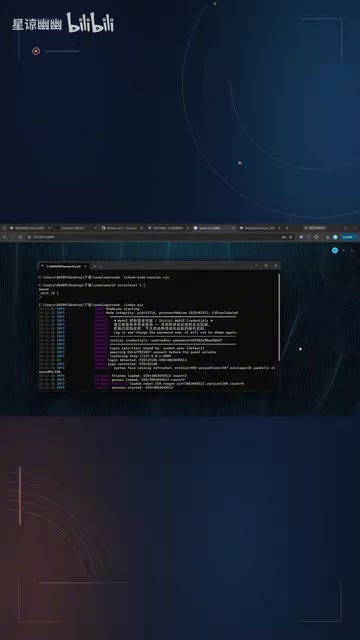
Note one detail: the "inject into the QQ process" mentioned in the video means this approach relies on interfering with the QQ client process. This is not an officially open bot interface—it takes a localized route in a gray area. Understanding this is the foundation for the later discussion of risks.
Process injection is a technique that forcibly writes external code or data into a target program's memory space while it is running, commonly used for debugging, cheats, and modular extensions. In this approach, Snowroom injects its own module into the QQ client process to intercept and forge QQ's network message sending and receiving, bypassing Tencent's official bot interface. This method inherently depends on the internal implementation of the QQ client; once the client updates or its memory structure changes, the injection may fail or even crash QQ. In addition, it violates the terms of service of most platforms, and accounts may be judged as using cheats and banned. Compared with the official QQ bot open platform, the process injection approach requires no review and no public server—it's quick to get started with, but far worse in stability and compliance.
Breaking Down That Configuration Workflow in the Video
The core on the DSH side is the API Key and presets. The video says: open the DSH official website, download and install, add a preset in settings, and fill in your own API Key. If you don't have a Key, go to the usage query page on the official website to get one, then obtain quota by topping up.
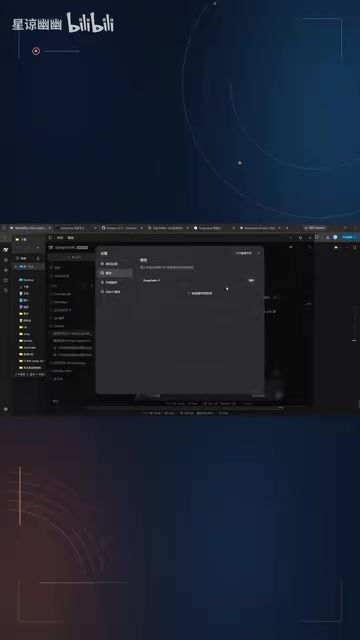
This step itself has no real barrier—any tool that calls an LLM API follows the same logic: get credentials, put them into the client, confirm quota. The video glosses over it with "smart you have already learned 99%," but what actually tends to get people stuck is the later process injection and Token integration, not applying for a Key.
Judging from the pacing of the demo, the author is clearly familiar with this workflow, so the explanation is compressed to almost shorthand. For someone encountering it for the first time, lines like "extract to the folder you want to install in," "click the Bat file," and "enter the Token into it" all require you to fill in the context yourself—for example, which configuration item the Token goes into, whether paths should be absolute or relative, and how to roll back when injection fails.
The Key Jump from QQ to DSH
The most error-prone part of the chain is the QQBridge segment. The video describes it as: based on the address shown in the console, find the corresponding file in the folder, open it with Notepad, copy the Token into the browser, and once you see a successful connection, it's done.
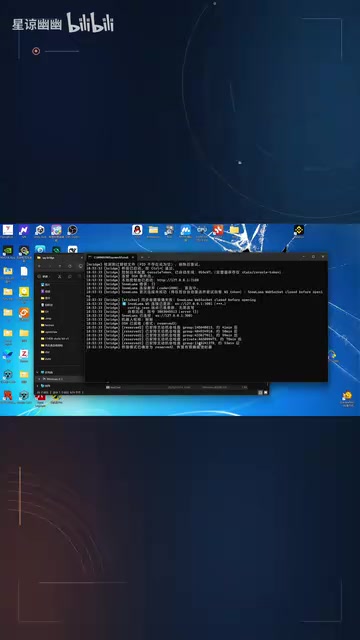
The object of operation here is a local service address, and the Token serves for authentication. In other words, this tool starts a local web service; messages from the QQ side are relayed through it, and it then calls the model behind DSH. Security depends entirely on whether this local service listens only on the local machine, whether the Token is sufficiently random, and whether the configuration file might be accidentally leaked. The video does not discuss these, yet they are precisely the factors that determine "whether it can be used long-term."
The video ends by mentioning "if any problems occur during installation, you can ask DSH to help you solve them," then shows the table performance in the group chat and thanks the open-source project. This self-reference of "using AI to fix AI tools" is quite interesting, but it also shows that the fault-tolerance design of this workflow is not friendly—it relies on the model to backstop troubleshooting.
Local web service and Token authentication: QQBridge starts an HTTP service locally and generates a random Token as an access credential. Messages from the QQ side are relayed through this service, and callers must carry the correct Token to use the interface. The core security premise of this design is that the service binds only to 127.0.0.1 (accessible only from the local machine), and the Token is sufficiently long and random. Once the service listens on 0.0.0.0 or the router does port mapping, anyone on the LAN or even the public internet may be able to scan that port; if the Token is also written in a plaintext configuration file that is accidentally shared or leaked in a screenshot, an attacker can directly consume your model quota, or even send arbitrary messages to the group through the interface. The video demonstration does not explain how to confirm the listening address and Token strength; before实际操作, you should check the host and port settings in the configuration file.
Why "Three Seconds" Is Clickbait, but the Direction Is Real
Strictly speaking, the "three seconds" in the video title is ironic; in the main content, the author himself admits that it needs to be configured step by step. What is truly worth noting is that it verifies one thing: the open-source community has already lowered the barrier of "QQ group + LLM" to the point where ordinary users can follow a video through it.
But a lower barrier does not mean you can dive in without thinking. Process injection solutions naturally come with several problems: QQ client version updates may cause injection to fail; accounts risk being judged by the platform as abnormal behavior; if the local service is exposed to the public internet, a Token leak is equivalent to handing over model invocation permissions. As entertainment-oriented content, the video will not expand on these, but those preparing to try it need to evaluate them themselves.
Another overlooked point is cost. The API Key requires topping up; in group chat scenarios, message volume is large and context is long, so token consumption will be much higher than in personal conversations. The video breezes past "use the usage to top up," but the actual bill may exceed expectations.
API invocation cost: LLM APIs are usually billed by the number of input and output tokens. In group chat scenarios, each reply requires sending the recent chat history as context, so token consumption grows linearly with group activity and context length. An active group of a few dozen people may generate thousands of messages a day; if every message triggers a model call carrying historical context, the cost will be far higher than personal conversations. In addition, most APIs have rate limits and concurrency caps, so queues or errors may occur during group chat peaks. Before preparing for long-term operation, it is recommended to set trigger frequency limits, context truncation length, and daily budget caps on the server side to avoid runaway bills.
Conclusion
The value of this video is not how rigorous the tutorial itself is, but that it strings a technical path originally scattered across GitHub docs and group chats into a followable workflow in a few minutes. Those who want to try it can use it as a roadmap, but every step should be confirmed against each project's official documentation, especially the parts involving process injection and local service exposure. You can watch the meme content, but configure with caution.
One-line Summary
Breaks down the three-layer toolchain for connecting DeepSeekAd to a QQ group in a Bilibili meme video, and supplements its risk and cost boundaries.
Paragraph Summary
Using a Bilibili meme video as an entry point, the article breaks down the technical path for connecting DeepSeek to a QQ group: Snowroom injects into the QQ process and captures messages, QQBridge starts a local web service for relay and Token authentication, and DSH serves as the model invocation client with an API Key filled in. The author points out that the video's explanation is extremely compressed, and what really gets people stuck is process injection and Token integration rather than applying for a Key; the author also emphasizes that this approach relies on unofficial interfaces and carries three types of risks: injection failure due to QQ version updates, accounts judged abnormal, and Token leakage due to local service exposure. Token consumption in group chat scenarios is far higher than in personal conversations, and costs are easily underestimated. The video's value lies in providing a roadmap; for actual operation, one should return to each project's official documentation to confirm details.
Related articles

Build an AI Super Employee System at Zero Cost: A Full Breakdown of Automated Agent Workflows
A deep breakdown of the AI super employee system demoed on Bilibili: agent orchestration, digital human voiceovers, map and enterprise lead generation, 24/7 customer service, and legal modules. We analyze the business logic and compliance risks behind zero-cost signup to help entrepreneurs judge the real ROI of this AI digital employee system.

The Essential Difference Between Chatbots and AI Agents: Crossing from Conversation to Execution
What's the difference between a chatbot and an AI agent? Based on the MCP series on the Learn Tech channel, this article uses examples like booking flights and summarizing notes to explain: a chatbot only gives answers, while an agent actually completes tasks through a think-act-observe loop. It breaks down the four core components—model, tools, memory, and goal—as well as MCP's role as a bridge, and discusses agents' applicable boundaries and permission risks.

Free GitHub Repo: 342 Hours of AI Courses, from Math to MCP Servers
A free GitHub repo offers 342 hours of AI courses: 523 lessons across 20 phases, from math fundamentals to agent building and MCP servers. Nearly 100,000 learners have started.