Getting Started with Agent Skills: Structure, Principles, and Practical Usage

Agent Skills packages AI capabilities into structured bundles of SKILL.md, references, scripts, and assets.
Agent Skills maps human professional skills onto AI Agent capabilities using a structured file bundle: SKILL.md for workflows, references for docs, scripts for tools, and assets for static files. Unlike simple prompts, Skills are reusable, extensible, and far more powerful for building specialized AI workflows.
As tools like Claude Code, OpenClaw, and Hermes gain explosive popularity, a concept called Agent Skills is rapidly making waves. What exactly are they? How do they differ from the prompts we're already familiar with? This article walks you through the structure, principles, and practical usage of Agent Skills from the ground up.
What Exactly Are Agent Skills
Skills, simply put, are abilities. The concept is actually quite intuitive — every profession has its own set of specialized skills.
For example, if you're a student, you can write essays, solve math problems, and complete English assignments. If you're a programmer, you have the skills to understand requirements, write code, and debug issues. These skills represent the capabilities associated with your role.
The core idea behind Agent Skills is to map "human skills" onto "AI Agent capabilities." Just as people have various skills, Agents have corresponding Skills — fundamentally the same concept.
Background: What Is an AI Agent? An Agent (intelligent agent) represents a key evolution in large language model applications. Unlike earlier RPA (Robotic Process Automation) or fixed rule scripts, AI Agents can understand natural language, autonomously plan execution steps, and dynamically invoke external tools to complete complex tasks. Claude Code, Cursor, and Devin are all prime examples of this paradigm. Compared to traditional automation tools, the critical breakthrough of Agents lies in "autonomy" — they don't require humans to pre-define every decision branch. Instead, the model makes decisions based on context. Agent Skills emerged in this context: to help Agents perform more stably and professionally in specific domains, developers needed a standardized way to describe and package "professional capability bundles" for specific scenarios.
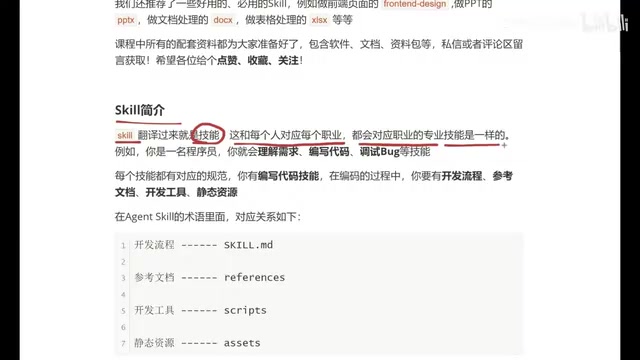
This design transforms Agents from generic conversational tools into specialized executors capable of professional performance in specific business and professional contexts.
What Does It Take to Complete a Skill
Truly executing professional work requires more than just the skill itself. Take a programmer writing code — you need four types of elements:
Development Workflow
Before actually writing code, you need to fully map out the business logic — what to do first, what comes next, and how each step connects. This is the development workflow, which represents the overall plan for completing a task. In the context of Agents, "workflow" is especially critical: large language models generate text sequentially by default and tend to produce "hallucinations" or skip steps without clear workflow constraints. By explicitly describing the workflow in SKILL.md, you can lock the model's behavior into a predictable execution path, dramatically improving task completion quality.
Reference Documentation
When writing code, you reference API docs, requirements documents, and other materials to guide the actual implementation. This is reference documentation.
For AI Agents, reference documentation serves an additional purpose: it overcomes the Knowledge Cutoff limitation of large language models. A model's training data has a cutoff date, leaving it unaware of the latest SDKs, frameworks, or business rules. By injecting up-to-date documentation into the references folder, the Agent can "learn on the fly" and cite it accurately, avoiding calls to outdated or nonexistent APIs — a technique also widely studied in the RAG (Retrieval-Augmented Generation) field.
Development Tools
You can't write code with plain text documents alone. Front-end developers use VS Code, Java developers use IntelliJ IDEA — just as doctors need the right instruments, development tools make work more efficient.
In the Agent Skills framework, the scripts folder serves exactly this "toolbox" role. These scripts (typically Shell, Python, or Node.js) give Agents the ability to perform system-level operations — calling external APIs, processing files, running build commands, and more. This aligns with the same design philosophy behind OpenAI's Function Calling and Anthropic's Tool Use: connecting the model's "language capability" with the external world's "execution capability" through a tool layer, enabling Agents to genuinely affect the real world.
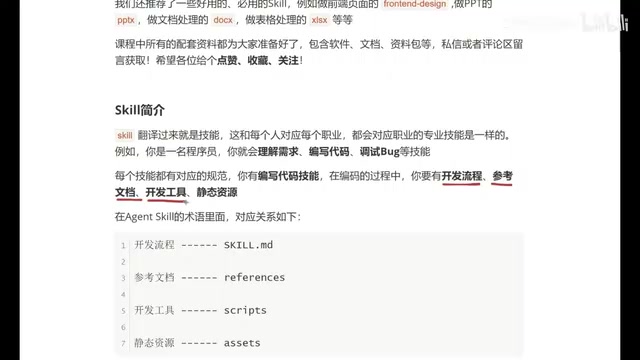
Static Assets
If you're building a webpage, images, audio, and video files all count as static assets. With these materials in place, you can truly realize a complete project.
The File Structure of Skills: Four Core Components
Agent Skills elegantly maps these four elements to specific files and folders:
| Real-World Element | Skills Equivalent |
|---|---|
| Development workflow | SKILL.md file |
| Reference documentation | references folder |
| Development tools | scripts folder |
| Static assets | assets folder |
Package all of this into one folder and you have a complete skill bundle.
One key point worth emphasizing: not every file and folder is required — only SKILL.md is mandatory. The other three are added based on actual needs — sometimes none are needed, sometimes all three are used, depending on what the skill is designed to accomplish.
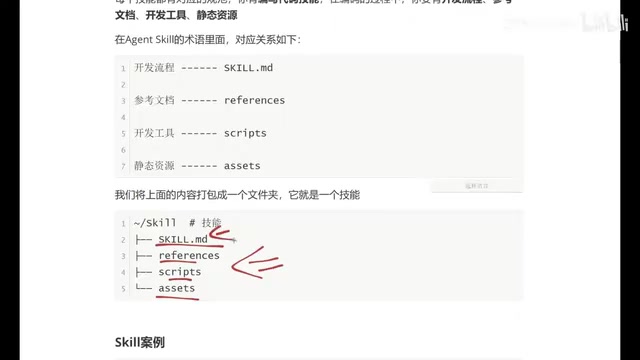
This "compose as needed" design keeps Skills lightweight while giving them powerful extensibility for complex scenarios. It's worth noting that this design philosophy aligns closely with the Single Responsibility Principle in software engineering: each Skill handles one type of professional capability, different Skills are loosely coupled, and they can be freely combined and stacked to build complex multi-skill Agent systems.
Breaking Down a Real Example: Brand Material Design
Take the Skill "Generate brand-appropriate material designs for Evan Restaurant" as an example. The SKILL.md file typically contains two major sections:
Metadata
Located at the top of the file, this includes the skill's name and description. For example, the description might read: "Generate brand-appropriate design concepts for Evan Restaurant's marketing materials. When a user asks to create a specific type of material (poster, roll-up banner, packaging box, etc.), output the corresponding design concept." This description determines when and how the Agent invokes this skill.
Background: How Does Metadata Drive Skill Routing? In a multi-skill Agent system, metadata plays the role of a "routing label." When a user submits a request, the Agent's dispatch layer performs semantic matching between the user's intent and the names and descriptions of all registered Skills, determining which skill (or skills) to activate. This mechanism is similar to intent recognition in search engines, or the Tool Selection logic in frameworks like LangChain and AutoGPT. As a result, the quality of the description directly affects skill recall accuracy — the more precise the description and the clearer its boundaries, the lower the false-trigger rate when the Agent invokes the skill, and the more stable the overall system performance.
Instructions
Just as every natural language message you send to a language model is essentially an instruction, the Instructions section in SKILL.md specifies in detail:
- Core brand elements: brand name, style, IP character, primary color palette, slogan
- Task definition: when a user requests a specific material, output content that matches the brand style
- Output format: thematic concept, visual style, layout composition, detail recommendations
Background: Why Does
SKILL.mdUse Markdown Format? Markdown is a lightweight markup language widely used in technical documentation for its clear hierarchy and human-readable syntax. For large language models, Markdown has a natural advantage: mainstream models (GPT, Claude, Gemini, etc.) were trained on large amounts of Markdown content — GitHub READMEs, technical blogs, wikis — giving them strong semantic understanding of structures like headings (#), lists (-), and code blocks (```). Compared to plain text instructions, structured Markdown helps models more accurately distinguish between "rules" and "examples," "main tasks" and "sub-steps," reducing instruction ambiguity and improving execution reliability.
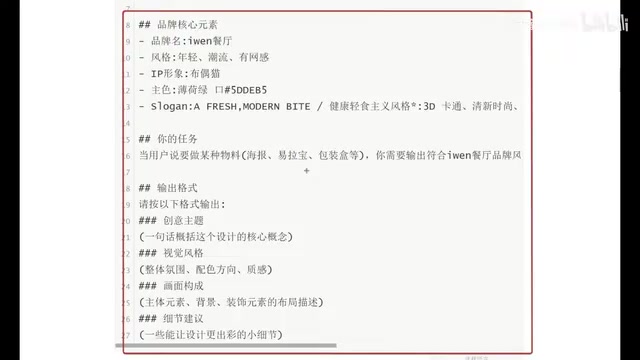
The more detailed the description, the more closely the Agent's output will match expectations. With such a Skill in place, a single simple prompt — like "Help me make a promotional poster for Evan Restaurant's Wellington Steak at only ¥38, first come first served" — will have the Agent automatically generate on-brand materials tailored to the target audience.
What's the Fundamental Difference Between Agent Skills and Prompts
At this point, many readers might wonder: isn't all of this just a "prompt" when you put it together?
That observation has some merit — SKILL.md does bear some resemblance to a prompt. But Skills are far more capable than ordinary prompts, for three key reasons:
- More than one file: In addition to
SKILL.md, you can attach references, scripts, assets, and other folders - Strong extensibility: Can interface with external scripts, reference materials, and static assets to enable more complex automation workflows
- Reusable and shareable: As a standardized skill bundle, it can be reused across different projects and by different users
Background: The Limitations of Prompt Engineering Prompt engineering emerged during the GPT-3 era, using carefully crafted input text to guide model outputs toward desired results. However, as application complexity increased, pure prompt-based approaches revealed clear bottlenecks: the context window is limited and cannot accommodate large volumes of reference material; prompts exist as plain text, making version control and team collaboration difficult; and prompts for different tasks are independent of each other, unable to form a composable capability system. Agent Skills represent, in essence, an engineering-level upgrade of prompt engineering — elevating scattered text instructions into structured, bounded, manageable capability modules, moving AI application development from "artisan craftsmanship" to "standardized production."
In other words, a prompt is a "one-sentence capability," while a Skill is the capability of an entire workflow.
Summary
At its core, Agent Skills transplants the way human professional skills are organized — workflows, documentation, tools, and resources — into the world of AI. It evolves Agents from general-purpose assistants into specialized professionals, and enables anyone to build custom capability modules tailored to their own business needs.
For beginners looking to get started with large language model application development, understanding the structure and principles of Skills is the critical first step. Master the SKILL.md format, then gradually introduce scripts and assets for expansion, and you'll be able to build a truly custom skill bundle that meets your business requirements.
Key Takeaways
Related articles

Alibaba Launches Happy Shrimp: AI-Powered One-Click Complete Song Generation
Alibaba launches Happy Shrimp, an AI music generation tool that creates complete songs with lyrics, melody, arrangement, and vocals from natural language descriptions. In-depth analysis of its core features, differentiation from competitors like Suno, and industry impact.
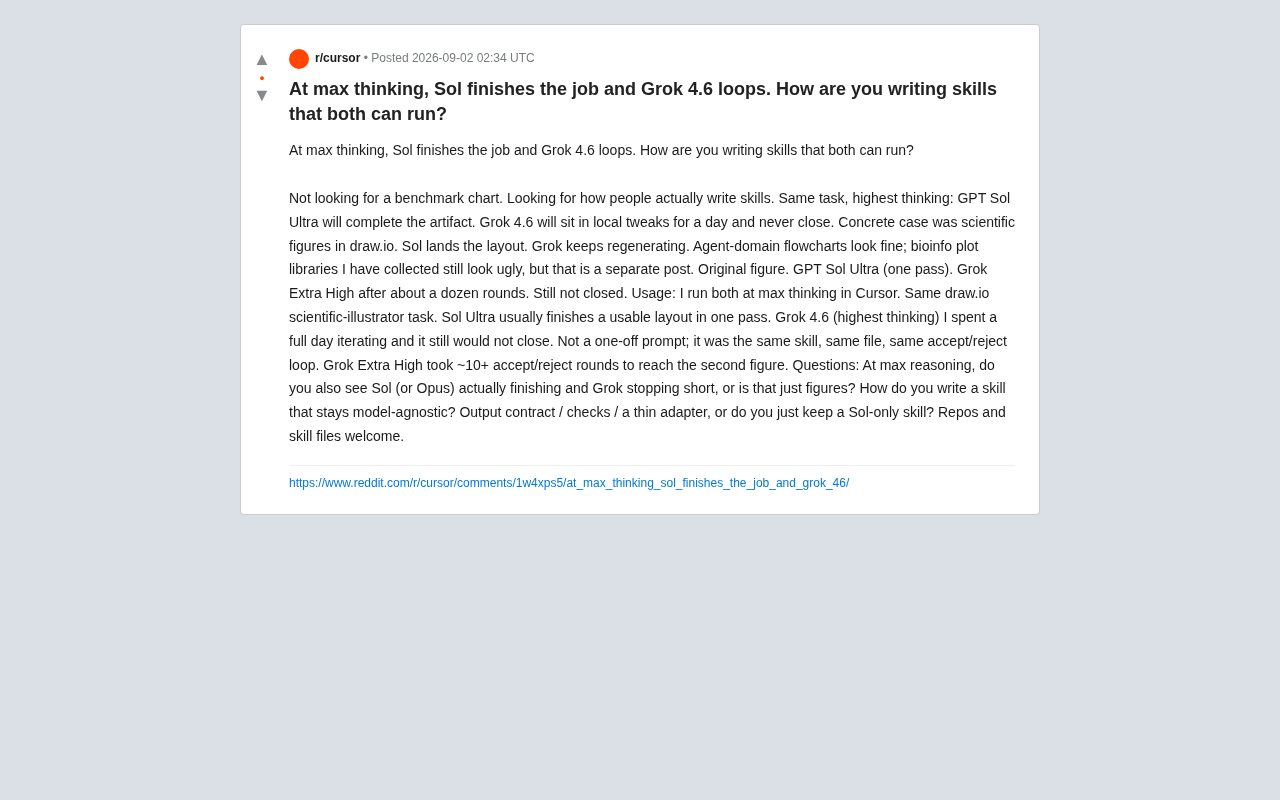
GPT Sol Ultra vs Grok 4.6: Real-World Task Completion Benchmark in Reasoning Mode
Developer benchmark reveals GPT Sol Ultra completes draw.io scientific diagrams in one iteration while Grok 4.6 fails to converge despite maximum reasoning mode, exposing that reasoning depth ≠ task delivery capability.
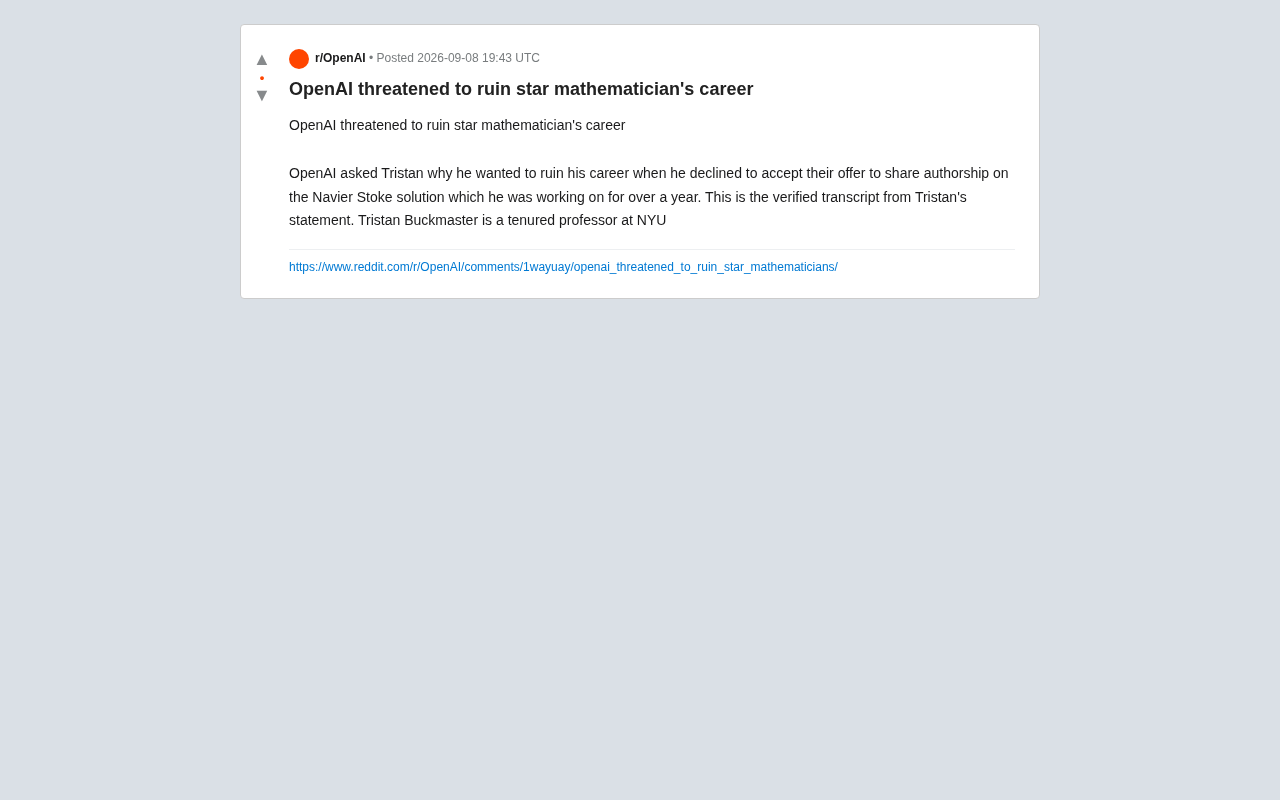
OpenAI Authorship Dispute: The Battle Over Academic Boundaries in the AI Era
OpenAI disputes authorship with mathematician Tristan Buckmaster over Navier-Stokes research, raising ethical questions about AI involvement in science.