Getting Started with AI Agent Development: A Complete Learning Path for Enterprise-Grade Agents

A Bilibili creator's 3-month AI Agent course covers everything from core principles to enterprise-grade projects.
This article reviews a structured AI Agent development course created by a Bilibili content creator. Built over three months to address the fragmented state of existing tutorials, the course covers three stages: Fundamentals (principles and environment setup), Advanced (tool calling and multi-agent collaboration), and Practical Projects (enterprise use cases). It includes frameworks like LangChain, CrewAI, and Dify, along with companion resources such as mind maps, source code, and real interview questions. The article affirms the course's structural value while cautioning learners to look past marketing language and treat it as a starting point rather than a complete solution.
A Structured AI Agent Course for Complete Beginners
As large language models continue to grow more capable, AI Agents have moved from concept to reality, becoming a focal point for developers and enterprises alike. A Bilibili creator recently launched a brand-new, systematically designed AI Agent development course — one aimed at addressing a common problem with existing tutorials: they're scattered and lack coherent structure.
According to the creator, he spent a month revisiting the topic from a beginner's perspective, studying everything from Bilibili's most-viewed viral tutorials to obscure videos with just a few hundred plays. His conclusion: most existing content is "not systematic enough and not complete enough." He then spent three months consolidating the key knowledge points across the platform into a course that blends theory with hands-on practice.
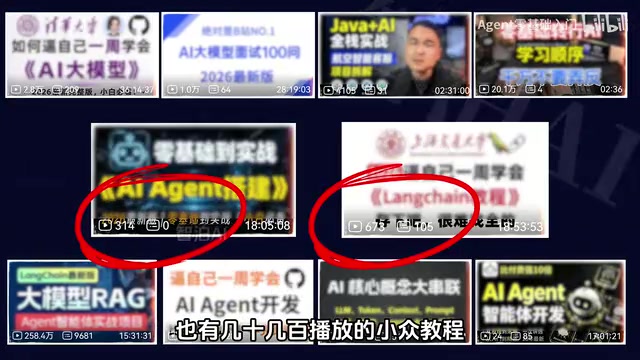
This observation is worth taking seriously. The AI Agent space evolves rapidly, frameworks update constantly, and fragmented tutorials tend to cover only isolated pieces of the puzzle — making it hard for learners to build a comprehensive mental map. A course that connects foundational principles all the way through to real-world implementation genuinely fills a gap.
Course Structure: Three Stages — Fundamentals, Advanced, and Hands-On
The course is organized into three modules: a Fundamentals section, an Advanced section, and a Practical Projects section, forming a relatively clear and progressive learning path.

Fundamentals: From Core Principles to Environment Setup
The fundamentals module starts with the core principles behind AI Agents, covering environment setup, Prompt Engineering, and calling large language models — the essential building blocks. This section forms the foundation of the entire curriculum. Understanding how an Agent works — the closed loop of perception, planning, tool invocation, and execution — is a prerequisite for everything that follows. Prompt engineering and model interaction are the basic skills that determine the stability and quality of an Agent's output.
The core operating mechanism of an AI Agent is commonly described as the "Perceive–Plan–Act" loop. In practice, an Agent receives input from the user or environment (perception), uses an LLM to decompose and reason about the task (planning), then executes specific operations via function calls or API requests (action), and feeds the results back to the model for the next round of reasoning. This loop enables Agents to handle multi-step tasks requiring dynamic decision-making — far beyond simple one-shot Q&A. ReAct (Reasoning + Acting) is one of the most widely used Agent reasoning frameworks today; it alternates between generating "thought" and "action" steps in the model's output, making the reasoning process more transparent and debuggable. Understanding this underlying mechanism helps learners grasp why certain design choices are made in later framework work, rather than blindly copying API calls.
Advanced: Tool Calling and Multi-Agent Collaboration
The advanced module focuses on two core capabilities: tool calling development and multi-agent collaboration. These are precisely what set Agents apart from ordinary conversational models — the ability to extend their reach by invoking external tools, and the ability to divide complex tasks among multiple agents working in concert.
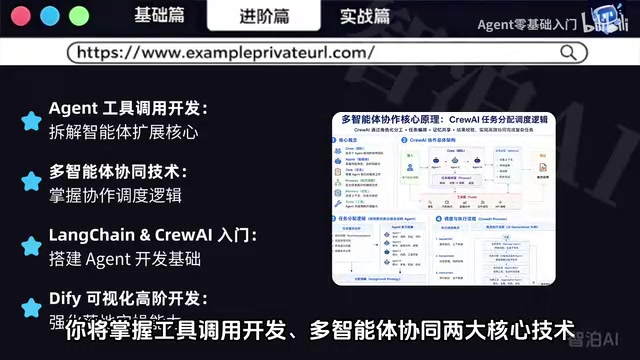
On the framework side, the course covers LangChain, CrewAI, Dify, and other mainstream tools. Each has its own emphasis: LangChain is a general-purpose framework for building LLM applications with a mature ecosystem; CrewAI specializes in multi-agent orchestration; and Dify is a low-code application development platform. Mastering these frameworks is a practical necessity for deploying Agent solutions in the real world.
Tool Calling (also known as Function Calling) is a critical capability extension mechanism in modern large models. Developers provide the model with structured descriptions of external tools — such as search engines, database queries, code executors, or third-party APIs. During inference, the model determines when and which tool to call, generates properly formatted parameters, and the runtime environment executes the call and returns the result for the model to continue processing. OpenAI officially introduced the Function Calling interface in 2023, and most major model providers have since adopted similar mechanisms — making tool calling a standard paradigm in Agent development. Multi-agent collaboration extends this further: different Agents each have their own role definitions and toolsets, and they work together through message passing or shared state to handle complex workflows that a single Agent couldn't manage alone. Common patterns include the Orchestrator-Worker architecture and decentralized peer-to-peer collaboration.
Practical Projects: Enterprise-Grade, Project-Driven Learning
The practical module is driven by enterprise-grade projects. Case studies include a multi-agent collaborative office system, an enterprise knowledge base agent, an automated data analysis Agent, and an intelligent customer service Agent. These scenarios cover the most prevalent real-world AI Agent use cases in enterprise settings — knowledge base and customer service agents in particular represent high-adoption, production-ready applications. Project-driven learning helps integrate scattered concepts into deliverable, job-ready skills.
Supplementary Resources and Learning Support
To lower the barrier for beginners, the course also comes with a set of companion resources.
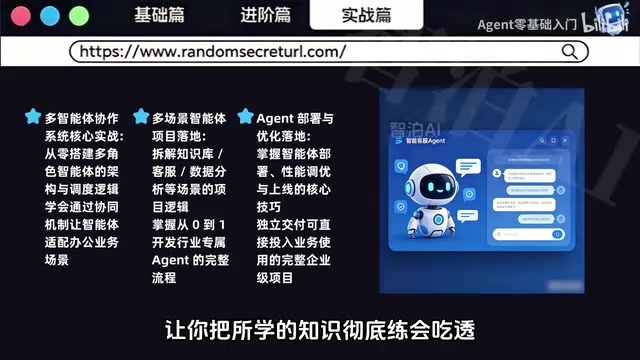
According to the creator, these materials include a comprehensive AI Agent learning mind map, hands-on source code from the videos, deployment tools and installation packages, lecture notes and slides, and beginner-friendly e-books. Also included are real interview questions from AI Agent positions at major tech companies, along with industry reports — intended to bridge the gap between learning and employment.
These companion resources offer real practical value for self-learners. Mind maps help build a structured knowledge framework; source code and deployment tools shorten the distance between understanding something conceptually and actually getting it running; and interview questions reflect what the industry genuinely expects from Agent-related roles.
A Realistic Assessment of This Type of Structured Course
Based on publicly available information, this course is well-structured in its design, covers the key aspects of AI Agent development, and selects frameworks that align with the current mainstream ecosystem. For learners who want a systematic introduction, this kind of structured content is genuinely more accessible than a patchwork of standalone videos.
That said, a realistic perspective is warranted. Phrases like "get hired after finishing" and "master everything" in the title carry obvious marketing overtones. Actual learning outcomes still depend on individual effort and hands-on practice. The AI Agent space evolves quickly, and no course is immune to the passage of time — framework versions and API interfaces can change at any moment. Treat the course as a starting point for building your mental model, not a one-and-done destination.
For beginners, the recommended approach is: focus first on deeply understanding the principles in the fundamentals module; in the advanced and practical stages, actively reproduce the projects yourself; then supplement with official documentation to stay current with the latest framework changes. Tools will get updated, but a solid understanding of how Agents actually work has lasting value.
Framework version churn in the AI Agent space is notoriously fast. LangChain, for example, underwent a major architectural overhaul between v0.0.x and v0.2.x during 2023–2024, rendering some early tutorial code incompatible with newer versions. CrewAI and Dify similarly maintain a high pace of updates. This means courses recorded against a specific framework version will often see breaking interface changes within six to twelve months. The most effective strategy is to treat the course as a vehicle for understanding design philosophy and engineering patterns — and when code throws errors, go straight to the framework's official Changelog rather than trying to replicate the course content verbatim. Building the habit of reading official documentation is the core skill for staying effective as a long-term learner in this fast-moving field.
Related articles

Uber Deploys ChatGPT Work Company-Wide: AI in the Workplace Enters the Scaled Implementation Phase
Uber deploys ChatGPT Work to 30,000+ employees, extending it from engineering to all roles. We analyze its expert-engineer pairing, end-to-end automation, and questions of AI control and power concentration—insights for scaling AI in the workplace.

Shift at Midnight Hands-On: When "ID Verification" Becomes Alien Hunting
Shift at Midnight blends ID verification with horror survival in a four-player co-op game. We break down its inspection mechanics and chaotic humor.

Zelensky Recounts the Outbreak of War: I Need Ammunition, Not a Ride
Zelensky recalls the first day of war in a YouTube interview: farewell to family, rejecting Biden's evacuation offer with "I need ammunition, not a ride," and how Bucha shaped his stance on compromise and peace talks.