Getting Started with AI Agents: Core Definitions and AI Agent Workflow Explained

An Agent is an iterative execution system combining an LLM with tools, replacing AIGC as the mainstream.
Using OpenClaw's 2026 Spring Festival surge as an entry point, the article explains that the agent concept has gone mainstream, yet general tools can't serve vertical domains, so developers must understand Agents to build customized solutions. It defines an Agent as an LLM (brain) plus tools (hands) that iteratively understand tasks, select tools, and re-reason until completion. It compares AIGC and AI Agents across capability, interaction, output, and external interaction, concluding Agents represent the future.
Starting from the OpenClaw Craze: Why We Need to Understand Agents
During the 2026 Spring Festival, the explosive popularity of OpenClawAd (commonly known as "Lobster") brought the concept of agents into the mainstream. Both enterprises and individuals are trying to use OpenClaw to boost efficiency. But as developers, we should think more carefully: how can we build highly customized agents tailored to a company's specific business? After all, general-purpose tools can't dig deep into vertical domains, so secondary encapsulation becomes inevitable. Behind all this lies a fundamental question: what exactly is an agent?
The Core Definition of an Agent: Combining LLMs with Tools
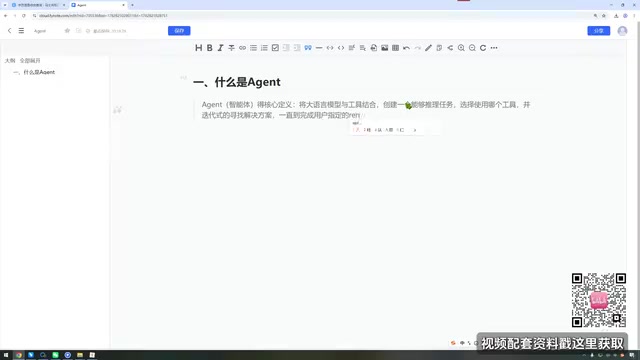
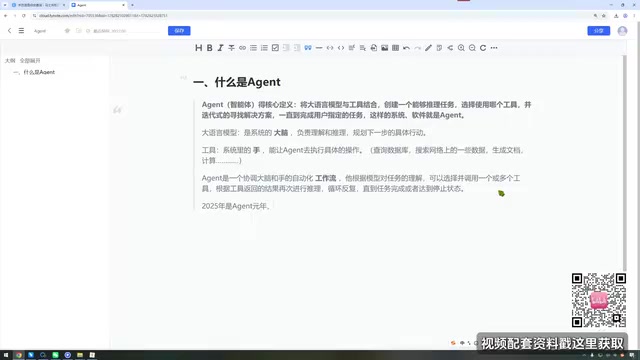
An Agent is a system that combines a large language model with tools to create something capable of reasoning about tasks, choosing which tool to use, and iteratively looping toward a solution until the user's specified task is complete. Simply put, Agent = Brain (LLM) + Hands (Tools).
The large language model (such as GPT, Claude, Gemini, etc.) is responsible for understanding, reasoning, and planning the next action; tools carry out concrete operations like querying databases, searching the web, generating documents, or performing calculations. The Agent coordinates the two into an automated workflow: the model understands the task → selects and invokes one or more tools → reasons again based on the tool's returned results → loops until the task is complete or a stopping state is reached. The stopping condition is likewise determined by the large model.
Note that everyday chatbots like Doubao are not strictly Agents—they simply connect to a model for Q&A, whereas an Agent must be able to actually "do things."
The ReAct loop is the key paradigm for understanding how Agents operate. ReAct (Reasoning + Acting) was proposed by Shunyu Yao et al. in 2022. Its core idea is to have the large model alternate between "reasoning" and "acting": the model first outputs a thought explaining the current task progress and next-step intent, then invokes a tool to perform an action, observes the returned result, and continues reasoning—looping in this way. This "thought—action—observation" closed loop is precisely the theoretical origin of what the original text describes as "reasoning about tasks, selecting tools, and iterating in a loop." Alongside it is the Tool/Function Calling mechanism: developers describe each tool's name, purpose, and parameters using a structured schema, and the model uses this to decide which tool to call and what arguments to pass, after which the platform returns the call result to the model. ReAct and Function Calling together form the underlying foundation of modern Agent frameworks.
AIGC vs AI Agent: Comparing Core Capabilities and Interaction Models
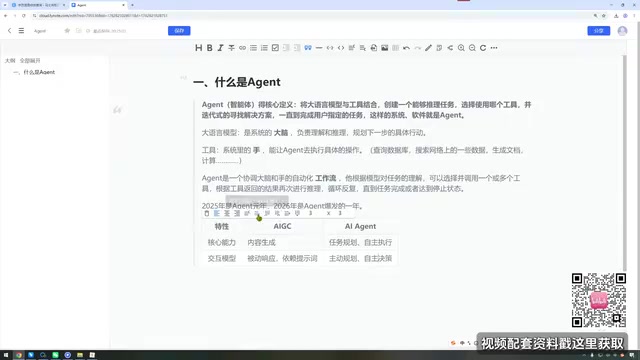
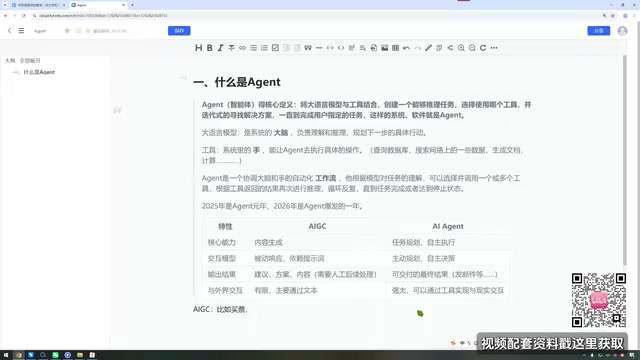
2025 was regarded as the first year of Agents, but it was the emergence of OpenClaw during the 2026 Spring Festival that truly set things off. The rise of Agents has also brought a shift in concepts: what was hot before was AIGC (AI-generated content), and now it's AI Agents. The key differences between the two are as follows:
- Core capabilities: AIGC focuses on content generation (writing articles, drawing images, editing videos), whereas Agents can plan and autonomously execute large tasks. For example, in producing a short drama, AIGC can generate the script, storyboard, images, and video, but cannot connect the entire pipeline; an Agent can handle it end to end.
- Interaction model: AIGC responds passively and depends on precise prompts; Agents actively plan, make autonomous decisions, and try to deliver the optimal solution through a workflow.
- Output: AIGC provides suggestions, plans, or content that require subsequent human processing; Agents deliver executable results, such as code generation, testing, deployment and running, or sending emails, compiling reports, querying databases, and so on.
- Interaction with the outside world: AIGC interacts mainly through text (and images); Agents can interact with the real world through tools, such as ordering takeout or buying high-speed rail tickets.
Take buying a ticket as an example: AIGC can only query train schedules and tell you to go buy on 12306; an Agent (like OpenClaw) can directly complete the entire process of seat selection and payment.
The difference in Prompt Engineering is the technical root that distinguishes AIGC from the Agent interaction model. In AIGC scenarios, users need to provide a precise, complete prompt in one shot, and the model generates the result in a single turn—prompt quality almost determines the output ceiling. In Agent scenarios, prompts serve more to "set goals" and "define system roles," while the specific execution path is decided autonomously by the model across multiple loops. This also brings new engineering problems: Agents need system prompts to constrain behavioral boundaries, context management to cope with the token bloat accumulated over multi-turn conversations, and stopping conditions to prevent infinite loops. As a result, the focus of Agent developers shifts from "polishing the wording of a single sentence" to "designing tool sets, planning workflows, and setting constraints"—which is the deeper reason why general-purpose tools are hard to reuse directly and must be secondarily encapsulated.
The Present and Future of Agents: Mainstream Already, Iterating Fast
Agents have moved from trend to mainstream. There was OpenClaw at Spring Festival; a new hit may emerge mid-year, and an even more powerful agent may arrive by year's end—the pace of iteration is extremely fast. Traditional AIGC still has its place—quickly answering detailed questions (such as vehicle dimensions)—but when it comes to concrete work tasks, the Agent is the primary operator. Companies across industries are moving toward AI Agents.
Large models alone cannot substantially improve work efficiency or everyday convenience (such as shopping), whereas Agents can execute tasks and actions. Today, AIGC and AI Agents complement each other, but Agents undoubtedly represent the future.
Understanding the definition and working principles of Agents is the foundation for every developer to stay competitive in the age of agents.
One-line Summary
An Agent is an iterative execution system combining an LLM with tools, and it is replacing AIGC as the mainstream.
Paragraph Summary
Using the explosive popularity of OpenClaw during the 2026 Spring Festival as an entry point, the article notes that the agent concept has gone fully mainstream, but general-purpose tools cannot dig deep into vertical domains, so developers need to understand the essence of Agents to build highly customized solutions. The article gives the core definition: an Agent is the combination of a large language model (the brain) and tools (the hands), completing goals through an iterative loop of understanding the task, selecting tools, and reasoning again based on returned results—with the stopping condition also decided by the model—which is fundamentally different from chatbots that only do Q&A. The article further compares AIGC and AI Agents across four dimensions: core capabilities, interaction model, output, and interaction with the outside world: AIGC passively generates content, while Agents actively plan and deliver executable results. Finally, it points out that Agents have become mainstream and are iterating rapidly; AIGC can still assist with detailed Q&A, but Agents represent the future.
Related articles

Random Pruning of the DPO Computation Graph: 1.4x Training Speedup and Lower Peak Memory
DPO training too slow and memory-hungry? This paper proposes a random pruning framework for the DPO computation graph, sampling independently across position, sequence, and branch dimensions; branch pruning achieves a 1.426x step-time speedup and cuts training time by about 30%, with in-depth attribution of memory and time gains.

Why Does JEPA Underperform MLM in Longitudinal EHR Representation Learning?
New study compares JEPA and MLM for longitudinal EHR representation learning on MIMIC-IV: three JEPA variants train stably without collapse but underperform MLM; target size, not heterogeneity, drives prediction error.

Transfer Learning + Visible Light Communication: A New Approach to Energy-Efficient Indoor Positioning
A study proposes a transfer learning-based visible light communication indoor positioning method, achieving 47% accuracy improvement on the BOSCH factory dataset, 67.5% model efficiency under high noise, and introducing the ME composite metric for energy-efficient positioning in energy-constrained industrial IoT scenarios.