Getting Started with AI Large Models: A Complete Technical Overview from Machine Learning to Agents

A beginner's roadmap from machine learning fundamentals to LLMs and AI Agents.
This article systematically traces the evolution from artificial intelligence and machine learning through deep learning and the Transformer architecture to today's large language models (LLMs). It explains core generative AI principles, compares mainstream models like GPT, Claude, and Gemini, and looks ahead to the rise of AI Agents — helping beginners build a complete understanding of the modern AI landscape.
Before diving into large model application development, many beginners find themselves overwhelmed by a flood of concepts: artificial intelligence, machine learning, deep learning, generative AI, large language models (LLMs) — how do they all relate to each other? Some assume ChatGPT is the entirety of AI; others think large models are completely independent technologies. In reality, there's a clear evolutionary thread connecting all these concepts. This article traces that technical lineage to help you build a solid foundational understanding.
Artificial Intelligence: A Technical Field, Not a Single Product
At its core, artificial intelligence (AI) is the study of how to give computers or machines capabilities similar to human learning, understanding, reasoning, and action. Two keywords stand out: machine and intelligence. The subject of study isn't humans themselves, but rather computer programs, software systems, or robots.
Expectations around "intelligence" vary wildly. If your benchmark is Jarvis from the movies — possessing self-awareness, capable of independent thought and action — then current technology falls far short. But if the standard is "completing tasks that previously required humans," then the voice assistant on your phone and the route planning in your maps app already fall within the scope of AI applications.
Therefore, AI isn't a specific product but an entire technical field encompassing computer science, mathematics, statistics, linguistics, and even neuroscience. From an engineering perspective, what we should really focus on is: Can AI help me solve real problems? — rather than debating whether it possesses consciousness.
Two Landmark Moments: Deep Blue and AlphaGo
There are two key milestones in AI history. In 1997, IBM's Deep Blue defeated world chess champion Garry Kasparov; in 2016, AlphaGo defeated world Go champion Lee Sedol.
Deep Blue demonstrated that in domains with clearly defined rules, machines can surpass humans through sheer computational power. It relied on search algorithms: analyzing vast numbers of possible moves in advance, evaluating the win probability of each option, and selecting the optimal move.
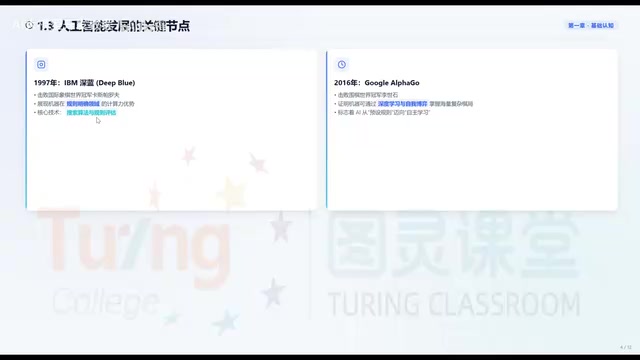
But this approach requires that rules can be predefined programmatically. Many real-world tasks — such as writing an article, analyzing complex information, or determining whether a picture contains a cat — have no clear rules to follow. This was the bottleneck of traditional AI, and it drove the arrival of the next stage.
Machine Learning: Letting Machines Discover Patterns from Data
The logic of traditional AI was "humans tell the machine the rules first," but in reality, we often don't know what rules to provide. Enter machine learning: instead of directly telling the machine the answers, we let it discover hidden patterns through large amounts of data.
Take cat-vs-dog recognition as an example. The traditional approach involves manually defining rules like "cats have pointed ears, dogs are larger," but real-world photos vary wildly in angle, lighting, and other conditions — rules simply can't cover every case. Machine learning takes a different approach: feed the model massive amounts of data and let it learn on its own.
Machine learning has three classic paradigms:
- Supervised Learning: Give the machine "questions + answers." Each image is labeled (Image A is a cat, Image B is a dog), and the machine learns the correspondence between images and labels. Spam detection and financial risk management both fall into this category.
- Unsupervised Learning: Data has no labels; the machine finds patterns on its own. For example, given large amounts of user data (age, browsing habits, purchase history), the model independently discovers which users behave similarly, enabling customer segmentation.
- Reinforcement Learning: Behavior is adjusted through trial-and-error and feedback. Like a child learning to walk — fall down, adjust; succeed, receive positive feedback.
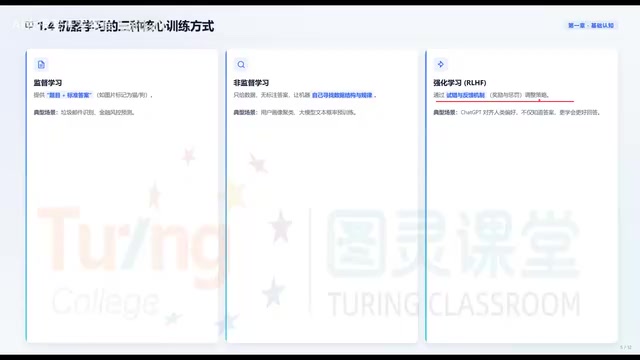
Reinforcement learning is particularly important in the large model domain. After ChatGPT completes its base training, it still needs further optimization through RLHF (Reinforcement Learning from Human Feedback) — because knowing a lot of information doesn't mean the model knows which answers better meet user needs or are safer. Simply put, it's about making the model not only know the answer but also know how to answer better.
Deep Learning and Transformer: The Foundation of Modern Large Models
As tasks like image recognition, speech understanding, and natural language processing grew more complex, traditional machine learning hit a ceiling. Deep learning emerged as a crucial branch of machine learning, with neural networks as its core technology.
Inspired by how neurons connect in the human brain, neural networks link together large numbers of computational nodes, processing information through multiple layers: the first layer learns edges and colors, the second learns shapes and structures, the third learns object compositions. The "deep" in deep learning refers to the number of layers — more layers enable richer levels of information learning. Of course, early deep learning faced the problem of information loss during multi-layer transmission. The later introduction of residual connections, which allow information to pass directly across layers, became a critical foundation for modern deep learning.
Attention is All You Need: The Breakthrough of the Attention Mechanism
In 2017, eight researchers at Google published the paper Attention is All You Need, proposing the Transformer architecture — the key foundation of modern large models.
The challenge of human language is that the same word can mean different things in different contexts. For example, "This project is too hard" could refer to technical complexity, difficulties in execution, or simply be an emotional expression. Traditional computers couldn't understand context, and therefore couldn't truly understand language.
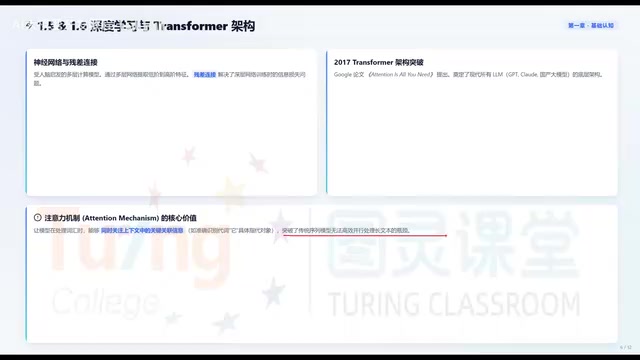
The core of Transformer is the attention mechanism. Take the sentence "Apple released a new phone, and it was well-received by many users." The attention mechanism enables the model, when processing the word "it," to automatically focus on "Apple phone" earlier in the text, thereby establishing an accurate semantic connection. More importantly, compared to traditional Recurrent Neural Networks (RNNs) which tend to "forget" earlier content in long texts, Transformers can analyze multiple parts of the text simultaneously, making it possible to process longer and more complex information. This also laid the groundwork for the large model development trajectory of "scaling up models, increasing data, and boosting compute power."
Generative AI and Large Models: From Judgment to Creation
Looking back at the AI development path — from rules, to machine learning, to deep learning, to Transformer — a clear shift emerges: past AI was primarily focused on classification and judgment (detecting spam, recognizing images), while the biggest breakthrough of generative AI lies in creating something from nothing.
Previous AI answered "What is this thing?" Today's large models can answer "Create something new based on your needs" — writing articles, generating code, creating images.
Large Language Models (LLMs) are AI systems trained on massive text datasets that can understand and generate natural language. Three major factors drive their explosive growth: the accumulation of data at scale, the leap in compute power (GPU clusters), and the architectural breakthrough (Transformer) — ultimately achieving a qualitative transformation from quantitative growth.
How Ordinary People Can Get Started with Large Models
Many people ask: Do I need to deeply study the underlying technology to learn about large models? It depends.
If your goal is to become an AI researcher developing new model architectures, then yes, you need a strong foundation in mathematics, statistics, and algorithms. But for the vast majority of people looking to enter the AI application space, the goal isn't to build a new large model from scratch, but to learn how to use one — developing practical applications on top of existing large models, such as building enterprise knowledge bases or developing intelligent customer service systems.
It's like after the automobile was invented: most people didn't need to study engine mechanics — they just needed to learn how to drive to improve their commute. The most fitting role for large models today isn't to completely replace a job, but to serve as highly efficient assistants, handling large volumes of repetitive work and freeing people to focus on goal-setting, decision-making, and creative work.
Guide to Choosing Mainstream Large Models
- OpenAI GPT Series: The most globally influential, covering a wide range of scenarios including code assistance, knowledge Q&A, and data analysis.
- Claude: Excels at long-text analysis and logical reasoning, highly popular among developers.
- Google Gemini: A multimodal model capable of processing text, images, audio, and video.
- Chinese Models: Alibaba's Qwen (open source), Baidu's ERNIE series, and the increasingly notable DeepSeekAd.
There's no definitive answer on which model to choose — it depends on your task, usage environment, and objectives. Enterprise scenarios also require additional consideration of data security, support for private deployment, and cost control.
Future Direction: Agents Will Transform AI Application Paradigms
Looking ahead, large models will evolve in three directions: continuously enhanced capabilities (reasoning, coding, multimodality), industry specialization (domain-specific large models for finance, law, and healthcare), and the rise of AI Agents.
Agents don't just answer questions — they form an intelligent closed loop of "perceiving goals → planning steps → invoking tools → executing tasks." For example, ask one to "analyze this year's company sales performance," and it can automatically read the data, analyze trends, generate a report, and offer recommendations. This will be the most important application paradigm in the coming years, and the critical stepping stone from "getting started" to "enterprise-level implementation."
Related articles

Amphibious Transforming Drone: Beyond 100x Power Savings, What Are the Real Needs?
Is the amphibious transforming drone just a gimmick? Starting from the 100x power difference of the M4 Morphobot, explore real application scenarios and thesis topic ideas, analyzing boundary conditions where pure drones and pure ground robots both fail.

Warhound Raises $200 Million: Genetically Engineered "War Dogs" Paired with Anduril Gear
Warhound raises $200M, backed by Ben Lamm and Palmer Luckey, to genetically engineer dogs for military and law enforcement use and equip them with Anduril gear. This article analyzes its technology direction, funding logic, and ethical controversy.

Claude API Comes to Google Cloud: IAM Integration and SDK Access Guide
Anthropic hosts the full Claude API on Google Cloud with IAM-controlled permissions and unified billing. This guide covers the Vertex AI and Anthropic-hosted entry points, IAM role configuration, and SDK access.