Getting Started with Codex: The Right Way to Use AI Coding Agents

A practical guide to getting started with Codex and understanding AI coding agents vs. large models.
This article explains the key differences between AI agents and standalone large models, compares Codex and Claude Code through hands-on testing, and provides practical guidance for beginners. It covers why Codex currently offers the best overall experience, how agents must be paired with underlying models, and how to overcome the first hurdle of GPT account registration for users in China.
From Large Models to AI Agents: A Conceptual Upgrade
Before diving into Codex, it's important to clarify a commonly confused concept: AI agent tools and standalone large models are two different things.
If we compare a large language model to a "brain," it excels at thinking, analyzing, and generating content, but essentially can only "talk" — it can't actually execute tasks, modify files, or run commands for you. Tools like Codex and Claude Code, on the other hand, are like giving that brain "hands, feet, and tools." They can read your project code, invoke the terminal, execute operations, and translate thinking directly into action.
From a technical perspective, the core characteristics of AI agents include three capabilities: perceiving the environment (reading codebases, understanding project structure), autonomous decision-making (planning task steps, choosing execution strategies), and executing actions (writing files, running commands, calling APIs). In computer science, the concept of Agents can be traced back to distributed artificial intelligence research in the 1980s, but it wasn't until the breakthrough in large model capabilities in 2023-2024 that they became truly practical. Modern AI agents typically employ the ReAct (Reasoning + Acting) paradigm — reasoning first, then acting — forming an "observe-think-execute" loop. This is exactly the underlying working logic of Codex and Claude Code when handling complex programming tasks.
This is also why these tools are called "agents" rather than "chatbots." Understanding this distinction is the first lesson in getting started with AI programming.
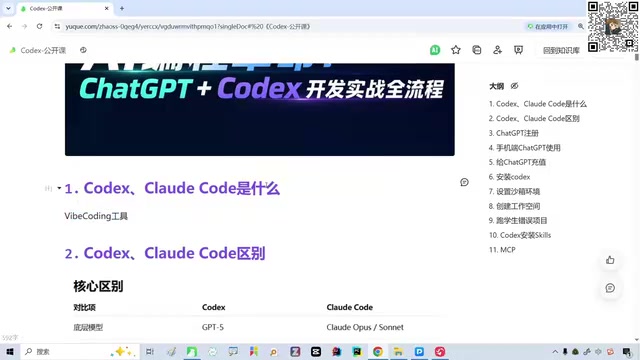
Why Choose Codex and Claude Code
Among the many AI programming tools available, Codex and Claude Code currently sit firmly in the "first tier" and are the two most widely used among programmers. Whether or not you can code, these tools are becoming essential industry skills that everyone should master.
This point deserves elaboration. Traditional thinking holds that AI programming tools are exclusive to programmers, but the reality is: even if you don't know Java, can't write Python, and know nothing about the underlying mechanics of large models, you can still use these agent tools to complete real projects. Technical barriers are being rapidly leveled by AI — "not knowing how to code" is no longer a reason for being unable to deliver software.
The "large model fundamentals" mentioned here refers to the technical foundation of mainstream large language models (such as GPT-4o, Claude 3.5/4, DeepSeek-V3, etc.). These models are all based on the Transformer architecture, trained on massive amounts of text and code data to gain powerful language understanding and code generation capabilities. You don't need to understand attention mechanisms or know what RLHF alignment is — you just need to describe your requirements in natural language, and the model will translate your intent into executable code.
For non-programmers, here's a practical suggestion: even if you don't need a full agent tool right now, you should at least have access to GPT for daily queries and assistance — that alone is a valuable step.

Codex vs Claude Code: Hands-On Comparison
Bottom Line First: Codex Offers the Better Overall Experience
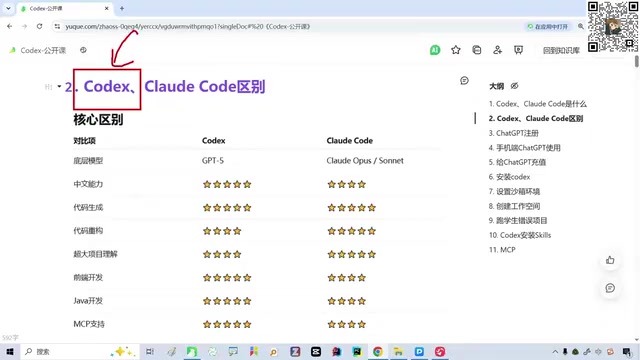
After simultaneously installing Codex, Claude Code, and several other tools for a side-by-side comparison, the hands-on conclusion is — Codex currently offers the best overall experience among AI coding agents.
This judgment is based on several dimensions:
- Stronger Chinese language comprehension: The model configured under Codex better understands Chinese-language contexts
- Better requirements analysis: More accurately grasps the functional intent you want to implement
- Solid full-stack development capabilities: Strong coverage across both frontend and backend development
- Rapidly growing MCP ecosystem: As a key product backed by OpenAI, its tool ecosystem is expanding quickly
Regarding MCP, a supplementary explanation is warranted. MCP (Model Context Protocol) is an open protocol standard proposed by Anthropic in late 2024, designed to solve the standardized connection problem between AI models and external tools/data sources. You can think of it as the "USB protocol" for the AI world — it defines a unified interface specification that allows databases, APIs, file systems, browsers, and other tools to connect to AI agents in a standardized way. OpenAI subsequently announced full support for the MCP protocol, making it quickly become a de facto industry standard. Codex's rapid adoption of the MCP ecosystem means it can connect to an increasingly rich set of external tools and data sources, continuously expanding its practical capabilities.
A Fair Caveat: Tool Choice Varies by Individual
It should be noted that "Codex is the best" is a judgment based on personal hands-on experience and current model capabilities — it's not an absolute conclusion. A broader trend is: foreign models are currently slightly ahead of domestic Chinese ones, but this gap is closing rapidly. When tools reach capability parity, the selection criteria will shift from "which is stronger" to "which offers better value for money."
Looking at industry data, since 2024, domestic Chinese models represented by DeepSeek, Qwen (Tongyi Qianwen), and GLM have approached or even partially surpassed GPT-4-level performance on multiple benchmarks (such as HumanEval for code generation, MATH for mathematical reasoning, and MMLU for comprehensive knowledge). The current gap is mainly reflected in three areas: stability in complex reasoning chains (the probability of "dropping the ball" in long-step tasks), context retention in multi-turn conversations, and reliability of tool calling (Function Calling). With the flourishing open-source ecosystem and continuous innovation in training methods — such as DeepSeek's MoE (Mixture of Experts) architecture breakthrough in inference efficiency — this gap is expected to narrow further within 2025. At that point, domestic users will have significantly more choices.
For users who have the means, I recommend trying both to experience the differences firsthand — after all, whether a tool works well ultimately comes down to whether it feels right in your hands.
Agents Must Be Paired with Models: The Unavoidable First Hurdle
Using any AI coding agent tool requires pairing it with an underlying large model. There's a notable cost difference here:
- Claude Code uses Claude models, which are relatively expensive
- To save costs, many people pair Claude Code with cheaper models like DeepSeek, but the hands-on experience isn't as good as the native solution
- Codex paired with GPT models offers the best overall value
Why must agents be paired with underlying models? Think of it this way: the agent itself is an "execution framework" that defines the procedural logic for reading files, invoking commands, and interacting with users; the underlying model is the "engine" driving this framework, responsible for understanding your natural language instructions, analyzing code logic, and generating solutions. An agent without a model is like a car without an engine — no matter how elegant the frame, it won't run. This also explains why the same agent tool performs noticeably differently with different models: the engine's performance directly determines the driving experience.

The Real Roadblock for Beginners: GPT Account Registration and Setup
For the vast majority of users in China, the first hurdle to mastering these tools isn't technical — it's registering and configuring a GPT account.
This pain point has even spawned a business — when these tools were at peak popularity, many people made money helping others register and configure GPT accounts. This speaks to two things: first, demand for these tools is genuinely strong, and second, information asymmetry at the onboarding stage still exists.
Specifically, the obstacles domestic users face include: network access restrictions, overseas phone number verification, payment methods (requiring foreign credit cards or virtual cards), and API Key application and configuration. Each of these steps is not complicated on its own, but stacked together they form a "compound barrier." The good news is that once you complete the initial setup, subsequent use is virtually frictionless — invest the effort once, benefit long-term.
Therefore, mastering the independent registration and configuration of a GPT account is the critical first step to completing this learning path with minimal detours. Once you've handled this foundational step, everything that follows — environment setup, core feature usage, and project work — falls into place naturally.
Final Thoughts
AI coding agents are transitioning from "programmers' toys" to "fundamental tools for every industry." Understanding the essential difference between agents and large models, choosing the right tool, and getting past the account configuration hurdle are tasks that everyone who wants to embrace AI productivity should complete.
From a longer-term perspective, we're at an inflection point in the software development paradigm. In the past, programming was a professional skill that required years of study to master; now, natural language is becoming the new "programming language." This doesn't mean programmers will lose their jobs — quite the opposite. Knowing how to precisely describe requirements, how to verify and debug AI-generated code, and how to architect complex systems — these "human-AI collaboration skills" are becoming the most valuable skill set of the new era.
Whether you're a seasoned developer or a complete coding novice, now is a great time to get hands-on with Codex.
Related articles

Gluetun VPN Disconnection Troubleshooting: Version-Pinned Users Should Upgrade to v3.41.3
Gluetun version-pinned users may face silent VPN disconnections breaking their arr stack. Learn how upgrading to v3.41.3 fixes the issue and tips to avoid it.

Trump Downplays AI Extinction Risk: 'Whoever Wins AI Wins' Sparks Controversy
Trump downplays AI extinction risks with 'Whoever wins AI wins,' sparking fierce debate over whether AI safety is an urgent reality or a future hypothetical.

David Sacks on AI Regulation: Frontier Models Don't Need Mandatory Legislative Constraints
David Sacks argues OpenAI and Anthropic can self-regulate frontier model development without external legislation. A look at the logic, controversy, and governance dilemmas involved.