Getting Started with DeepAgents: Sub-Agents and Its Place in the LangChain Ecosystem
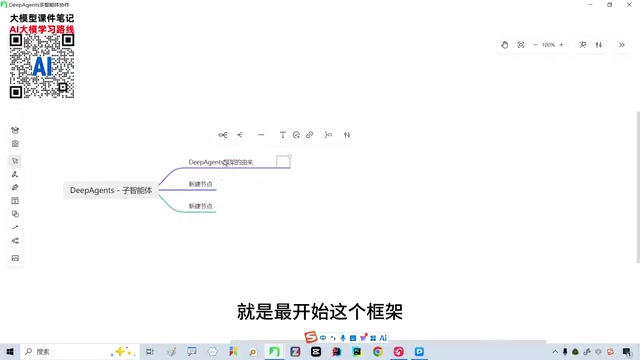
DeepAgents is the LangChain team's high-level framework for building stable, complex multi-agent systems.
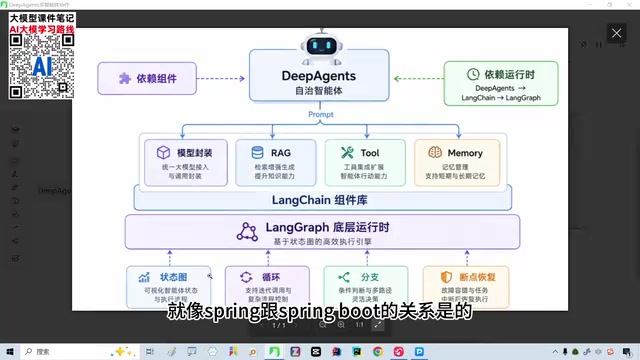
DeepAgents is a next-generation agent framework from the LangChain team, positioned above LangChain (component library) and LangGraph (execution engine) — much like Spring Boot is to the Spring ecosystem. Its core value is addressing enterprise needs for stable, long-horizon task execution without requiring manual assembly of low-level components. The framework introduces Sub-Agents with both synchronous (serial) and asynchronous (parallel) orchestration modes, enabling task decomposition and multi-agent collaboration. It has become the go-to architecture for enterprises building autonomous agents.
What Is DeepAgents: A New Framework from the LangChain Team
DeepAgents is a framework released by the LangChain team for building complex, long-running agent workflows. According to the official definition, its core goal is to make it easier for developers to create stable, long-running intelligent teams — and "stability" is really the key word for understanding the value of this entire framework.
Most developers are already familiar with LangChain and LangGraph. So why introduce yet another framework? The answer lies in the need for reliability in complex task scenarios. You can certainly build agents with LangChain + LangGraph, but when enterprises need agents that are more autonomous, more controllable, and capable of handling long-horizon tasks, a higher-level abstraction and orchestration layer becomes necessary — and that's exactly the problem DeepAgents is designed to solve.
DeepAgents' Position in the LangChain Ecosystem
LangChain itself is a large ecosystem made up of several core components:
- LangChain: Provides the building blocks — model wrappers, RAG, tool calling, memory management, context handling, and more;
- LangGraph: Provides the execution engine — think of it as the agent's "chassis," handling state management, loops, branching, and checkpoint recovery;
- LangSmith: Handles monitoring and observability for agents;
- DeepAgents: Stands on the shoulders of LangChain and LangGraph, assembling these capabilities into a more complete and robust agent architecture.
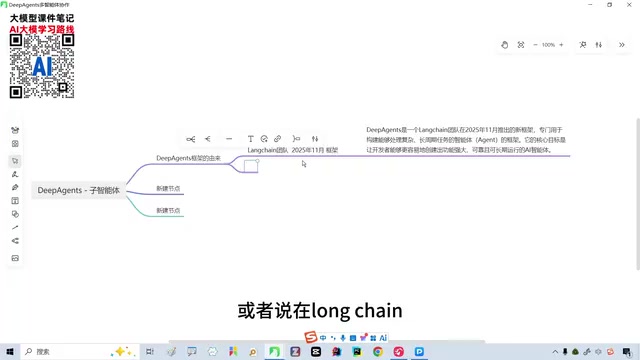
In other words, DeepAgents isn't a brand-new system built from scratch — it's a higher-level integration of existing capabilities. LangChain provides the raw materials, LangGraph provides the execution engine, and DeepAgents assembles them into a ready-to-use, more stable agent architecture.
A Fitting Analogy: Spring Boot
For developers with a Java background, the tutorial offers an intuitive analogy: DeepAgents is to the LangChain ecosystem what Spring Boot is to the Spring family.
When building Java applications, most developers rarely configure the low-level details of Spring and Spring MVC directly, because Spring Boot has already integrated those internals, freeing developers from tedious boilerplate configuration. Similarly, when using DeepAgents, you don't need to manually wire together LangChain's various components and LangGraph's flow controls — the framework handles that integration layer for you.
This analogy also addresses a common concern among beginners: even if your foundational knowledge of LangChain or LangGraph isn't deep, that won't stop you from understanding and using DeepAgents, because the underlying flow mechanics have already been abstracted away.
LangGraph, as the agent's "execution chassis," is worth a brief explanation. LangGraph models an agent's execution as a directed graph, where each node represents a processing step (such as calling an LLM, executing a tool, or evaluating a condition), and edges represent state transition paths. This design supports loops (the agent retries until a condition is met), branching (different paths based on context), and checkpoint recovery (pausing mid-execution, allowing human intervention, then resuming). It's precisely because LangGraph provides this fine-grained flow control that DeepAgents can deliver the stability required for long-horizon tasks — without forcing developers to design their own state machines or retry logic.
Why Sub-Agents Matter
The central topic of this tutorial is one of the most important concepts in DeepAgents: the Sub-Agent. In complex task orchestration, a single agent often can't handle everything on its own — tasks need to be broken down and delegated to multiple sub-agents working together.
There are two ways to create sub-agents:
- Synchronous sub-agents: Execute in sequence; the main workflow waits for a sub-task to return its result before proceeding;
- Asynchronous sub-agents: Can process tasks in parallel, suited for scenarios where multiple sub-tasks need to run simultaneously to improve overall throughput.
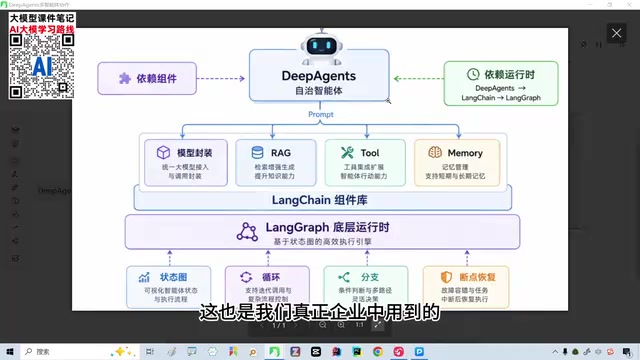
Understanding why this matters is more important than memorizing the API. A real-world agent workflow is rarely as simple as "user asks a question → agent answers directly." After receiving a query, an agent typically needs to analyze the problem, call tools, assess whether the available information is sufficient, trigger RAG retrieval when necessary, and potentially manage memory. Distributing these steps across different sub-agents is the key to building stable, complex agent systems.
The choice between synchronous and asynchronous sub-agents is fundamentally a question of task dependency. Synchronous mode fits "serial dependency" scenarios: sub-task B depends on the output of sub-task A and can't start until A finishes. Asynchronous mode fits "parallel independence" scenarios: multiple sub-tasks have no data dependencies on each other, can be launched simultaneously, and their results are aggregated at the end. For example, a market research agent might need to simultaneously retrieve competitor information, fetch industry reports, and analyze user reviews — three independent tasks that can be parallelized with asynchronous sub-agents to significantly reduce overall runtime. Correctly identifying task dependencies is a prerequisite for designing any sub-agent orchestration strategy.
A Learning Path Oriented Toward Enterprise Deployment
The tutorial places a special emphasis on a pragmatic principle: teach what enterprises actually use. When companies build more powerful, autonomous, and stable agents today, they're largely adopting architectures like DeepAgents — not building raw on top of LangChain or LangGraph directly.
For learners looking to enter the LLM application development space, this means aligning your learning path with real engineering practice. A solid progression starts with clarifying the layered relationship between DeepAgents, LangChain, and LangGraph, then dives into synchronous and asynchronous sub-agent orchestration.
Summary
At its core, DeepAgents is a high-level abstraction layer built by the LangChain team on top of their existing ecosystem, making it easier to build complex agents that run reliably over long periods. It leverages LangChain's component capabilities, runs on LangGraph's execution engine, and uses sub-agent mechanisms to decompose tasks and orchestrate collaborative workflows. Mastering how to create both synchronous and asynchronous sub-agents is the essential first step to effectively using this framework.
Related articles

Chain of Thought Isn't Just for AI: How Humans Can Use CoT to Improve Thinking Quality
Chain of Thought isn't just a prompt trick for large models. Starting from a Hacker News discussion, this article analyzes why CoT works for human thinking too, breaks down actionable ways to transfer it, and highlights the key differences between human CoT and machine CoT.
Cloudflare Teams Up with OpenAI: Closi…
Cloudflare Teams Up with OpenAI: Closing the Loop from Vulnerability Discovery to Defense with AI
Cloudflare uses OpenAI Daybreak to investigate security vulnerabilities and generate reviewable remediation plans, while developers use Codex to boost coding efficiency and quality.

Orca Multi-Agent Orchestration in Practice: A Guide to Parallel Collaboration with Claude and Codex
Orca is Stable AI's free open-source agent workbench supporting 34 agents like Claude Code and Codex in parallel. Learn its Git worktree isolation, multi-model orchestration, and mobile management.