Getting Started with n8n AI Automation: A Beginner's Guide to Building AI Agents

Open-source low-code platform n8n charges per run, self-hosting offers unlimited executions, helping you build AI agents at low cost.
n8n is an open-source, low-code automation platform that connects everyday apps, APIs, and AI models into complete workflows, and supports building AI agents that can reason, plan, and act autonomously. Compared with step-based tools like Zapier and Make, n8n charges by workflow runs, and the self-hosted community edition has no execution limit, saving about $200 to $700 per year. Building your first AI agent takes just three steps: form trigger, AI node processing, and data table storage. It has already been adopted in healthcare, marketing, and logistics, with System.io cutting operational time by 97% and Vodafone saving £2.2 million. The trade-off is that self-hosting requires 1 to 4 hours of initial setup and ongoing maintenance, and AI agents still need human oversight to prevent hallucinations.
If you're a creator, freelancer, or business owner, you've probably been burned by task-based automation tools—your workflow finally runs smoothly, and then the bill spikes. n8n is changing the rules of the game. It's an open-source, low-code automation platform that not only connects apps and APIs, but also lets you build truly autonomous AI agents.
What Exactly Is n8n
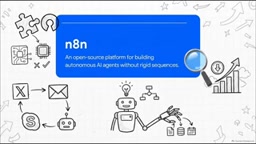
n8n positions itself as an open-source, low-code automation platform. You can use it to string together your everyday apps, APIs, and AI models into a complete automated workflow. Unlike traditional automation tools, n8n lets you build autonomous AI agents—agents that can reason, plan, and act on their own, without you having to pre-write fixed scripts for every possible scenario.
One user put it this way: n8n lets you integrate AI into your workflows in a safe, controllable way, and its value goes far beyond basic automation.
Low-code/no-code platforms refer to a category of tools that let you build applications or workflows through graphical interfaces (drag-and-drop, connectors, form configuration), so users don't need to master programming languages to accomplish work that would otherwise require a lot of code. "No-code" emphasizes never writing code at all, while "low-code" retains the ability to insert small scripts (such as JavaScript or Python) when necessary. n8n is a classic low-code platform: common operations are configured through nodes, and when you hit complex logic, you can embed code inside a node.
Autonomous AI agents are fundamentally different from traditional "automation scripts." A script has every step hard-coded and can only handle preset situations; an agent is driven by a large language model and can reason based on current input, break down tasks, choose which tools or APIs to call, and dynamically adjust its next action based on intermediate results. It typically consists of several parts—model, memory, tool calling, and planning—which is also the key value of n8n being able to connect various APIs and AI models.
Pricing Model: n8n's Biggest Differentiator
Platforms like Zapier or Make charge by step or module. A 10-step automation consumes 10 credits every time it runs. n8n charges by workflow runs, regardless of how many steps are inside. That means you can build extremely complex AI call chains without worrying about costs spiraling out of control.
More importantly: if you choose the self-hosted community edition, workflow executions are completely unlimited. For indie developers, students, and small teams, this may be the most attractive option. By one estimate, compared with alternatives, this model typically saves users $200 to $700 per year.

Self-hosting means deploying software on servers you control, rather than using a vendor's cloud service. This means your data, execution records, and keys stay in your own environment and never pass through third-party servers, giving you a natural advantage in compliance (such as HIPAA for medical data, or GDPR for European users) and avoiding cloud service execution-based billing.
There are several common ways to self-host: a cheap virtual machine from a cloud provider, an always-on home device, or a Docker container deployment. Docker is the easiest—just pull the official image and map the port and you're up and running. Note that the "free" in self-hosting mainly refers to free software licensing; server costs, backups, security updates, and troubleshooting are still your responsibility, which is the main trade-off compared with n8n Cloud.
Build Your First AI Agent in Three Steps
The process is much simpler than you'd imagine, and can basically be broken into three steps:
- Set up a simple web form as a trigger to receive user questions
- Pass the data into an AI node (such as a basic LLM chain) to let the model generate an answer
- Write the final result directly into n8n's data table for storage
The interface automatically handles the array data passing between nodes, so you don't need to write complex code and can focus your energy on tuning the quality of the AI's output. For beginners, the barrier to entry is quite friendly.
AI Applications in Real-World Scenarios
n8n's real-world cases already span multiple industries. In healthcare, there are HIPAA-compliant patient intake agents; marketing teams deploy vision-based AI scrapers to tailor customer outreach strategies; the logistics industry uses dynamic route optimization to save shipping time. There are also scenarios like automatically processing Stripe refunds and HR departments screening resumes.
The efficiency gains are substantial. System.io cut operational time by 97% after using n8n—a process that used to take 5 minutes was compressed to 10 to 20 seconds. Global enterprise Vodafone also used n8n to overhaul its threat intelligence process, saving £2.2 million.

How to Choose Between Free and Paid Versions
n8n offers two paths:
- n8n Cloud: $24 per month, includes 2,500 executions, zero maintenance
- Community edition: the software is completely free, executions are unlimited, but you need to host it yourself
Although the community edition software itself is free, you still need a server to run it. Typically, paying a hosting provider $4 to $7 per month is enough.
HIPAA (the U.S. Health Insurance Portability and Accountability Act) and GDPR (the EU General Data Protection Regulation) are two commonly mentioned compliance frameworks. HIPAA sets strict rules on the storage, transmission, and access of patient health information, and healthcare institutions usually require vendors to sign a Business Associate Agreement (BAA) when choosing tools; GDPR grants EU residents the right to be informed about their personal data, the right to erasure, and the right to data portability, and restricts cross-border data transfers.
This is precisely one of the core reasons for choosing self-hosting: data always stays on servers you control, and you don't have to rely on whether a third-party vendor meets compliance requirements. But note that compliance isn't just a question of "where it's deployed"—access control, log auditing, encrypted transmission, and data retention policies are also part of compliance obligations. Self-hosting merely shifts the corresponding responsibility onto your own team.
Strengths and Limitations
n8n's strengths are clear: significant cost advantages at scale, full HIPAA and GDPR compliance when self-hosted, and complete code control.
The limitations are equally real. Self-hosting requires some technical foundation, with initial setup taking about 1 to 4 hours, plus ongoing server maintenance. More importantly, autonomous AI agents still require human oversight to prevent hallucinations or erroneous outputs.
Practical Advice
Start simple. First build a basic automation workflow with a human review step, and once it's confirmed stable, gradually release more complex multi-step AI workflows into core business operations. With greater capability comes a steeper learning curve—this rule applies just as much in the world of AI automation.
If you're tired of old platforms that charge per task, n8n offers an alternative path worth serious consideration.
One-line Summary
Open-source low-code platform n8n charges per run, self-hosting offers unlimited executions, helping you build AI agents at low cost.
Paragraph Summary
n8n is an open-source, low-code automation platform that connects everyday apps, APIs, and AI models into complete workflows, and supports building AI agents that can reason, plan, and act autonomously. Compared with tools like Zapier and Make that charge by step, n8n charges by workflow runs, and the self-hosted community edition even has no execution limit, saving about $200 to $700 per year. Building your first AI agent takes just three steps: form trigger, AI node processing, and data table storage. It has already been adopted in healthcare, marketing, and logistics, with System.io cutting operational time by 97% and Vodafone saving £2.2 million. The trade-off is that self-hosting requires 1 to 4 hours of initial setup and ongoing maintenance, and AI agents still need human oversight to prevent hallucinations.
Related articles

Free Unlimited Claude Code Solution: Agnes AI + CC Switch Setup Guide
No paid subscription needed — pair the free AI platform Agnes AI with the open-source tool CC Switch to provide a backend for Claude Code, enabling unlimited free calls to text, image, and video models. This guide covers the full setup, test results, and usage boundaries.

A Complete Zero-Cost Guide to Getting Started with Claude Code for Beginners in China
A beginner's guide to Claude Code for users in China: two installation methods (command line and IDE plugin), full configuration steps for replacing the official API with the free domestic LongCat model, and a hands-on demo of building a small tool with natural language, plus tips.

When the NSA Gets Involved: The AI Supply Chain Crisis Behind Open-Source CVEs and API Key Hijacking
Multiple open-source projects disclosed severe CVEs in one day, PHP flaws alarmed the FBI, and Railway and OpenCode were breached with API keys stolen. This article breaks down the vulnerability window, AI-accelerated exploitation, and the AI supply chain crisis behind the API key black market, with a developer defense checklist.