Getting Started with Ollama: The Go-To Tool for Free Local LLM Deployment

Ollama lets you deploy open-source LLMs like DeepSeek locally for free, with no API costs.
Ollama is a free, open-source platform for managing and running large language models locally. It supports macOS, Windows, Linux, and Docker, and works with models like DeepSeek, LLaMA, and Mistral. By abstracting away complex GPU/CPU setup, Ollama makes local LLM deployment accessible to developers and enterprises alike — enabling private knowledge bases without cloud costs.
Why We Need Ollama
Large language models have become a staple of daily work. Whether it's OpenAI's ChatGPT, the wildly popular DeepSeek, or services like Baidu's ERNIE Bot and Alibaba's Tongyi Qianwen, most people have used some form of online AI service. But all of these share one thing in common: you log into a specific website and chat with a remote model you have no control over.
For casual conversations, this setup might be free and sufficient. But the moment you want to build something custom, the problems start. Calling ChatGPT or DeepSeek via API to build an application requires obtaining a dedicated API key — and that key is billed by token usage. Tokens are the basic units LLMs use to process text; roughly one English word equals 1–2 tokens, and one Chinese character also equals about 1–2 tokens. Input and output tokens are priced separately, and for high-frequency use cases (like enterprise Q&A systems or automated document processing), monthly API bills can easily run into hundreds or even thousands of dollars. As long as you're relying on a paid online service, cost and data privacy are concerns you simply can't ignore.
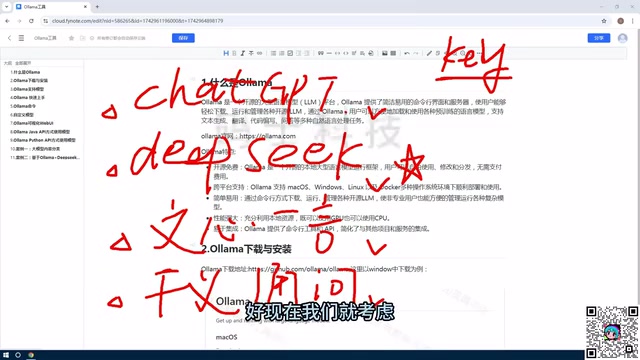
A natural question then arises: since models like DeepSeek are open-source, can we deploy them on our own local machines? It's worth noting here that the rise of open-source models like DeepSeek, LLaMA, and Mistral has fundamentally changed how large models are accessed — these models release their trained weights under open licenses, allowing anyone to download and run them locally without relying on cloud services. Open-source models are typically identified by parameter count, such as 7B, 13B, or 70B (where B stands for billion parameters). The more parameters, the more capable the model — but hardware requirements scale up accordingly. Local deployment requires no API key and incurs zero usage fees, running entirely on your own hardware. The answer is yes, and the key tool that makes it all possible is Ollama.
What Exactly Is Ollama
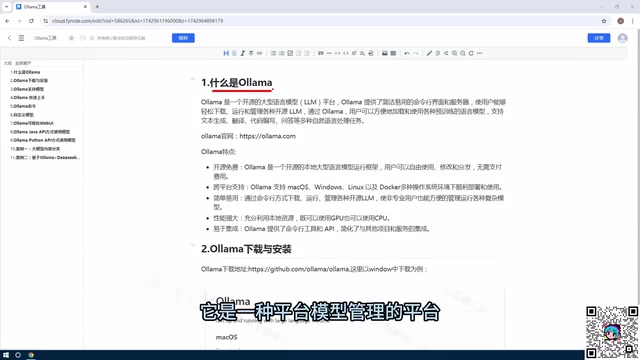
Ollama is a platform tool for managing various large language models, and its core purpose is to make it easy to deploy and use open-source models locally.
With Ollama, you can handle the full model lifecycle: downloading models, managing them, deleting them, and even creating customized versions based on existing ones. Beyond language models like DeepSeek, the community offers a wide range of open-source models for other domains — such as LLaVA for image understanding — all of which can be managed within Ollama.
Ollama offers two interaction modes:
- Command-line (CLI): Operate models directly by typing commands — ideal for everyday developer use.
- Web UI: A more intuitive visual interface that's friendlier for beginners.
Ollama also offers broad OS compatibility, supporting macOS, Windows, Linux, and Docker. Individual users can try it on a Mac or Windows machine, while enterprises can opt for Linux or Docker environments for large-scale deployments.
Core Advantage: Dramatically Lowering the Barrier to Local Deployment
What makes Ollama so compelling is how much it simplifies running large models locally.
Intelligent GPU and CPU Resource Scheduling
Before Ollama, deploying a large model locally typically meant wrestling with a complicated GPU environment setup. Developers had to manually install CUDA (NVIDIA's GPU computing framework), cuDNN, and other low-level driver dependencies, then configure inference frameworks like llama.cpp or vLLM inside Python virtual environments. Compatibility issues across different operating systems and GPU models were a constant headache — often discouraging non-specialist developers entirely. Ollama packages this entire complex dependency stack into a single executable, delivering a true out-of-the-box experience. It automatically detects and makes full use of the available compute resources on your machine, scheduling both GPU and CPU as needed, dramatically lowering the technical barrier for everyday users and developers.

Of course, larger models come with higher hardware demands. Deploying a large-parameter version of DeepSeek may require hundreds of gigabytes of storage and substantial hardware — something worth evaluating upfront.
Building a Private Knowledge Base Made Easy
For developers, Ollama's real value lies in the local API interface it provides. Once an open-source model is deployed locally, the most common use case is interacting with it via API and feeding in a company's private internal knowledge base to build a domain-specific Q&A chatbot.
The mainstream technical approach behind this is called RAG (Retrieval-Augmented Generation): internal documents are chunked and vectorized, then stored in a local vector database. When a user asks a question, the most relevant document chunks are retrieved first, then passed along with the question to the local model to generate a response. This preserves the model's language understanding capabilities while allowing it to accurately reference private knowledge — and since everything stays within the internal network, it's the go-to architecture for enterprises building AI-powered Q&A systems.

The advantages of this approach are clear: data never leaves the internal network, keeping everything secure and under control, while completely eliminating the ongoing costs of online services. On the language side, whether you're using Python, Java, or Rust, you can easily call the local model and integrate it into virtually any tech stack.
Ollama's Core Features at a Glance
To summarize, here are Ollama's main strengths:
- Free and open-source: Completely free with no licensing fees.
- Cross-platform support: Full compatibility with macOS, Windows, Linux, and Docker.
- Simple to use: Dual-mode CLI and Web UI with a low learning curve.
- Powerful performance: Intelligent GPU and CPU scheduling that abstracts away complex environment configuration.
- Easy to integrate: Provides API and CLI interfaces supporting offline model calls from multiple programming languages.
Summary
In one sentence: Ollama is an open-source local LLM management tool that lets you conveniently deploy open-source models like DeepSeek on your own machine, freeing you entirely from dependency on paid online services.
Whether you want to take control of your data, cut costs, or simply explore the capabilities of large models on your own hardware, Ollama is a foundational tool worth learning first. Future tutorials will dive deeper into installation and configuration, model downloading and management, CLI usage, and building a private knowledge base — stay tuned.
Related articles

DynamicLake 2.0: Bringing Dynamic Island to Your Mac
DynamicLake 2.0 brings iPhone's Dynamic Island experience to Mac, with notifications, file staging, format conversion, AirDrop, timers, and a new plugin system.

Proofrr: One Workspace for Creative Feedback, Review, and Approval
Proofrr unifies client feedback, version comparison, review, and approval for design and video teams in one workspace — with no-login sharing and AI-assisted review.

FATHER: A Mac Operations Monitoring Dashboard Built for Vercel Teams
FATHER is a Mac-native ops dashboard for Vercel teams, aggregating traffic, deployments, uptime, PageSpeed, and Search Console SEO data with downtime alerts, SSL reminders, local token storage, and a one-time purchase model.