GFlowNet Breaks Mode Collapse: Generating Diverse Expert Dialogue Synthetic Data

GFlowNet enables proportional diverse sampling to solve mode collapse in LLM expert dialogue synthesis, outperforming baselines across two domains.
This arXiv paper addresses the longstanding mode collapse problem in LLM synthetic data generation by proposing GFlowNet as an alternative to direct prompting or RL baselines for producing diverse expert dialogues. GFlowNet samples strategies proportionally to their frequency in real data rather than always favoring the highest-probability modes. The approach trains GFlowNet to generate latent conversation structures — modeling interpretable features like confusion episode dynamics and scaffolding balance via Gaussian mixture density — before expanding these into full dialogue text. Across tutoring and emotional support domains, the method outperforms RL and end-to-end LLM baselines on fidelity, mode coverage, and authenticity without directly replicating training data, while also providing stronger training signals for downstream classification tasks.
The Diversity Problem in Synthetic Data
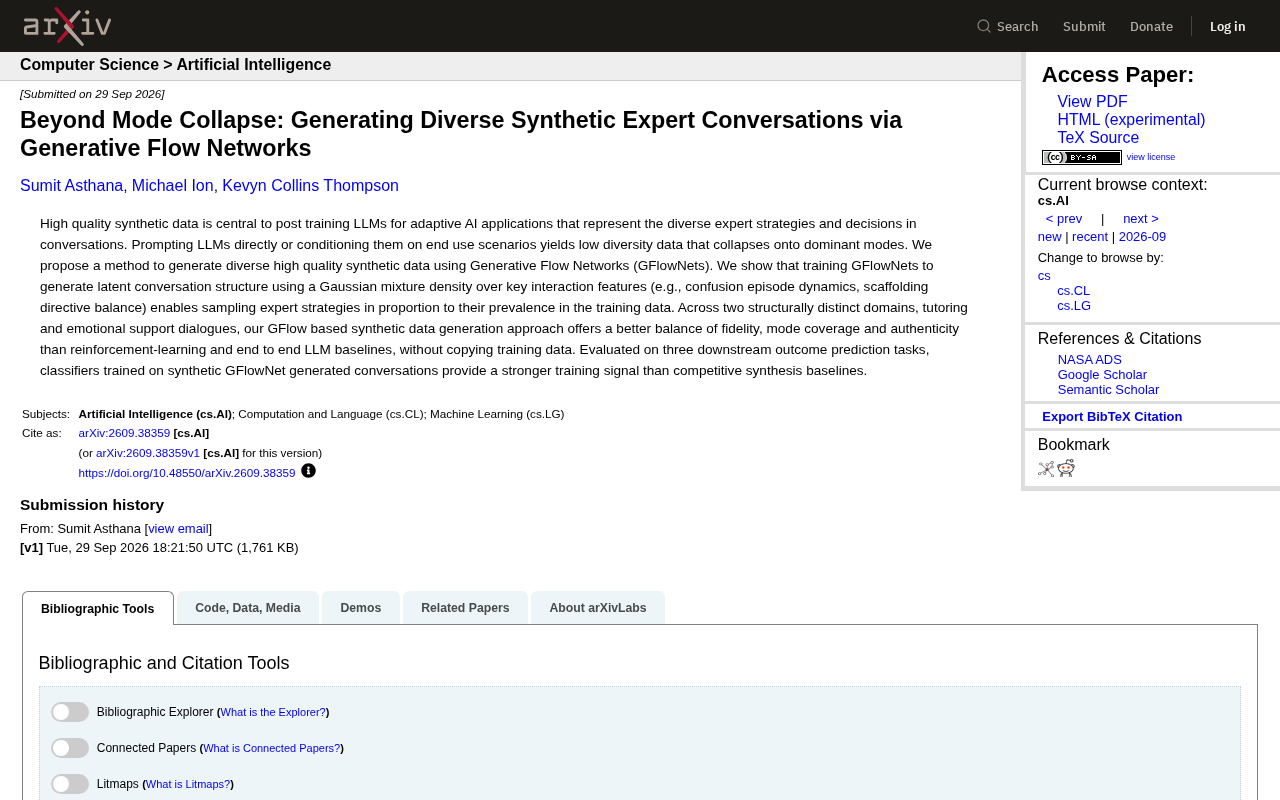
High-quality synthetic data has become a core resource for the post-training stage of large language models (LLMs), especially in adaptive AI applications that need to reproduce the diverse expert strategies and decision-making found in real conversations. However, current mainstream data generation approaches have obvious shortcomings: whether directly prompting LLMs or conditioning models on specific use cases, the resulting data tends to lack diversity and collapses into a handful of "dominant modes."
This Mode Collapse problem means that while model-generated conversations are fluent, they are highly homogeneous — the model repeatedly outputs the most common expert strategies while ignoring the less dominant but equally important strategy variants found in the real world. For training tasks that need to capture the distribution of expert behavior, this is a critical flaw.
A new arXiv paper (arXiv:2609.38359v1) proposes a novel approach: leveraging Generative Flow Networks (GFlowNets) to generate synthetic expert dialogue data that is both diverse and high-quality.
Mode Collapse is a widely observed phenomenon in generative modeling, originally discussed prominently in the context of GAN training: the discriminator's gradient signal guides the generator to repeatedly produce a few "safe" samples, causing it to ignore the long-tail patterns in the true data distribution. For LLM synthetic data generation, the causes differ — the autoregressive decoding of language models inherently favors high-probability sequences, and alignment training such as RLHF further reinforces dominant "human preference" patterns, leading to highly concentrated dialogue strategies. In tasks like expert dialogue that have higher demands for distributional coverage, this problem is especially pronounced: a real tutoring teacher might employ multiple strategies — Socratic questioning, direct explanation, analogical reasoning — depending on the student's state, while LLMs typically only produce one or two of the most common approaches, causing downstream models trained on such synthetic data to similarly lose strategic flexibility.
How GFlowNet Samples Expert Strategies Proportionally
The core advantage of GFlowNet lies in its sampling mechanism. Unlike traditional methods that tend to converge on high-probability modes, GFlowNet can sample according to the proportion at which each strategy appears in the training data, naturally preserving the diversity of the strategy distribution.
The paper's specific approach is to train a GFlowNet to generate the latent conversation structure rather than directly generating surface-level text. This latent structure is characterized by modeling key interaction features using Gaussian mixture density, covering:
- Confusion episode dynamics: the evolution of how confusion arises and gets resolved among learners or help-seekers during a conversation;
- Scaffolding directive balance: the tradeoff an expert makes between giving direct instructions versus heuristic guidance during the facilitation process.
By modeling these interpretable interaction dimensions, GFlowNet can generate structurally diverse conversation skeletons, from which rich expert strategy samples can then be elaborated. This layered "structure first, content second" generation approach is key to avoiding mode collapse.
Generative Flow Networks (GFlowNets) were proposed by Yoshua Bengio's team in 2021, originally designed to address insufficient exploration in reinforcement learning. Unlike traditional RL that pursues a single optimal policy, GFlowNet models the generation process as a flow problem on a directed acyclic graph (DAG): each node is an intermediate state, edges represent construction steps, and "flow" is proportional to the reward of terminal states. By training for flow conservation, GFlowNet can sample different terminal states with probability proportional to their reward — meaning multiple high-reward solutions are all covered, rather than converging to a single global optimum. This property makes it naturally suited for sampling scenarios that require "diverse yet not poor quality" outputs, in sharp contrast to traditional beam search or greedy decoding strategies that only retrieve the top solution. In this study, the "reward" corresponds to how well the generated latent conversation structure matches the true expert conversation distribution, driving GFlowNet to explore multiple structural patterns rather than collapsing to the most common one.
Cross-Domain Validation: Tutoring and Emotional Support
The research team validated the method across two domains with significantly different structures:
Tutoring Dialogue
Educational tutoring scenarios emphasize knowledge transfer, error diagnosis, and progressive guidance, with expert strategies centered on helping learners effectively overcome confusion.
Emotional Support Dialogue
Emotional support scenarios focus more on empathy, active listening, and psychological counseling — a strategy logic fundamentally different from tutoring dialogue.
In both domains, the GFlowNet approach achieved a better balance across three dimensions compared to reinforcement learning (RL) baselines and end-to-end LLM baselines:
| Evaluation Dimension | Meaning |
|---|---|
| Fidelity | How closely generated data approximates real expert dialogues |
| Mode Coverage | Breadth of coverage across diverse strategies |
| Authenticity | How natural and credible the dialogues appear |
More importantly, the paper emphasizes that this performance was achieved without directly replicating the training data — meaning the generated samples are genuinely new, not memorized replays, balancing diversity with generalization capability.
Including both domains in the validation reflects a deliberate methodological design: tutoring and emotional support dialogues differ significantly in goals, pacing, and expert strategy logic — the former centers on cognitive correction and knowledge construction, while the latter revolves around emotional regulation and empathetic response. If a synthetic data method only performs well in one domain, it may simply be because that domain's conversational structure happens to align with the method's inductive bias. By achieving consistent improvements across two structurally distinct domains, the research provides more convincing evidence for the domain-agnostic generalization capability of the GFlowNet framework, and demonstrates that its advantages stem from the method's modeling of diverse sampling rather than overfitting to domain-specific features. This dual-domain comparative evaluation design is worth adopting as a reference paradigm in synthetic data research.
Stronger Training Signal for Downstream Tasks
The true value of synthetic data is ultimately tested in downstream tasks. The study evaluated the effectiveness of training classifiers on synthetic data across three outcome prediction tasks.
Results showed that classifiers trained on GFlowNet-generated dialogues provided stronger training signals compared to models trained on other competitive synthetic methods. This indicates that GFlowNet-generated data not only "looks diverse" but also conveys valuable, discriminative information in actual modeling.
For applications where obtaining large-scale real expert dialogues is difficult due to privacy, cost, or scarcity constraints, this result is especially meaningful — it provides a viable path for building high-quality training sets that does not rely on simple data replication.
Significance of This Research
The contributions of this paper can be understood on several levels:
At the methodological level, it introduces GFlowNet — a generative framework skilled at "proportional diverse sampling" — to the specific problem of synthetic expert dialogue, directly addressing the mode collapse pain point.
At the modeling level, by characterizing interpretable interaction features (confusion dynamics, scaffolding balance, etc.) through Gaussian mixture density, the generation process is no longer a black box but is grounded in meaningful conversational structure.
At the practical level, systematic evaluation across two domains and three downstream tasks provides fairly solid evidence for the method's generalization capability. This is a direction worth watching for LLM post-training, dialogue system construction, and adaptive AI applications that require expert behavior modeling.
(This article is based on an arXiv preprint abstract. Please refer to the original paper for specific experimental details and complete conclusions.)
Related articles

Uber Deploys ChatGPT Work Company-Wide: AI in the Workplace Enters the Scaled Implementation Phase
Uber deploys ChatGPT Work to 30,000+ employees, extending it from engineering to all roles. We analyze its expert-engineer pairing, end-to-end automation, and questions of AI control and power concentration—insights for scaling AI in the workplace.

Shift at Midnight Hands-On: When "ID Verification" Becomes Alien Hunting
Shift at Midnight blends ID verification with horror survival in a four-player co-op game. We break down its inspection mechanics and chaotic humor.

Zelensky Recounts the Outbreak of War: I Need Ammunition, Not a Ride
Zelensky recalls the first day of war in a YouTube interview: farewell to family, rejecting Biden's evacuation offer with "I need ammunition, not a ride," and how Bucha shaped his stance on compromise and peace talks.