GhostDeck: A Retro-Inspired, Low-Poly Offline Music Player for Mac

GhostDeck is an offline Mac music player with a retro deck UI and low-poly 3D visuals that pulse to your music.
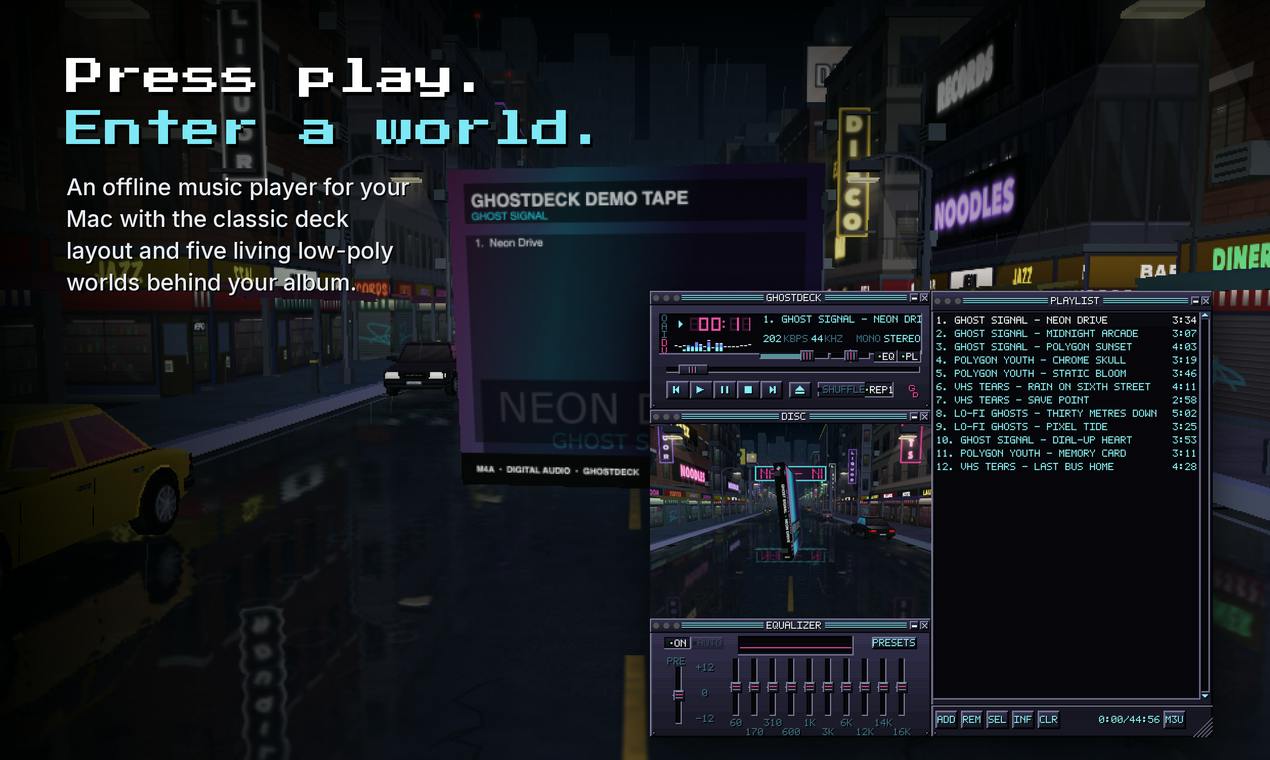
GhostDeck, built by developer Djordje Janjic, takes a contrarian path in the streaming era: it plays only local audio files, requires no account, and tracks nothing. It recreates a classic late-'90s deck-style layout with a ten-band EQ and modular playlists, while using Apple's Metal framework to render five low-poly 3D worlds that animate in sync with your music. The result pulls the player out of the background and into an experience worth watching. It earned 84 upvotes on Product Hunt, targeting privacy-conscious Mac users who appreciate retro aesthetics — though its offline-only stance and lack of streaming integration naturally limit its mainstream appeal.
In an era dominated by streaming subscriptions, a Mac music player that insists on playing local files — prioritizing offline use and privacy — stands out as a genuine outlier. GhostDeck, built by developer Djordje Janjic, recently launched on Product Hunt, earning 84 upvotes and a #20 ranking. It pairs a classic late-'90s "deck-style" interface with a low-poly 3D world that pulses to your music, aiming to turn the act of listening into something worth looking at.
Bringing Music Back to Local and Offline
GhostDeck's most defining stance is simple: play your own music files. It doesn't rely on any streaming service, requires no account login, and everything happens locally. The official page explicitly highlights three keywords: Native Metal (Apple's native Metal rendering), Offline, and No tracking.
This positioning targets users who care about privacy and data ownership — people who prefer to hold their own audio collections rather than lose access when a subscription expires. For listeners with large local music libraries, tools like this are becoming a meaningful complement to streaming.
Metal is Apple's low-level graphics and compute API, introduced in 2014 as a replacement for OpenGL. It allows developers to interact more directly with GPU resources. Compared to general cross-platform frameworks, Metal is optimized specifically for Apple hardware, significantly reducing CPU overhead and rendering latency. For a music player that needs to run in the background for extended periods, using Metal means dynamic 3D visuals won't noticeably drain battery or slow system responsiveness — which is why the "Native Metal" label carries real practical weight for Mac users.
A Modern Take on the Classic Deck Layout
On the feature side, GhostDeck recreates the "late-'90s deck layout" — evoking the golden age of desktop music players. The interface revolves around three core components:
- Deck-style main control panel: mirrors the operational logic of physical playback hardware;
- Ten-band EQ: gives audiophiles precise tonal control;
- Dockable playlists: a modular playlist design for organizing your local library.
This isn't pure nostalgia. A ten-band EQ is already quite rare in mainstream streaming apps today, and its return speaks directly to enthusiasts who want control over their sound.
The "late-'90s deck layout" evokes the aesthetic of early 2000s desktop players like Winamp and XMMS: horizontally stretched dark panels, LED-style time displays, mechanical-looking buttons and sliders. These apps defined the PC music experience before broadband became widespread and served as many users' introduction to digital music. The ten-band equalizer (with bands from 31Hz to 16kHz) was essentially standard in that era, but as streaming platforms consolidated control over audio quality, fine-grained tools like these nearly vanished from consumer products — surviving only in professional DAWs or audiophile-grade players.
A Low-Poly World That "Comes Alive"
GhostDeck's most distinctive selling point is visual. The developer describes how, behind the album art, sits a "jewel case" — flip it over, and one of five low-poly 3D worlds is revealed, each animated in sync with the music.
Low-poly style uses simplified geometric surfaces to strike a balance between performance and aesthetics, and has gained popularity in indie games and visual design in recent years. GhostDeck uses Apple's native Metal graphics framework to render these dynamic scenes, which means smooth real-time performance on Mac with minimal resource overhead. This transforms the music player from a background utility into something closer to a "music visualization space" worth lingering on.
The low-poly aesthetic originated as a practical compromise in early 3D games constrained by hardware limitations. It was later embraced by indie game developers and graphic designers, evolving into a visual language that balances geometric precision with a handcrafted feel. Its defining trait is building shapes from a limited number of triangular faces, omitting detailed textures and letting light work directly across broad color planes. This style is especially well-suited for music visualization: responding to real-time audio data (such as vertex displacement or face color shifts) can be implemented with relatively simple shaders, yet produces an intuitive sense of rhythm — without the heavy computational cost of particle effects or fluid simulations.
Positioning and Potential Limitations
Looking at the Product Hunt data, GhostDeck's 84 upvotes and just one comment reflect modest but real traction. It carves out a clear niche: Mac users who prefer local music, care about privacy, and appreciate both retro aesthetics and dynamic visuals.
That said, this positioning comes with inherent constraints. Being offline with no streaming integration means it simply can't serve the majority of users who have shifted to subscriptions. For those who don't care about 3D visuals or EQ, these features aren't compelling enough to drive adoption. Additionally, publicly available information doesn't yet mention supported audio formats or pricing details — factors that will directly affect the barrier to entry.
For those who genuinely maintain a local music library and treat listening as something of a ritual, GhostDeck offers a distinctly personal option — one that pulls the music player out of the background and back into the realm of something worth watching.
Related articles

Free Unlimited Claude Code Solution: Agnes AI + CC Switch Setup Guide
No paid subscription needed — pair the free AI platform Agnes AI with the open-source tool CC Switch to provide a backend for Claude Code, enabling unlimited free calls to text, image, and video models. This guide covers the full setup, test results, and usage boundaries.

A Complete Zero-Cost Guide to Getting Started with Claude Code for Beginners in China
A beginner's guide to Claude Code for users in China: two installation methods (command line and IDE plugin), full configuration steps for replacing the official API with the free domestic LongCat model, and a hands-on demo of building a small tool with natural language, plus tips.

When the NSA Gets Involved: The AI Supply Chain Crisis Behind Open-Source CVEs and API Key Hijacking
Multiple open-source projects disclosed severe CVEs in one day, PHP flaws alarmed the FBI, and Railway and OpenCode were breached with API keys stolen. This article breaks down the vulnerability window, AI-accelerated exploitation, and the AI supply chain crisis behind the API key black market, with a developer defense checklist.