Ghostifier: Starting from Your Inbox to Help You Get Companies to Delete Your Personal Data
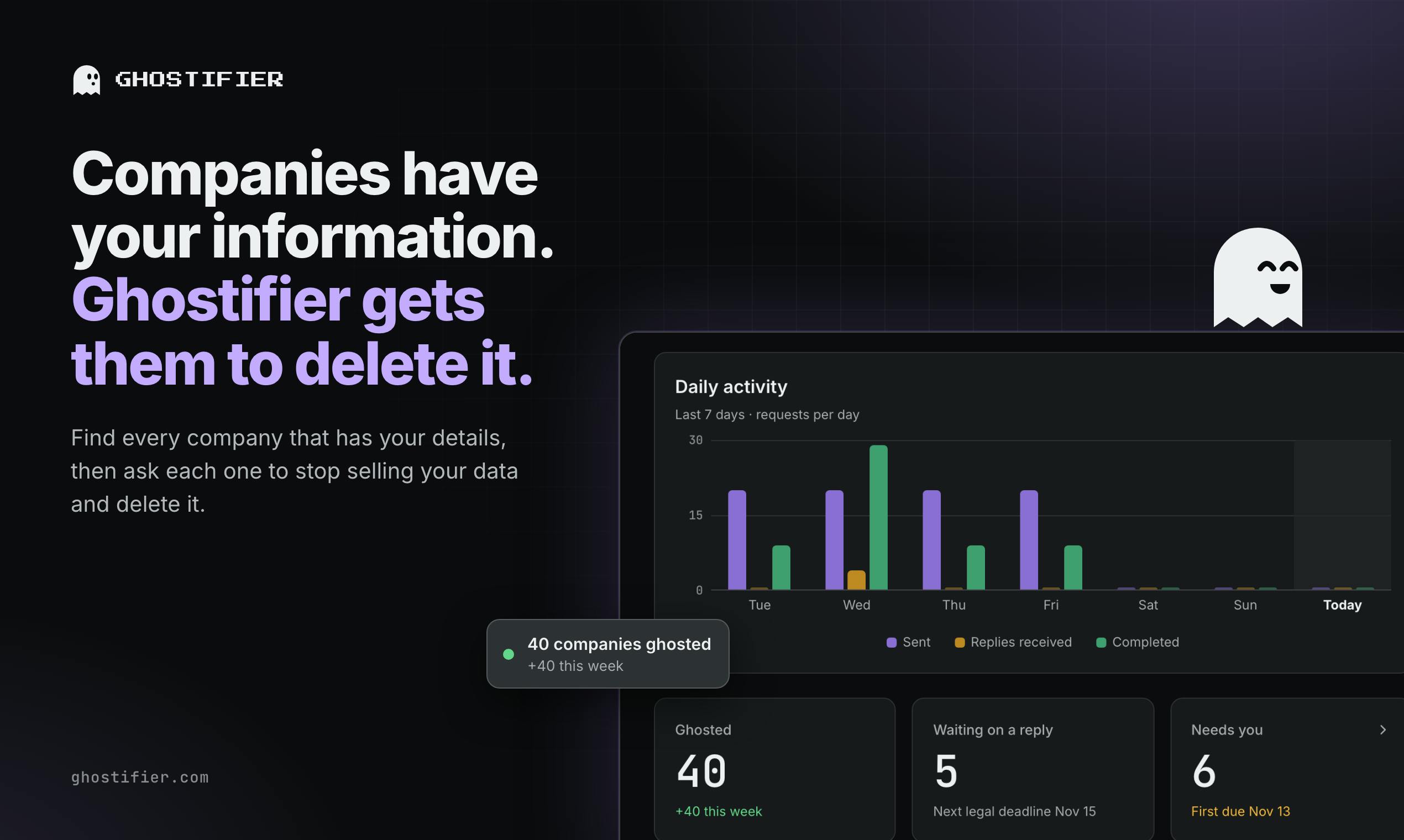
Ghostifier turns your Gmail inbox into a data deletion engine, automating privacy rights with fixed rules and no AI.
Ghostifier is a privacy automation tool that treats your Gmail inbox as a map of data holders. By scanning only email headers (never message bodies), it identifies companies that have your data, then works in phases: day-one unsubscribes and opt-outs, followed by a wait for return windows to expire, then formal deletion requests with response tracking. It skips banks, insurers, and employers while reaching out to data brokers users can't easily contact on their own. Fully rule-based with zero AI, it launched on Product Hunt with 67 upvotes, built by Jonathan Wise.
The Challenge of Data Deletion: Who's Holding Your Information
In the digital age, nearly every signup, purchase, or subscription leaves personal information in some company's database. The real problem isn't how hard it is to submit a single deletion request — it's that ordinary users have no idea just how many companies are holding their data. The traditional approach of filling out deletion forms one company at a time is time-consuming and nearly impossible to do comprehensively.
Ghostifier offers a different angle: instead of hunting down companies one by one, start with your own inbox. This privacy tool — which launched on Product Hunt with 67 upvotes and ranked 20th for the day — treats your email inbox as a "map of data holders," following the trail to identify every organization that has your information.
How It Works
Ghostifier's workflow is designed as a fixed, automated sequence rather than a one-off action.
Identifying Data Holders from Your Inbox
Once connected to Gmail, Ghostifier scans your inbox to find companies that have emailed you — and therefore likely hold your data. This directly addresses the fundamental pain point of users not knowing who to even ask for deletion in the first place.
A Phased Approach, Not a One-Step Fix
The tool operates on a deliberate timeline. On day one, it executes unsubscribes and exercises opt-out rights — meaning it refuses companies permission to sell or share your data. It then waits for any return/refund windows to expire, a thoughtful detail: requesting data deletion during an active order protection period could interfere with returns, warranties, or after-sales support. Only after those windows close does it formally send deletion requests, tracking every response along the way.
Protective Exemptions for Key Institutions
Ghostifier explicitly skips banks, insurance companies, and your employer. These institutions often have legitimate legal, financial, or employment-related reasons to retain your data. Blindly demanding deletion from them is both impractical and potentially problematic. This "knowing when not to act" design reflects a genuine understanding of real-world scenarios.
Coverage of Data Brokers
Beyond companies you've directly interacted with, Ghostifier also sends deletion requests to data brokers — companies that buy and sell personal information behind the scenes, a frequently overlooked link in the privacy leakage chain.
Data brokers are companies whose core business is collecting, aggregating, and selling personal information. They typically don't serve consumers directly; instead, they operate in the background, pulling data from public records, social media, shopping behavior, location data, and more to build detailed personal profiles that they sell to advertisers, insurance companies, recruiters, and anyone else willing to pay. Major global data brokers include Acxiom, LexisNexis, and Spokeo, whose databases often contain names, addresses, income estimates, health tendencies, and even political preferences for hundreds of millions of people. Since ordinary users have never directly interacted with these companies, they often don't even know their information has been collected — let alone how to request its deletion. California's CCPA and some other state laws explicitly grant residents the right to demand data brokers delete their information, but submitting requests to hundreds of brokers individually is practically impossible for any single person to do alone.
Privacy Design: Two Notable Trade-offs
Ghostifier makes two compelling technical choices in its own privacy commitments.
First, Gmail access is limited to headers only. It reads only metadata like sender and subject — never the body of any email. For a tool that sells itself on privacy protection, this constraint directly addresses users' biggest concern: "Will I expose my entire inbox just to get my data deleted elsewhere?"
Second, it uses no AI whatsoever. The product explicitly states that every decision follows fixed rules. In an era where almost every product touts AI capabilities, Ghostifier goes against the grain. The reasoning is clear: for high-sensitivity operations like personal data deletion — where predictability and auditability are paramount — rule-based logic is more reliable and trustworthy than probabilistic AI judgment.
Product Positioning and Real-World Significance
Categorized across Email, Privacy, and Security, Ghostifier was built by Jonathan Wise. It targets a genuine and increasingly important need: as data protection regulations (such as privacy laws granting users deletion rights) continue to spread, users theoretically have the right to demand companies delete their data — but the cost of exercising that right is extremely high. Ghostifier is essentially an "rights executor" — automating a scattered, tedious, and ongoing deletion process.
A clear-eyed assessment is warranted: the actual effectiveness of tools like this depends heavily on whether companies cooperate, how quickly they respond, and how compliant data brokers are. The product claims to "track every response," which implicitly acknowledges that deletion isn't always a one-click affair — it's an ongoing negotiation.
For users increasingly concerned about their digital footprint, Ghostifier represents a product direction worth watching: using automation and explicit rules to make privacy rights that were previously high-barrier actually actionable. Whether it delivers on its promises in real-world use remains to be seen with more user feedback, but its design philosophy — starting from the inbox, executing in phases, rule-driven, restrained toward sensitive institutions — genuinely addresses the core of the problem.
Some useful context: the major global data deletion rights frameworks currently include Article 17 of the EU's General Data Protection Regulation (GDPR), which enshrines the "right to be forgotten"; California's CCPA/CPRA; and a growing number of U.S. state privacy laws. These regulations theoretically require companies to respond to deletion requests within a reasonable timeframe, but enforcement is inconsistent — corporate response rates vary widely, some companies impose burdensome identity verification requirements, and data brokers frequently delay or refuse requests citing "technical limitations." This gap has given rise to a category of "privacy rights proxy" tools, including DeleteMe and Privacy Bee. Ghostifier's differentiator in this space is its inbox-first discovery mechanism, along with its (currently unclear) non-subscription pricing model.
Summary
Ghostifier isn't just another form-filling assistant — it treats personal data deletion as a complete systems challenge. Its value proposition is clear: help you find who's holding your data, initiate deletions at a sensible pace, protect relationships that shouldn't be deleted, and reach the hidden world of data brokers. Reading only email headers and using zero AI also bakes "trust" directly into the product architecture. For privacy-conscious users, this is a tool worth keeping an eye on.
Related articles

Cursor AI Programming in Practice: Build a Student Management System from Scratch in 30 Minutes
A Bilibili creator demonstrates Cursor AI programming: generating a student management system in 30 minutes with natural language. Details on Agent mode, Claude selection, prompt techniques, and thresholds.

Top 20 AI Coding Tools Ranking: From Rock-Solid to Lackluster, a Scored Matrix
Bilibili creator releases top 20 AI coding tools ranking, tiered T0–T4 from rock-solid to lackluster, with Claude Code and Codex tied at T0. This article details the scoring dimensions (capability, reliability, robustness, durability, cost, domestic availability) and tool performances to help developers choose the right AI coding assistant.

Vibe Coding Systematic Tutorial: Master AI-Assisted Programming from Zero
A three-month Vibe Coding tutorial from a Bilibili creator covering Codex, ClaudeCode, and Cursor, from core logic to commercial project practice for beginners.