Giant Scorpion Fossil Over 1 Meter Long Discovered in the UK: An Ancient Predator from 400 Million Years Ago

A 400-million-year-old giant scorpion over 1 meter long discovered in UK Devonian strata.
Paleontologists have described Praearcturus gigas, a new giant scorpion species from Lower Devonian rocks in the UK, dating back 410–420 million years. Exceeding 1 meter in length, it was likely an apex predator in ancient coastal ecosystems. The discovery fills a key gap in early scorpion evolution, sheds light on Paleozoic arthropod gigantism driven by ecological rather than purely atmospheric factors, and provides biostratigraphic evidence for Laurasian paleogeographic reconstruction.
A Giant Predator from the Ancient Past: A New Devonian Scorpion Species
Paleontologists have recently formally described a new species of giant scorpion — Praearcturus gigas — discovered in Lower Devonian (Lochkovian) strata in the United Kingdom. This discovery not only fills a critical gap in the evolutionary lineage of Early Devonian scorpions but also reshapes our understanding of the size limits these ancient arthropods could reach. Dating to approximately 410 to 420 million years ago, this species is closely related to the extinct order Eurypterida and ranks among the largest known scorpion-like animals of its time.
The Eurypterida are a completely extinct group of chelicerates (Chelicerata), belonging to the same subphylum as modern scorpions, spiders, and horseshoe crabs. They were not true scorpions, but their superficial resemblance earned them the common name "sea scorpions." Eurypterids first appeared in the Middle Ordovician and reached their peak in diversity and body size during the Silurian — some species of Pterygotus and Jaekelopterus exceeded 2 meters in length, making them the largest arthropods ever known in Earth's history. With streamlined bodies, powerful swimming appendages, and well-developed chelicerae, they adapted to a wide range of environments from shallow seas to estuaries and even freshwater habitats. They declined sharply after the Middle Devonian and ultimately vanished entirely by the end of the Permian.
The species name "gigas" comes from Latin, meaning "giant" — a direct reference to the creature's most striking characteristic. Based on fossil remains, the individual is estimated to have exceeded 1 meter in body length, making it an undeniably formidable apex predator in its ecosystem.
Fossil Discovery Context and Geological Significance
The Lochkovian: A Critical Turning Point in the History of Life
The Lochkovian is the earliest geological stage of the Devonian Period, spanning from approximately 419 to 410 million years ago. The Devonian Period itself is the fourth of six periods in the Paleozoic Era, covering roughly 419 to 359 million years ago, and is often called the "Age of Fishes." The Paleozoic Era began with the Cambrian around 541 million years ago and ended with the great Permian extinction approximately 252 million years ago — it was the pivotal era during which multicellular animals radiated extensively from the oceans onto land. The Devonian played a transitional role in this grand narrative: the foundations of terrestrial plant life established in the Silurian rapidly expanded into forest ecosystems during the Devonian, and tetrapods among the vertebrates took the critical step from water to land in the Late Devonian.
The Lochkovian followed closely on the heels of the biotic recovery from the Ordovician–Silurian mass extinction event. This extinction (approximately 445 to 443 million years ago) was the first of the "Big Five" mass extinctions of the Phanerozoic, wiping out around 85% of marine species. The event is generally attributed to global glaciation triggered by the drift of Gondwana toward the South Pole, leading to dramatic sea-level drops, massive loss of marine habitats, and plummeting ocean temperatures. The extinction occurred in two main pulses: the first associated with glacial maximum sea-level regression, and the second linked to oceanic anoxia events during glacial retreat. The Silurian through Early Devonian represented an important recovery period, during which surviving lineages rapidly radiated into vacated ecological niches, creating opportunities for the rise of diverse new groups — including giant scorpions.
This period was also a critical transition for vertebrate expansion onto land. Terrestrial plants were progressively colonizing coastal environments, while large arthropods still dominated the ecological niches at the water-land interface.
In this context, the appearance of Praearcturus gigas carries a twofold significance: first, it demonstrates that scorpions had already evolved remarkably large body sizes by the Early Devonian; second, the fossil record from the UK locality provides new biostratigraphic evidence for paleogeographic reconstruction of the European portion of Laurasia.
Biostratigraphy is the discipline of using fossil assemblages to subdivide and correlate geological strata. Its core principle is based on the "law of faunal succession" — the same species does not reappear in different geological periods, so specific fossil assemblages can define specific geological time windows. In paleogeographic reconstruction, the discovery of identical or closely related species on different continents can indicate that those landmasses were once in close proximity or connected by migration corridors, thereby providing independent verification for plate tectonic theory. The discovery of Praearcturus gigas in the UK can be compared with contemporaneous scorpion fossils from other continents, helping to reconstruct the paleogeographic configuration of Laurasia during the Early Devonian.
Laurasia was an ancient supercontinent composed of the precursor landmasses of North America, Europe, and Asia. In the Early Devonian, the core components of Laurasia — Laurentia (the precursor of North America) and Baltica (the precursor of Northern Europe) — had already collided and merged during the Caledonian Orogeny in the Late Silurian, forming the "Old Red Sandstone Continent." At that time, the area that is now Britain was situated along the southern margin of this continent, near the equator, enjoying a warm and humid climate with extensive estuarine deltas and shallow coastal lagoons — ideal habitats for large aquatic or semi-aquatic arthropods.
Why UK Fossil Localities Command Such Attention
The Silurian to Devonian strata of Scotland and Wales are renowned in the scientific community for their exceptional fossil preservation conditions, having already yielded numerous important early vertebrate and invertebrate fossils. The discovery of Praearcturus gigas continues this tradition, adding a remarkable new entry to the paleobiological diversity record of these localities.
Taxonomic Classification and Morphological Features
The Giant Scorpion's Place on the Evolutionary Tree
The genus name Praearcturus is a combination of "Prae-" (before) and "Arcturus" (a known genus of ancient scorpion), suggesting that this genus is evolutionarily earlier than or ancestral to Arcturus. This naming strategy reflects the researchers' assessment of its phylogenetic position — it likely represents an early branch of a major lineage within the order Scorpiones.
Scorpiones is an order within the subphylum Chelicerata, with approximately 2,700 extant species, all of which are terrestrial. However, the fossil record shows that the earliest scorpions lived in aquatic or marginal aquatic-terrestrial environments during the Silurian. Silurian scorpion fossils — such as Dolichophonus from Scotland — retain gill-like respiratory structures, providing strong evidence for an aquatic lifestyle. The transition from water to land involved a suite of adaptive changes in the respiratory system (from gills to book lungs), osmoregulation, and waterproofing of the body surface, a process that was completed gradually between the Devonian and Carboniferous. The book lungs of modern scorpions are thought to have evolved from the book gills of their aquatic ancestors through invagination, sharing developmental homology with the respiratory organs of horseshoe crabs.
The Early Devonian was a critical window for the water-to-land transition of scorpions, and the large body size of Praearcturus gigas reveals an important signal: diverse ecological strategies existed during this transition — gigantism itself may have been an adaptive response to specific predation pressures or prey resource availability.
Evolutionary Interpretation of Arthropod Gigantism
Gigantism was a widespread trend among Paleozoic arthropods, a phenomenon closely linked to fluctuations in atmospheric oxygen levels and also driven by predation pressure and ecological niche competition. Arthropods (especially insects and myriapods) rely on tracheal systems or book lungs for gas exchange, and their respiratory efficiency directly constrains maximum body size. Paleo-atmospheric models (such as the GEOCARBSULF model) indicate that atmospheric oxygen levels reached approximately 30–35% during the Carboniferous to Early Permian (compared to about 21% today), which is considered a key factor behind the appearance of Carboniferous giant dragonflies (wingspans exceeding 70 cm) and giant millipedes (Arthropleura, body lengths exceeding 2 meters).
Praearcturus gigas, together with contemporaneous eurypterids (sea scorpions) and giant millipedes, forms an important piece of the puzzle in the Paleozoic arthropod gigantism lineage.
Notably, estimated atmospheric oxygen levels during the Early Devonian were only around 15–17%, below modern levels and far from their historical peak. This means that the gigantism of Praearcturus gigas was likely driven more by ecological factors — such as abundant food sources and fewer competitors — rather than simply by the relaxation of physiological constraints. For aquatic or semi-aquatic scorpions, dissolved oxygen in water, the surface area of gills or book gills, and circulatory system efficiency were likely equally important, and ecological factors such as the absence of competing predators and prey abundance should not be overlooked in the evolution of body size.
Paleoecological Significance: Reconstructing the Food Web of 400 Million Years Ago
A Super-Predator at the Water-Land Interface
In the ancient coastal or estuarine environments of Lochkovian-age Britain, Praearcturus gigas very likely occupied the top or near-top position in the food chain. Its potential prey included early jawed fishes, jawless fishes (such as early members of the Placodermi), and various invertebrates. A massive body exceeding 1 meter in length meant it possessed powerful chelicerae and impressive pursuit capabilities, sufficient to subdue most prey of its time.
The Placodermi were the most iconic jawed fish group of the Devonian, with their heads and anterior trunks encased in heavy bony armor. They were remarkably diverse in form, ranging from small bottom-dwelling antiarchs to apex predators like Dunkleosteus, which could exceed 6 meters in length. Alongside placoderms, the Early Devonian also hosted jawless armored fishes (such as ostracoderms and heterostracan fishes), acanthodians, and early ray-finned and lobe-finned fishes. This rich fish diversity not only provided ample prey for large scorpions, but the evolution of bony armor in fishes may itself have been partly a defensive adaptation against arthropod predation — presenting a compelling case of coevolution.
Contemporary fossil records show that fish diversity was already quite rich in the Early Devonian, providing a substantial food base for large scorpions. At the same time, these large scorpions may in turn have exerted selective pressure on vertebrate evolution, driving fishes to develop enhanced escape or defensive strategies.
Ecological Niche Replacement with Eurypterids
Eurypterids (commonly known as "sea scorpions") were once the undisputed apex predators of marine and freshwater ecosystems prior to the Devonian, with some species reaching lengths of up to 2.5 meters. As the Devonian progressed, eurypterids gradually declined, while true scorpions began expanding toward larger body sizes.
The timing of Praearcturus gigas's appearance coincides precisely with this ecological transition, suggesting that true scorpions may have partially filled the ecological void left by the retreating eurypterids — a momentous "changing of the guard" in Paleozoic aquatic ecosystems.
Research Value and Future Prospects
This discovery holds significant reference value for clarifying the early evolutionary trajectory of scorpion-like animals. The research team's descriptive work has been published in preliminary form, but extensive follow-up work remains to be done, including phylogenetic analysis, paleogeographic distribution reconstruction, and paleoecological modeling of this species.
From a broader perspective, the discovery of Praearcturus gigas once again confirms that UK Devonian strata still harbor rich paleontological treasures waiting to be unearthed. With continued advances in fossil preparation techniques and micro-CT scanning technology, re-examination of existing specimens and systematic exploration of new localities hold great promise for revealing more secrets of ancient life.
Micro-computed tomography (Micro-CT) is a non-destructive technique that uses X-rays to produce high-resolution three-dimensional images of small samples. In paleontology, micro-CT scanning has revolutionized fossil research: it can reveal fine internal anatomical structures without destroying the rock matrix, including hidden appendages, visceral cavities, tracheal tubes, and vascular channels. With resolutions down to the micrometer scale, researchers can perform virtual preparation and 3D reconstruction of poorly preserved or extremely precious specimens. High-energy X-rays from synchrotron light sources (such as the European Synchrotron Radiation Facility, ESRF) can penetrate dense rock matrices, achieving unprecedented imaging of fossils embedded in ferruginous or siliceous concretions. This technology has been successfully applied to numerous landmark paleontological discoveries, including wing venation details of early insects, tiny vertebrates encased in amber, and the water vascular systems of crinoids.
Every discovery like Praearcturus gigas reminds us that the evolutionary history of life on Earth is far more complex — and far more spectacular — than we ever imagined. How many more unknown giant creatures lie waiting to be brought back into the light from rock layers that have slumbered for 400 million years?
Related articles

M&M's Spent Millions Replacing Artificial Blue Dye — Why Is It So Hard?
Mars spent millions trying to replace artificial blue dye in M&M's with spirulina, but thick material clogs pipes and residue risks mold, forcing a full production-line rebuild. Here's the engineering behind the reformulation.

Teammate Wanted for Meta Global AI Developer Hackathon: Computer Vision & Medical AI
A Reddit developer seeks teammates for the Meta Global AI Developer Hackathon, focusing on computer vision and medical AI. This article analyzes the track logic, skills-complementarity needs, and topic selection strategy behind this teaming signal.
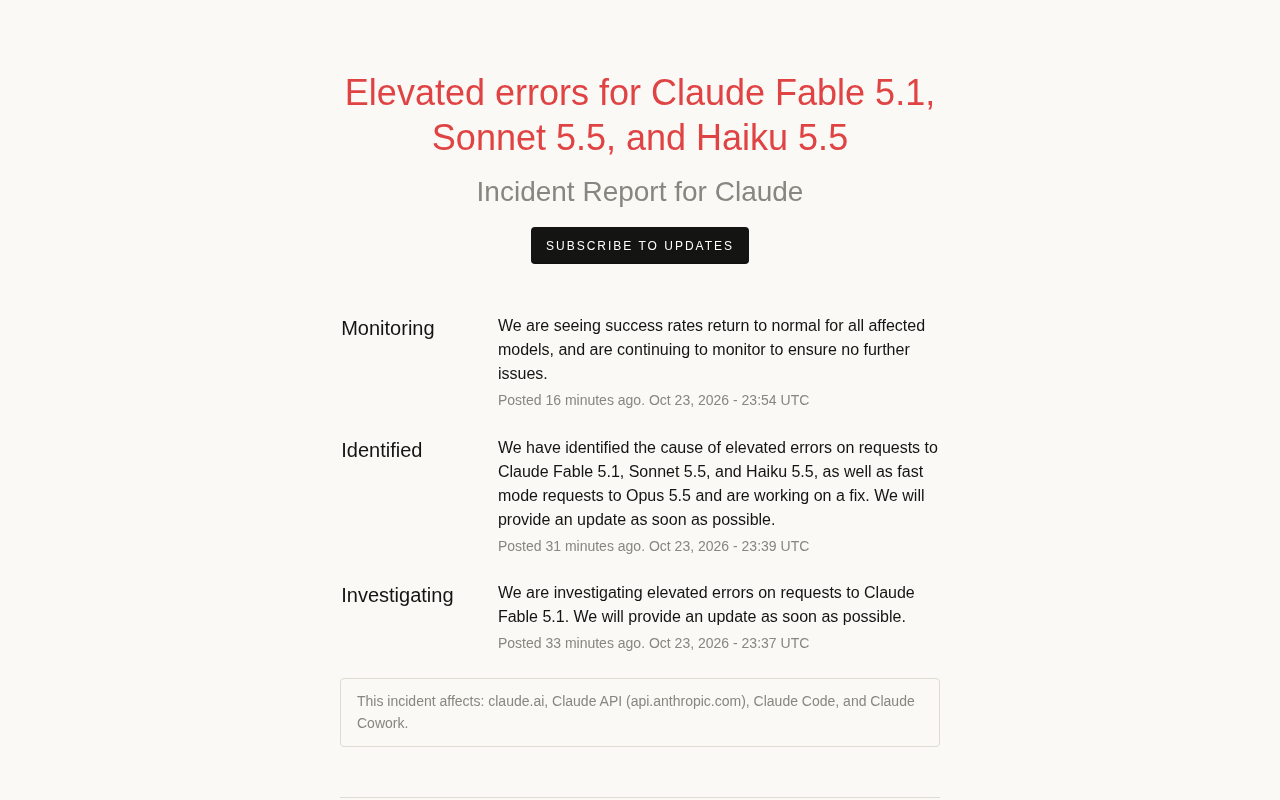
Multiple Claude Models Hit by Errors: A Postmortem of Fable 5.1, Sonnet 5.5, and Haiku 5.5
Claude Fable 5.1, Sonnet 5.5, Haiku 5.5, and Opus 5.5 fast mode saw elevated errors; Anthropic identified and resolved the issue in 17 minutes. This postmortem covers the timeline, the technical reasons for the multi-model cascading failure, and practical lessons for retry and degradation strategies.