GitGlow: Review Your Code and AI Agent Changes Before Shipping

GitGlow is a local Git tool designed to review both human and AI agent code changes before shipping.
As AI coding agents take on a larger role in daily development, traditional code review struggles to keep up with agents that can modify dozens of files in one run. GitGlow is a local Git workspace tool combining precise staging, clear commit history, and a checkout-aware terminal — with a core goal of reviewing both human and AI-generated changes before shipping. It's free for private local clones with no account required; the Pro tier adds review marks and a "stale after edits" mechanism that auto-invalidates review status whenever an agent touches already-reviewed code again.
When AI Agents Write Code, the Review Step Matters More Than Ever
As AI coding agents become deeply embedded in everyday development, codebases are no longer shaped solely by human engineers. AI agents can autonomously modify files, refactor logic, and generate patches — boosting efficiency while introducing a new review burden: who's actually responsible for what the agent changes?
GitGlow was built precisely for this pain point. After launching on Product Hunt, it earned 68 upvotes and ranked #12 for the day, listed under the Developer Tools, Artificial Intelligence, and GitHub categories. Built by developer Stoyan Korudzhiev, its core proposition is straightforward: review your own code and your AI agent's changes before you ship.
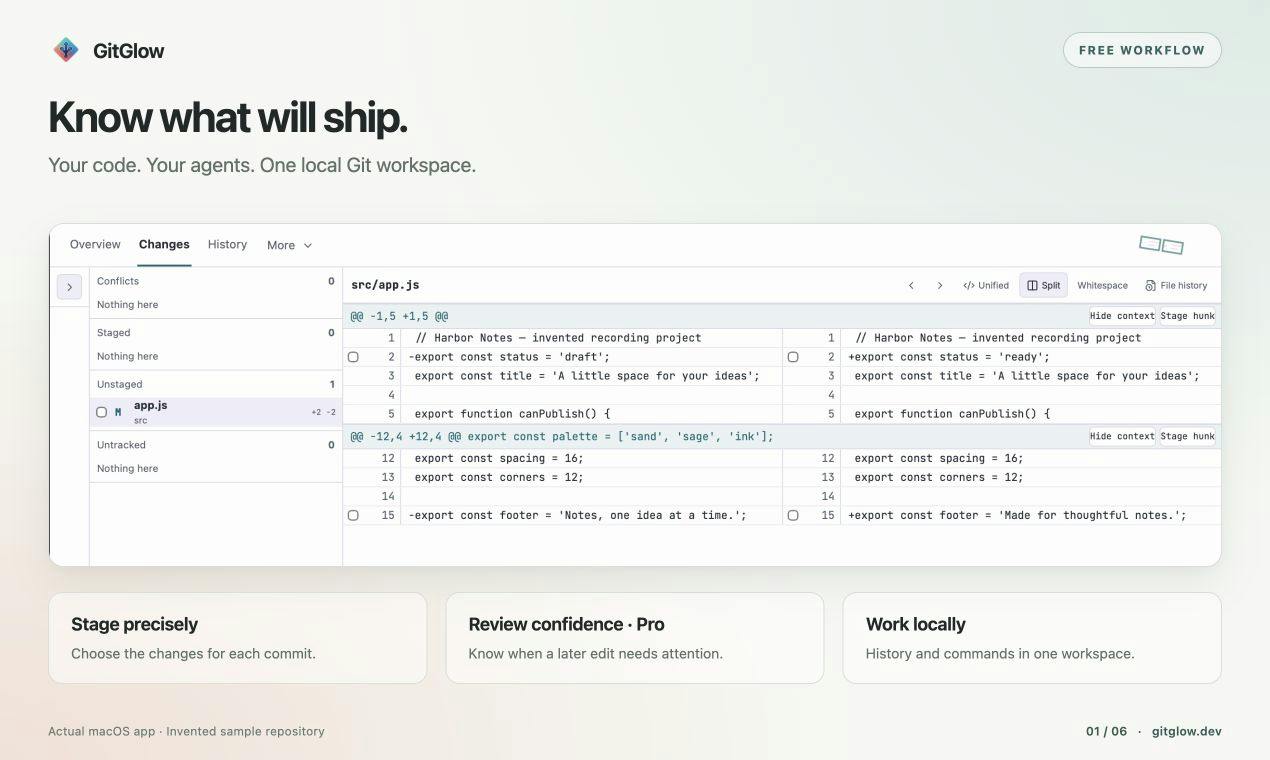
What GitGlow Actually Does
According to the official description, GitGlow brings three things together in a single local Git workspace:
- Precise staging: Control which changes make it into a commit at a finer granularity, instead of blindly running
git add .. - Clear history: Make commit history more readable and traceable, so you can follow the full context of every change.
- Checkout-aware terminal: A built-in terminal that understands your current branch and checkout state, reducing the risk of accidentally working on the wrong branch.
All three features serve the same goal — reducing the likelihood of blind edits and blind commits. For engineers comfortable on the command line, GitGlow isn't meant to replace Git; it provides a more intuitive review interface at the local level.
Where Free Ends and Pro Begins
GitGlow is completely free for private local clones, and no account registration is required — a thoughtful choice for developers who prioritize privacy and local-first workflows.
The paid Pro tier adds capabilities oriented toward team collaboration and agent governance:
- Review marks: Tag code sections that have already been reviewed.
- Checks that become stale after edits: Once a marked section of code is modified in a subsequent edit, its review status is automatically invalidated — a practical design that prevents the false sense of security from a single review pass.
- Managed agent and release tools: Support for managing AI agents and assisting with release workflows.
The "stale after edits" mechanism is especially relevant in high-frequency AI agent scenarios — an agent might touch code again after you've already reviewed it, and GitGlow will prompt you to re-verify.
"Precise staging" maps to the philosophy behind Git's native interactive staging (git add -p). Traditional git add . dumps every change in the working directory into the next commit, while precise staging lets developers selectively add changes at the granularity of individual hunks — or even single lines — into the staging area. When an AI agent modifies a large number of files in one shot, this level of control becomes critical: an agent might refactor an unrelated module while fixing a bug, and precise staging lets you split those into separate commits, keeping commit semantics clean. Clear commit history isn't just about readability — it directly affects the effectiveness of debugging tools like git bisect (binary search to pinpoint when a bug was introduced) and git blame (tracing who made a change and why).
Why "Agent Review" Is a Real Need
Traditional code review workflows were built around human collaboration: a developer opens a PR, a colleague reviews it, CI runs the tests. AI agents disrupt that rhythm. A single agent run can touch dozens of files — high volume, high velocity — and humans are often pushed forward before they've had a chance to go line by line.
GitGlow moves the review step earlier: local, before shipping, and treats the agent's changes as a first-class concern rather than an afterthought. This reflects an emerging trend: developer toolchains need to redesign their acceptance checkpoints for human-AI collaborative programming, rather than carrying over assumptions from an era of purely human collaboration.
From a product positioning standpoint, GitGlow's differentiation isn't about building yet another Git GUI. It's about making the trust state of a review explicit — what's been looked at, what changed after it was reviewed, and what came from the agent. That kind of traceable-state capability is the foundation teams need before they can confidently hand tasks off to AI agents.
Existing AI coding agents (such as GitHub Copilot Workspace, Cursor Agent, Devin, etc.) typically operate in task-level units: given a natural-language description of requirements, the agent autonomously plans steps, calls tools, reads and writes files, and runs until the task is done. A typical agent run might involve modifying dozens of files, adding new tests, and updating configs — almost entirely without human intervention. This is fundamentally different from how human engineers incrementally commit work. A human commit usually maps to a clear intention; an agent's output is a batch of results, with the intermediate reasoning opaque to humans. Traditional PR review assumes the reviewer can understand the intent behind a change, but when faced with large-scale agent-generated changes, intent often has to be reverse-engineered from the prompt rather than the code itself — dramatically reducing the effectiveness of existing review mechanisms.
A Grounded Assessment
Public information is still limited: 68 upvotes and 2 comments reflects early traction with a small but targeted developer audience. Whether the tool is actually pleasant to use, how smooth the precise staging and terminal experience are, and how mature the Pro-tier agent governance features are — all of that requires hands-on testing.
But the question it raises is worth every team's consideration: as more and more code is generated by AI, is your review process ready? GitGlow's answer is — make review happen locally, before shipping, and explicitly carve out a place for the agent's changes.
For engineering teams already bringing AI agents into their workflows, this kind of tool offers a useful reference point: efficiency gains shouldn't come at the cost of losing control, and review checkpoints need to evolve alongside how we collaborate.
Related articles

Chain of Thought Isn't Just for AI: How Humans Can Use CoT to Improve Thinking Quality
Chain of Thought isn't just a prompt trick for large models. Starting from a Hacker News discussion, this article analyzes why CoT works for human thinking too, breaks down actionable ways to transfer it, and highlights the key differences between human CoT and machine CoT.
Cloudflare Teams Up with OpenAI: Closi…
Cloudflare Teams Up with OpenAI: Closing the Loop from Vulnerability Discovery to Defense with AI
Cloudflare uses OpenAI Daybreak to investigate security vulnerabilities and generate reviewable remediation plans, while developers use Codex to boost coding efficiency and quality.

Orca Multi-Agent Orchestration in Practice: A Guide to Parallel Collaboration with Claude and Codex
Orca is Stable AI's free open-source agent workbench supporting 34 agents like Claude Code and Codex in parallel. Learn its Git worktree isolation, multi-model orchestration, and mobile management.