GitHub Daily · August 3: Rust Reshapes PDF Processing & Real-Time Voice Agents Rise

Rust PDF parsing, real-time voice Agents, and AI tool accessibility dominate GitHub Trending on August 3.
GitHub Trending on August 3 highlights three major themes: firecrawl/pdf-inspector leads with 1,769 daily stars, using Rust for intelligent PDF routing in RAG pipelines; livekit/agents matures as the premier open-source real-time voice AI Agent framework with high fork-to-star ratios indicating production use; and free-claude-code's viral popularity exposes massive unmet demand for affordable AI coding tools. The overarching trend: AI development is shifting from model obsession to infrastructure engineering, accessibility, and Rust-powered performance.
GitHub Daily · August 3: Rust Reshapes PDF Processing & Real-Time Voice Agents Rise
As a new week begins, the GitHub Trending chart paints a compelling picture: on one side, Rust-based system-level tools are surging; on the other, the AI Agent ecosystem continues to expand; and in between, classic technical learning resources remain evergreen. Today's chart isn't flooded with large model repositories — instead, it returns to the main themes of "infrastructure" and "engineering pragmatism." From intelligent PDF parsing to real-time voice Agent frameworks, from system design interview bibles to "free" AI coding tools, every project addresses real, concrete pain points.
If the past two years on GitHub were dominated by model weights and prompt engineering repos, then today in 2026, we're seeing a more mature developer mindset: no longer blindly chasing models themselves, but focusing on how to engineer AI capabilities into production, how to lower barriers to entry, and how to use faster underlying technologies to support upper-layer applications. This thread runs through virtually every project on today's chart. Let's break them down one by one.
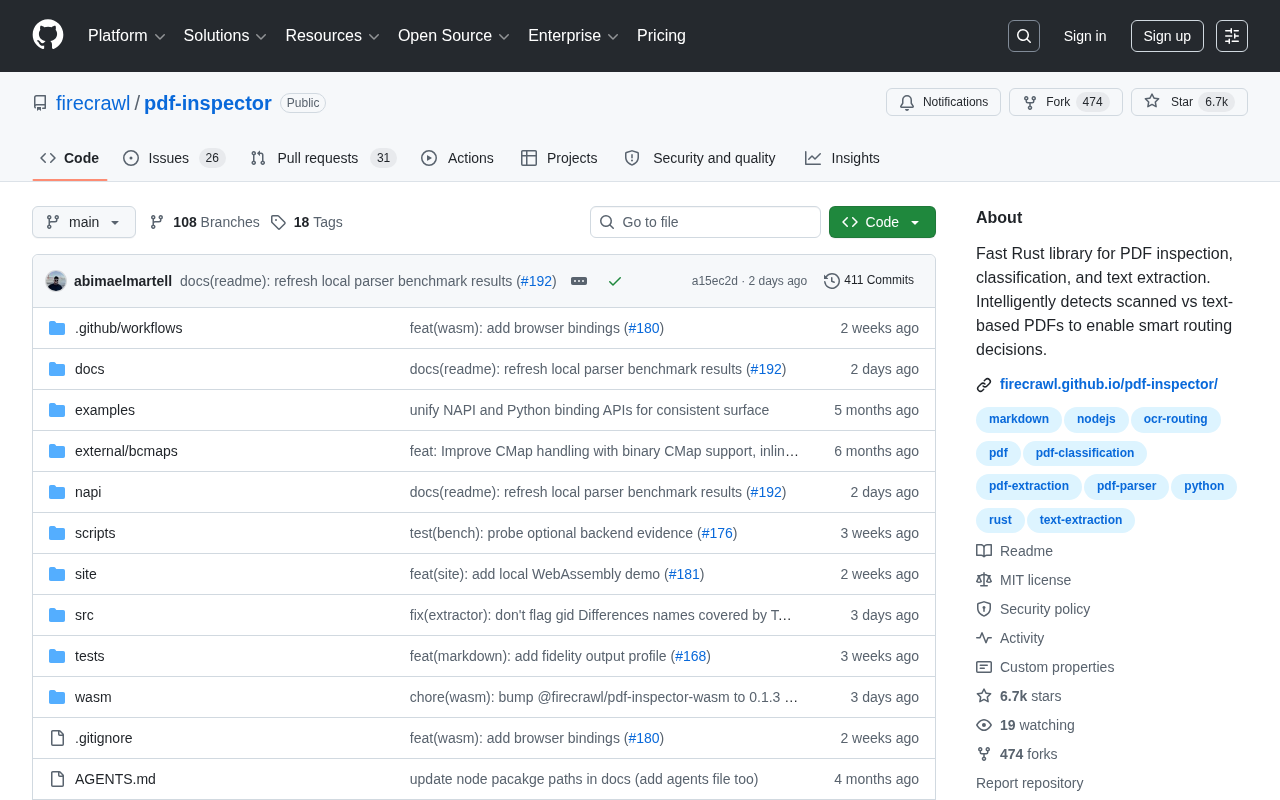
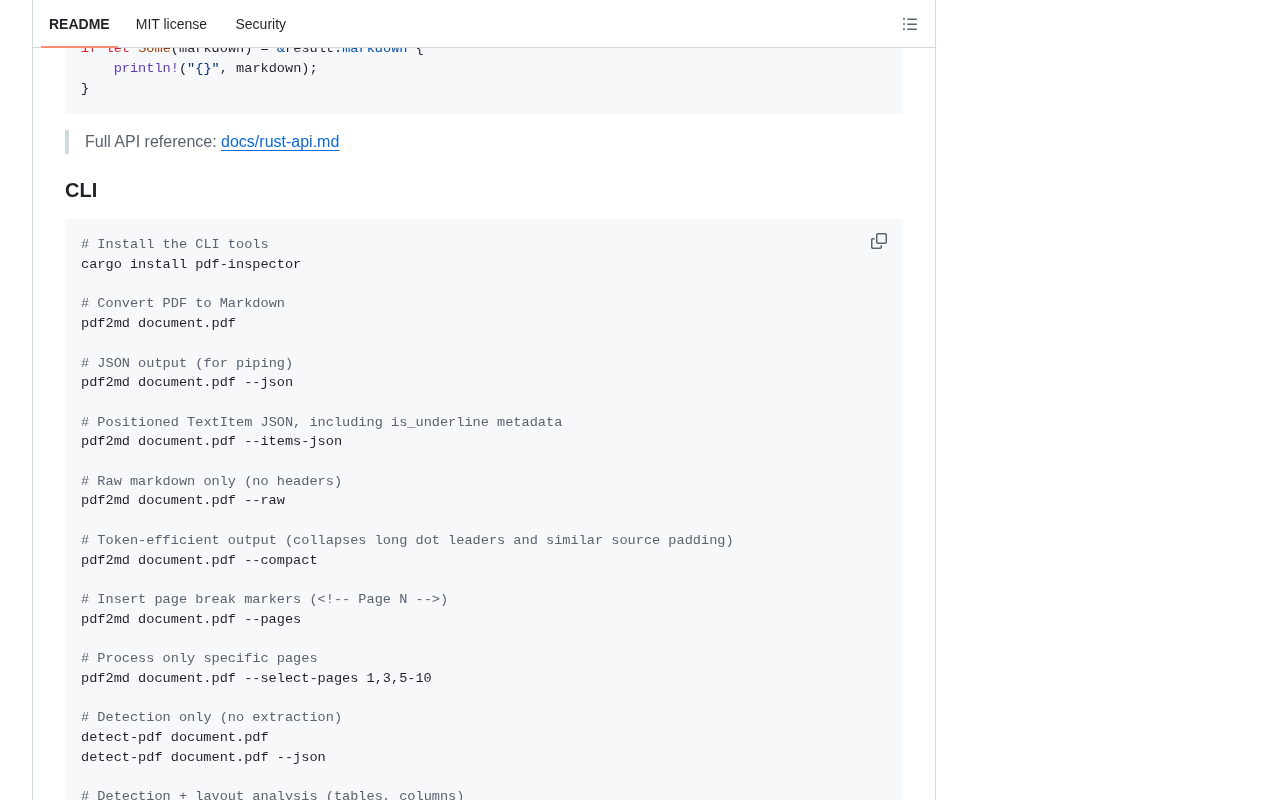
firecrawl/pdf-inspector: Redefining PDF Parsing Speed with Rust
Project Positioning: A high-performance PDF inspection, classification, and text extraction library written in Rust that intelligently distinguishes between scanned PDFs and text-based PDFs to make "smart routing" decisions.
Problem Solved: Any developer who's worked with document processing knows the pain of PDFs. PDF is a "print-oriented" rather than "data-oriented" format — the same PDF file might contain clean text layers or just scanned images. For the former, you simply extract text; for the latter, you must run OCR, with vastly different costs and latency. The traditional approach was often "one-size-fits-all" — either OCR everything (wasting compute) or blindly extract text (failing entirely on scanned documents). pdf-inspector fills this "intelligent pre-assessment" gap: it quickly detects the document type first, then decides which pipeline to use.
Core Features: The standout capability is its smart routing. In today's world where RAG (Retrieval-Augmented Generation) and document AI are booming, preprocessing massive PDFs before ingestion is the bottleneck of the entire pipeline. pdf-inspector achieves extreme detection speed in Rust, determining in milliseconds which path a document should take, reserving precious OCR compute for scanned documents that actually need it.
Use Cases: Enterprise document knowledge base construction, legal/financial document batch ingestion, academic paper parsing, and any RAG system that needs to feed PDFs to large models. When facing millions of PDFs from mixed sources, this library can save you substantial OCR API costs and processing time.
Tech Stack: Pure Rust. This is significant — it reflects the crystallizing trend of "writing AI infrastructure in Rust." Python handles glue code and model calls; Rust handles performance-sensitive underlying processing. This division of labor is becoming the standard architecture in the document AI space. Even if Python is your primary language, it's worth watching for its Python bindings or CLI interface.
Stars/Forks Analysis: 1,769 new stars today — the fastest-growing project on the chart — with total stars reaching 6,664. This explosive growth shows it precisely hits the hottest RAG engineering pain point. Notably, it comes from the firecrawl team — already known for web scraping and structured data extraction — now extending into PDF to form a comprehensive "feed everything to LLMs" data processing ecosystem.
donnemartin/system-design-primer: The 360K-Star Evergreen Classic
Project Positioning: The system design study bible — teaching you how to design large-scale distributed systems while serving as the ultimate resource for system design interview prep, complete with Anki flashcards.
Problem Solved: System design is an unavoidable challenge for every backend/architecture engineer and the interview topic that most differentiates candidates at major tech companies. Existing resources are either too academic and disconnected from practice, or scattered and unsystematic. system-design-primer systematically organizes classic problems like "how to design a URL shortener," "how to design Twitter's timeline," and "caching/load balancing/database sharding" into a complete knowledge map.
Core Features: Structured knowledge framework + numerous real-system design case studies + Anki flashcards. It doesn't just give you answers — it teaches you the mindset of making tradeoffs — which is the essence of system design.
Use Cases: Engineers preparing for big tech interviews, mid-level developers looking to systematically fill architecture knowledge gaps, and internal training materials for engineering teams.
Tech Stack: Primarily Python examples, but the content itself is language-agnostic architectural knowledge.
Stars/Forks Analysis: 360K stars, 57K forks — one of the most popular repositories on GitHub. Still gaining 138 new stars today. While the growth rate isn't as dramatic as newer projects, its continued activity as a long-time chart-topper speaks for itself — no matter how AI evolves, solid system design skills remain hard currency. In an era where AI can write code, architectural decisions and system tradeoffs have become even scarcer human capabilities.
Alishahryar1/free-claude-code: The Unconventional Path to Free Top-Tier AI Coding Tools
Project Positioning: Lets you use Claude Code, Codex, and Pi for "free" in your terminal, apps, IDE, or even on your phone, with voice operation support for an OpenClaw-like experience.
Problem Solved: Top-tier AI coding tools like Claude Code and Codex are powerful but come with significant subscription costs, creating barriers for students, indie developers, and developers in developing regions. This project attempts to lower usage costs so more people can experience the capabilities of frontline AI coding tools.
Core Features: Cross-platform + voice support is its biggest selling point. It extends Claude Code's capabilities to mobile and voice interaction, making "pair programming with AI anytime, anywhere" possible. Imagine using voice commands while walking to have AI fix your bugs — that experience is genuinely appealing.
Use Cases: Budget-constrained individual developers, users wanting mobile AI coding experiences, and voice-interaction enthusiasts.
Tech Stack: Python. As a wrapper/proxy tool, its value lies in integrating multiple AI coding backends with a unified interaction interface.
Stars/Forks Analysis: 43.8K stars, 7,226 forks, with 291 new stars today. Extremely popular, reflecting the universal real pain point that "AI coding tools are great but too expensive." However, it's worth noting that projects offering "free access to paid services" often operate in gray areas of terms of service — please understand its implementation and compliance risks before use. Its popularity is more of a market signal: there's enormous unmet demand between AI coding tool pricing and accessibility.
livekit/agents: A Framework Built for Real-Time Voice AI Agents
Project Positioning: A framework for building real-time voice AI Agents, supporting real-time voice, audio, and video interaction.
Problem Solved: As models like GPT-5 and Claude Fable 5 grow increasingly capable in multimodal scenarios, demand for "phone-call-style conversations with AI" has exploded. But the engineering complexity of real-time voice Agents is extremely high — you need to handle audio streams, low-latency transmission, speech interruption, TTS/STT coordination, multi-party calls, and many other challenges. livekit/agents packages these underlying capabilities into a ready-to-use framework, letting developers focus on Agent logic rather than audio/video pipelines.
Core Features: Built on LiveKit's real-time transmission infrastructure with native support for low-latency audio/video. It pushes "real-time performance" — the hardest aspect of voice Agents — to its limits, supporting speech interruption (barge-in) and other details essential for natural conversations.
Use Cases: Intelligent customer service voice bots, AI companion/coaching apps, real-time meeting assistants, voice navigation, and IoT interaction. Any AI application that needs to be "usable by speaking" is its target market.
Tech Stack: Primarily Python, with underlying dependency on LiveKit's WebRTC real-time communication stack. For developers wanting to build voice AI, it's currently one of the most mature open-source options available.
Stars/Forks Analysis: 11.8K stars, 3,448 forks, with 129 new stars today. The 3,000+ forks indicate many developers are actively building products on top of it — a high fork-to-star ratio typically means this is a "use it immediately" project rather than a "bookmark and watch" one.
Today's Trend Observations: The Triple Theme of Engineering, Accessibility, and Rust
Looking at today's four projects together, three clear trend lines emerge:
First, AI applications have entered the "deep waters" of engineering. pdf-inspector solves data preprocessing; livekit/agents solves real-time interaction engineering — neither is a model itself, but rather infrastructure surrounding models. This shows the community's focus is shifting from "training/calling models" to "how to reliably embed models in production systems." Real value creation increasingly happens in the engineering layer outside the model.
Second, "accessibility" of AI capabilities is becoming the new battleground. The viral success of free-claude-code bluntly reveals a contradiction: top AI tools are powerful, but too expensive for many. Lowering barriers and democratizing access is becoming a force that can't be ignored — and it's pressuring commercial companies to rethink their pricing strategies.
Third, Rust is consuming the AI infrastructure layer. pdf-inspector uses Rust for extreme performance, continuing the "Rustification" wave from data processing to inference engines. As the division of labor between Python (upper-layer logic) and Rust (performance bottlenecks) becomes increasingly clear, mastering Rust is becoming a competitive advantage for AI infrastructure engineers.
Meanwhile, system-design-primer's evergreen status provides a sobering footnote: beneath all the noise, solid system design and architectural thinking remain the hard skills that transcend technology cycles.
Today's Must-See TOP 3
🥇 firecrawl/pdf-inspector — Today's growth champion, precisely hitting the RAG engineering pain point. If you're working on document AI or knowledge bases, this is a performance powerhouse you can't miss.
🥈 livekit/agents — The best open-source starting point for real-time voice Agents. With multimodal large models maturing, voice interaction is the next application explosion point, and this framework saves you the hardest audio/video engineering work.
🥉 donnemartin/system-design-primer — No matter how powerful AI gets, architectural skills never go out of style. This 360K-star bible deserves a place in every engineer's bookmarks for repeated study.
Looking ahead, as large model capabilities plateau and competition shifts toward application deployment, we'll see more "infrastructure + engineering + democratization" projects like today's climbing the charts. Models are the engine, but these projects are the chassis and wheels that make the engine run. Stay tuned — see you next time.
Related articles
NVIDIA TensorRT Model Connect: Deploy Open-Source Models with Two Commands
NVIDIA TensorRT Model Connect deploys open-source models with just two commands — no ONNX conversion needed. Supports LLMs, diffusion, video generation, and more, with RTX consumer GPU compatibility and new dual DGX Spark multi-device inference.
NVIDIA cuML Accelerates Spectral Clustering: 100x+ Speedup Over Scikit-Learn Benchmarked
NVIDIA cuML lets Scikit-Learn spectral clustering run on GPU without code changes, delivering 200x+ speedups on large datasets. Learn how it works and how to use it.
Google DeepMind Launches New Institute to Bring the AGI Debate into the Open
Google DeepMind has launched a new institute to bring AGI debate into the public sphere. We analyze what this signals about the shift from technical competition to AI governance.