GitHub Daily · July 19: The Dual Advance of Heterogeneous Inference and Agent Toolchains
GitHub Daily · July 19: The Dual Advan…
ktransformers tops GitHub Trending as inference optimization and Agent infrastructure rise together.
ktransformers leads today's GitHub Trending, showing the community's shift from training toward inference optimization—letting consumer hardware run large models. Meanwhile jcode, cua, and AstrBot appearing together mark a layering Agent ecosystem moving from apps to reusable infrastructure. Today's TOP 3: ktransformers, cua, and voicebox.
GitHub Daily · July 19: The Dual Advance of Heterogeneous Inference and Agent Toolchains
Today's Trending list sends a very clear signal: LLM engineering is evolving deeply in two directions—from "training models" toward "squeezing hardware" and "building usable toolchains". At the top of the list, ktransformers focuses on heterogeneous inference optimization, enabling ordinary people's GPUs to run large models. Right behind it, jcode and cua represent the continued heating up of the Coding Agent and Computer-use Agent ecosystems. Meanwhile, the open-source AI voice studio voicebox holds a high position with nearly 43,000 stars, showing that user demand for "multimodal creation tools" is being genuinely met.
Notably, today's list features both heavyweight projects targeting cutting-edge AI and "evergreen" projects like Windows Terminal and the CS self-learning guide. This interweaving of hot and cool trends perfectly reflects the healthy ecosystem of the open-source community—chasing the latest waves while also building up foundational infrastructure. Let's break each one down in depth below.
kvcache-ai/ktransformers: Running Large Models Even on Consumer-Grade Hardware
Project Positioning: A flexible framework for heterogeneous LLM inference and fine-tuning optimization.
Problem Solved: Over the past year, models have grown ever larger, and the biggest pain point for individual developers and small-to-medium teams has never been "lacking models" but rather "being unable to run them." Flagship MoE models often require several A100/H100 GPUs, putting them out of reach for ordinary people. The value of ktransformers lies precisely in this—through a series of engineering techniques such as CPU/GPU heterogeneous scheduling, KV Cache optimization, and quantization, it enables you to smoothly run inference on large MoE models like DeepSeek and Qwen on a machine with a consumer-grade GPU plus ample RAM.
Core Features: The most noteworthy is its heterogeneous offload strategy—placing attention computation on the GPU while putting sparse expert layers on the CPU, using fine-grained memory and compute scheduling to cleverly bypass the hard barrier of "insufficient VRAM." At the same time, it maintains compatibility with the HuggingFace Transformers interface, making migration costs extremely low.
Use Cases: Enthusiasts running large models locally, teams wanting to do private inference on a limited budget, and academic researchers studying heterogeneous compute scheduling.
Tech Stack: Primarily Python, with heavy use of C++/CUDA kernel optimization at the lower level. It offers extremely high reference value for developers and is an excellent case study for learning "how to optimize inference under hardware constraints."
Data Analysis: 18,132 stars, up 328 today. That such a low-level framework can achieve this growth rate shows that the demand for "running large models locally" continues to expand, and lowering hardware barriers is one of the community's most-discussed topics.
jamiepine/voicebox: An Open-Source AI Voice Studio
Project Positioning: An open-source AI voice creation platform supporting voice cloning, voice input, and content creation.
Problem Solved: The AI voice space has long been dominated by closed-source commercial products—expensive, with questionable data privacy. voicebox offers a "locally controllable, open-source and free" alternative, packaging capabilities like voice cloning, dictation, and creation into a complete studio.
Core Features: Clone (voice cloning), Dictate (speech dictation), and Create (content creation)—a three-in-one solution with a high degree of productization. Compared to scattered open-source TTS models, it feels more like a ready-to-use finished application.
Use Cases: Podcast creators, video dubbing, independent developers needing personalized voices, as well as users who value data privacy and don't want to upload their voices to third-party clouds.
Tech Stack: Built with TypeScript, indicating it's a project leaning toward frontend/desktop application form, with interaction experience as its focus.
Data Analysis: 42,974 stars, up 629 today—the absolute popularity champion on today's list. The high growth rate confirms that "multimodal creation tools" are moving from tech novelty toward mainstream usability, allowing ordinary users to enjoy the AI voice dividend too.
andrewrabert/jellium-desktop: An Unofficial Desktop Client for Jellyfin
Project Positioning: An unofficial desktop client built for the open-source media server Jellyfin.
Problem Solved: As an open-source alternative to Plex, Jellyfin is widely popular, but the official desktop experience has always had room for improvement. jellium-desktop rewrites a smoother, more native client using a modern tech stack, filling the experience gap.
Core Features: Written in Rust, meaning smaller resource footprint and higher performance—especially important for a media client that needs to run in the background for long periods.
Use Cases: Users who self-host home media servers (NAS), and privacy-conscious households who don't want to use commercial streaming services.
Tech Stack: Rust. The rise of Rust in desktop applications (especially paired with Tauri) in recent years is well illustrated by this project.
Data Analysis: 1,202 stars, up 55 today. Small in size but with steady growth, it's a typical "small but beautiful" vertical tool that wins reputation by precisely meeting specific community needs.
microsoft/terminal: Evergreen Developer Infrastructure
Project Positioning: The next-generation Windows Terminal and the original Windows console host.
Problem Solved: For years, the Windows command-line experience was widely criticized. This project completely changed that, bringing multiple tabs, GPU-accelerated rendering, and rich customization capabilities.
Core Features: GPU-accelerated text rendering, multi-shell support (PowerShell, CMD, WSL), and powerful theming and configuration capabilities.
Use Cases: All developers on the Windows platform.
Tech Stack: C++. As Microsoft's official flagship open-source project, its engineering organization offers strong reference value for large C++ projects.
Data Analysis: 104,006 stars, up only 13 today. Slow growth but massive scale—a classic "infrastructure-type evergreen project." It has already become a standard, and its stable existence is itself the value.
AstrBotDevs/AstrBot: A Multi-Platform IM AI Agent Framework
Project Positioning: An AI Agent assistant and development framework integrating various IM platforms, LLMs, and plugins.
Problem Solved: Enterprises and individuals often want to integrate AI capabilities into instant messaging platforms like WeChat, QQ, Telegram, and Discord, but integrating each platform requires reinventing the wheel. AstrBot provides a unified abstraction layer, enabling one-time development and multi-platform deployment.
Core Features: Multi-IM-platform adaptation, a pluggable plugin system, and multi-LLM backend support. Officially positioned as an "openclaw alternative," it emphasizes self-hosting and extensibility.
Use Cases: Developers and teams wanting to build intelligent customer service bots, community management assistants, or personal AI assistants.
Tech Stack: Python, with a friendly plugin ecosystem and a low barrier to secondary development.
Data Analysis: 36,582 stars, up 62 today. Steady growth shows that "integrating AI into everyday IM" is a lasting and real demand.
1jehuang/jcode: A Lightweight Coding Agent Harness
Project Positioning: A runtime framework (harness) for coding agents.
Problem Solved: With tools like Claude Code, Cursor, and Devin gaining popularity, how to build a controllable coding agent execution environment in an open-source way has become a hot topic. jcode provides just such a lightweight, customizable "scaffold," giving developers control over the agent's execution loop.
Core Features: Written in Rust, pursuing high performance and reliability; focused on the "harness" layer—the skeleton responsible for tool invocation, context management, and execution orchestration.
Use Cases: Developers wanting to build their own coding agents, and teams researching agent execution paradigms.
Tech Stack: Rust. The choice of Rust shows the author places great importance on the performance and safety of the execution environment.
Data Analysis: 8,648 stars, up 199 today—a rather impressive growth rate. This directly confirms the trend of Coding Agents evolving from "using ready-made products" toward "building controllable frameworks in-house."
trycua/cua: Scalable Computer-use Agent Infrastructure
Project Positioning: Infrastructure providing open-source drivers, cross-OS clusters, and benchmarking for computer-use 2.0.
Problem Solved: Making AI "operate computers like humans" (computer-use) is one of the most cutting-edge directions in the Agent field, but it lacks scalable underlying drivers, cross-OS environments, and standardized evaluation. cua fills this gap—it provides drivers, cross-system fleet management, and benchmarks for training, evaluation, and data generation.
Core Features: Cross-OS fleets, open-source drivers, and a complete benchmark system for training/evaluation/data generation. This is a set of "Computer-use Agent infrastructure," not a single application.
Use Cases: Research institutions training computer-use models, enterprises doing RPA automation, and teams needing large-scale environment data collection.
Tech Stack: Primarily HTML markup (likely containing extensive documentation and demos), with cross-language core logic.
Data Analysis: 20,151 stars, up 136 today. As a cutting-edge infrastructure project, a 20,000-star scale shows that computer-use has moved from concept toward engineering implementation.
Flowseal/zapret-discord-youtube: Network Access Tools
Project Positioning: A toolkit that helps bypass network restrictions on services like Discord and YouTube.
Problem Solved: In some regions, specific services encounter network interference. This project provides a solution based on DPI-evasion techniques.
Core Features: One-click script configuration, lowering the barrier to use for ordinary users.
Use Cases: Users affected by network restrictions who want to access relevant services normally.
Tech Stack: Primarily Batchfile scripts, emphasizing "download and use immediately."
Data Analysis: 30,959 stars, up 117 today. High scale and sustained growth reflect the long-term rigid demand for network freedom tools.
Canner/WrenAI: Generative BI for AI Agents
Project Positioning: An open-source GenBI (Generative Business Intelligence) platform that achieves governed text-to-SQL through an open context layer.
Problem Solved: Letting business users query data with natural language has always been the holy grail of BI, but simple text-to-SQL easily generates untrustworthy results. WrenAI introduces an "open context layer" that injects semantics, metric definitions, and data governance rules into the generation process, turning natural language questions into trustworthy SQL, charts, and dashboards.
Core Features: Supports 20+ data sources including BigQuery, Snowflake, PostgreSQL, ClickHouse, Redshift, and Databricks; emphasizes being "governed"—the key differentiator from ordinary text-to-SQL toys.
Use Cases: Data teams, business departments needing self-service analytics, and developers wanting to give AI Agents data query capabilities.
Tech Stack: Python, built around the semantic layer and LLM orchestration.
Data Analysis: 16,035 stars, up 96 today. Steady growth shows that "AI + data analytics" is moving from demo toward trustworthy enterprise-grade implementation.
PKUFlyingPig/cs-self-learning: A Computer Science Self-Study Guide
Project Positioning: A systematic self-study roadmap for computer science.
Problem Solved: Faced with a vast sea of online courses and materials, beginners often don't know where to start. This guide organizes quality courses into clear paths by direction, serving as a "learning map" for countless self-learners.
Core Features: Covers various CS directions from beginner to advanced, maintained by the Chinese community, tailored to the needs of domestic learners.
Use Cases: Students and professionals wanting to change careers or self-study computer science.
Data Analysis: 74,047 stars, up 128 today. That a pure knowledge repository can sustain such high popularity confirms that "quality learning resources" are always scarce and highly valuable.
Today's Trend Observations
Stringing today's list together, three main threads stand out clearly:
-
Inference optimization becomes the core battlefield: ktransformers topping the list shows that the community's attention is shifting from "training larger models" toward "making existing models run more efficiently and faster." Lowering hardware barriers is currently the biggest dividend.
-
Agents move from applications to infrastructure: jcode (coding agent harness), cua (computer-use infrastructure), and AstrBot (multi-platform agent framework) all appearing on the list marks the layering of the Agent ecosystem—the upper layer builds products, and the lower layer builds reusable frameworks and drivers. This is a classic signal of a field reaching maturity.
-
Rust continues to penetrate system-level tooling: Both jcode and jellium-desktop chose Rust, as performance and safety become default considerations for new projects.
Today's Must-See TOP 3
-
kvcache-ai/ktransformers — If you want to run large models on your own machine, this is an unavoidable framework and a textbook case of heterogeneous inference optimization.
-
trycua/cua — Infrastructure for Computer-use Agents, representing the most cutting-edge engineering direction in the Agent field. Worth studying for anyone following AI automation.
-
jamiepine/voicebox — Today's popularity champion, an open-source AI voice studio with an extremely high degree of productization. Highly valuable for both use and learning.
From heterogeneous inference to Agent infrastructure, today's list paints a clear picture: the AI battle is descending from the "model layer" to the "engineering layer." Whoever can run large models more efficiently and build agents more controllably will hold the initiative in the next phase.
Related articles
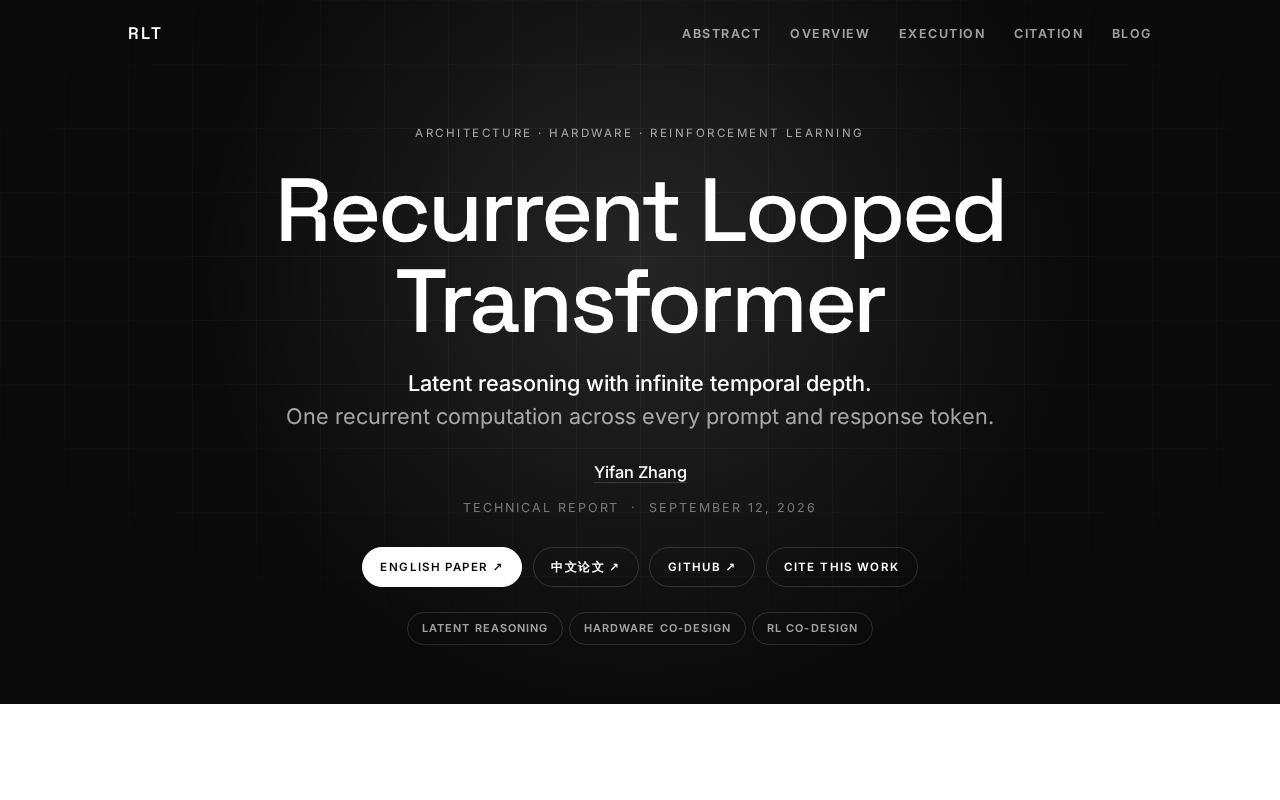
Recurrent Looped Transformers: A New Architecture That Teaches Models to "Think Again"
Recurrent Looped Transformers repeatedly apply the same Transformer block to decouple compute from parameters, enabling variable reasoning depth without scaling model size.
"Everyone Else Should Slow Down AI — Except Me": The Double Standard Trap in Big Tech
A viral Hacker News quip — "Everyone should slow down AI, except me" — exposes the double-standard at the heart of the AI race. We unpack why it's a Prisoner's Dilemma, not mere hypocrisy, and why institutions matter more than moral self-discipline.
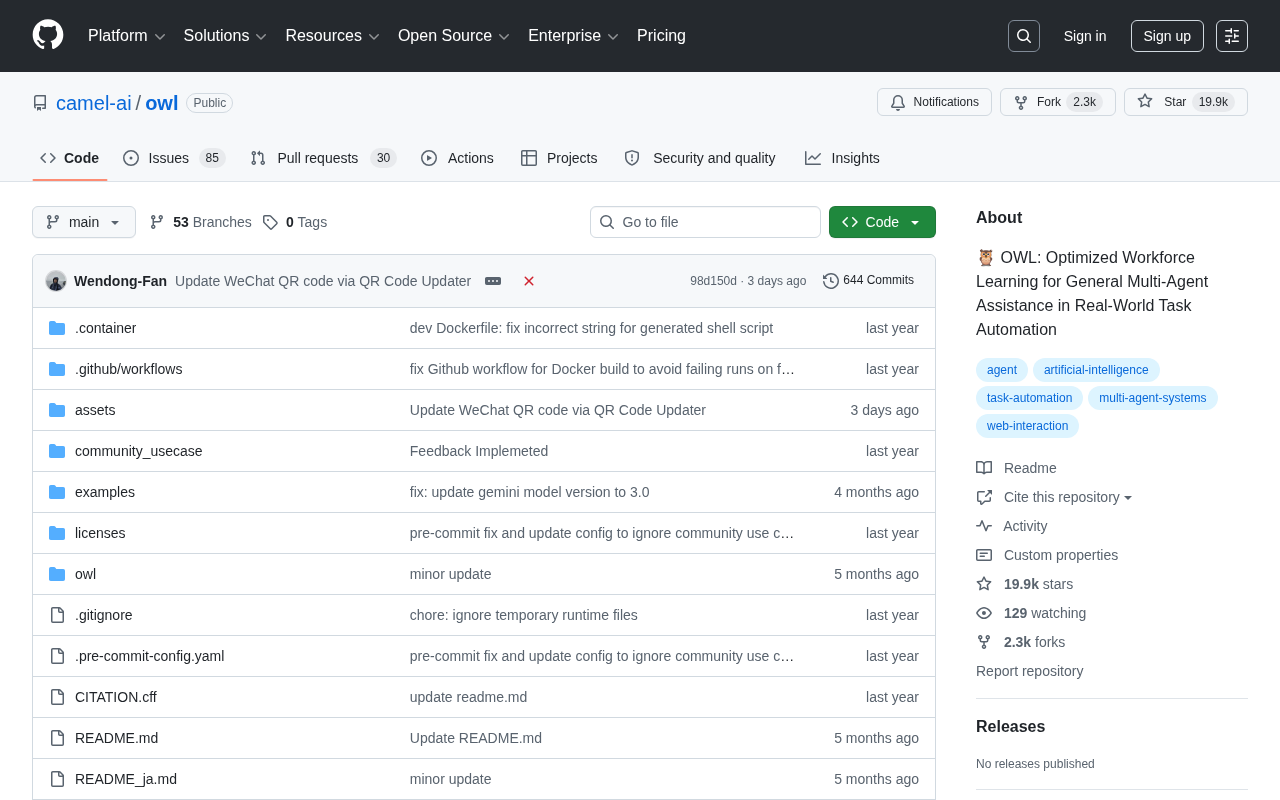
OWL: An Open-Source Multi-Agent Framework for Real-World Task Automation
OWL (Optimized Workforce Learning) is an open-source multi-agent framework by camel-ai for real-world task automation, with 19K+ GitHub Stars. Learn how it works.