GitHub Daily · October 16: The Agent Skills Ecosystem Explodes

Agent skill ecosystems dominate GitHub trends as obra/superpowers gains 897 stars and Anthropic, Cursor launch official plugin directories.
Today's GitHub trending list shows 8 of 13 projects tied to AI agent skill systems, plugin specs, or context optimization. obra/superpowers gained 897 stars in a day, while Anthropic and Cursor both launched official plugin directories—signaling a collective ecosystem pivot.
GitHub Daily · October 16: The Agent Skills Ecosystem Explodes
One glance at today's leaderboard and you can't sit still. Of the top thirteen projects, eight are directly tied to AI agent skill systems, plugin specifications, or context optimization. This isn't a scattered trend—it's an ecosystem-level collective pivot. Everyone suddenly arrived at the same realization: model capabilities have been pushed to a certain point, and the real differentiator now lies in how you equip your agent with hands, feet, and memory.
Let's start with the most eye-catching ones.
obra/superpowers: A Methodology That Gained 800+ Stars in a Single Day
What it is: An agent skill framework that doubles as a software development methodology.
The problem it solves: Agent tools are proliferating, but most people don't know what to do with them once they get their hands on one. How to write prompts, how to break down tasks, when to let the agent run on its own—superpowers aims to provide exactly this set of actionable rules. That "that works" in its repo description is telling—the author clearly knows there are far too many frameworks out there that are all talk.
Key features: It doesn't just hand you a pile of skill files—it embeds an entire development workflow. How you organize projects, how you validate in stages, how you give the agent clear decision criteria at every step—all of this is codified into reusable patterns.
Use cases: Indie developers and small teams. Especially the scenario where one person is managing several agents—you need a stable rhythm, or things spiral out of control fast.
Tech stack: Primarily written in Shell. That choice alone says something—it's going for the lowest possible barrier to entry and maximum compatibility, not tied to any specific language or platform.
Stars/Forks analysis: 240K stars, 20K+ forks, and 897 stars gained today alone. That scale combined with that growth rate means it's no longer just a niche play—it's becoming something of a default option.
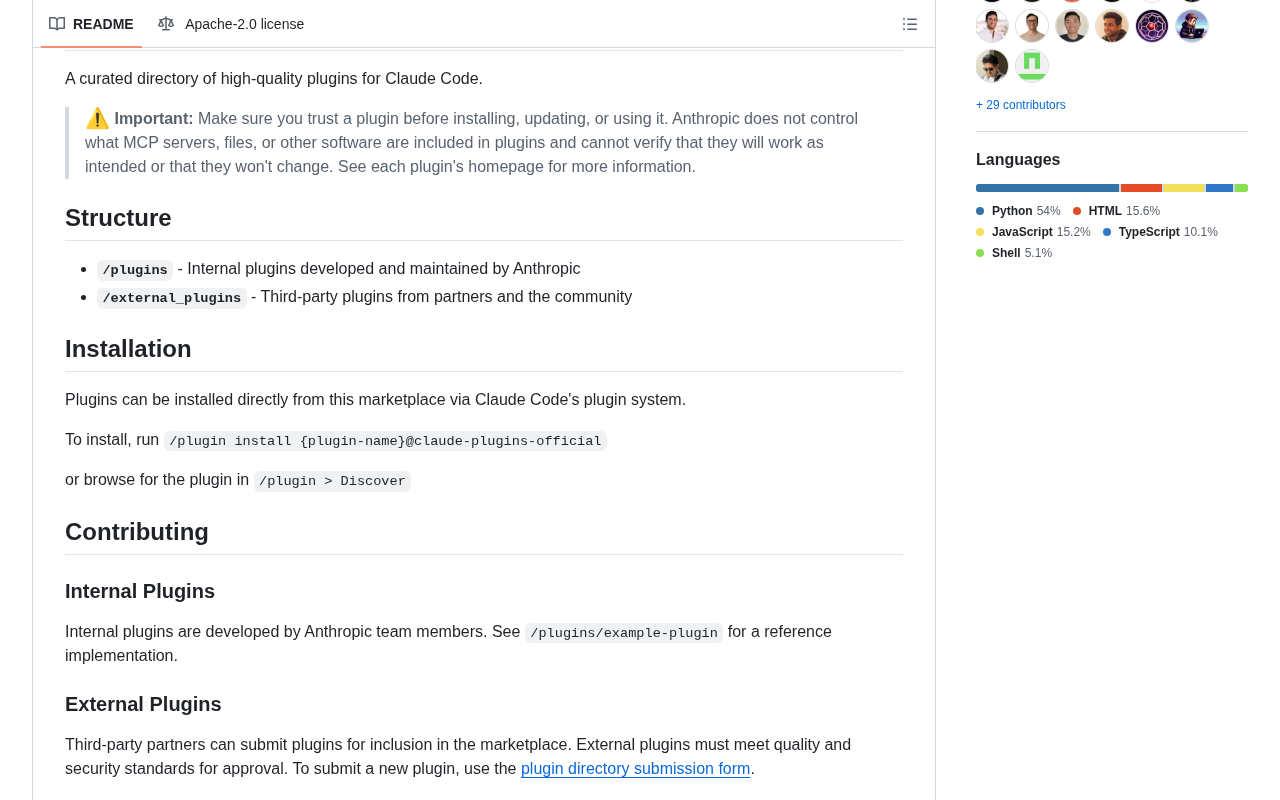
anthropics/claude-plugins-official: The Official Body Steps In to Set the Rules
What it is: Anthropic's officially maintained Claude Code plugin directory.
The problem it solves: The biggest fear with any plugin ecosystem is wild, unchecked growth. Who vets quality, who defines what makes a good plugin, how do users know which one to trust? An official directory consolidates all of that. It provides a trusted channel.
Key features: The most notable aspect is its curation. This isn't a simple list—there's Anthropic's screening and ongoing maintenance behind it. For plugin developers, getting into this directory is essentially an official endorsement.
Use cases: Every developer using Claude Code. When you want to extend functionality, check this directory first—it's far more reliable than searching around on your own.
Tech stack: Python. 30K+ stars, 3,800+ forks. Today's growth was only 47 stars, though—this is the kind of project that has already firmly established itself.
Stars/Forks analysis: Steady growth, but an extremely thick foundation. Official projects like this don't tend to rely on explosive growth—they gradually capture the market through sustained presence.
K-Dense-AI/scientific-agent-skills: Turning Agents Into Scientists
What it is: The largest agent skill library in the scientific domain.
The problem it solves: General-purpose agents often flounder when doing research because scientific data is scattered across hundreds or thousands of databases in wildly different formats. This project bundles 163 validated skills with over 100 scientific databases, bypassing that wall entirely.
Key features: Covers biology, chemistry, medicine, and drug discovery. It's also compatible with Cursor, Claude Code, Codex, Pi, Antigravity, and the open Agent Skills standard. That compatibility list is itself a statement: I work with everyone's tools.
Use cases: Researchers. The project claims 1.75 million scientists are using it—if that number is accurate, it's no longer just a tool; it's approaching infrastructure status.
Tech stack: Python. 35K+ stars, gained 498 today.
affaan-m/ECC: Giving Agents a Complete Brain
What it is: A performance optimization system for agent runtime frameworks.
The problem it solves: For an agent to truly be useful, skills alone aren't enough—it also needs intuition, memory, safety awareness, and a research-first development approach. Implementing any one of these individually isn't hard; the hard part is integrating them all without conflicts. ECC handles that integration layer.
Key features: Skills, intuition, memory, safety, research-first—five dimensions bundled together. It's clearly aimed at complex tasks; simple scenarios don't need something this heavy.
Use cases: Complex agent systems that need to run long-term. Think projects that operate continuously for days while retaining context throughout.
Tech stack: JavaScript. 225K stars is a pretty absurd number. Gained 486 today.
mksglu/context-mode: Use Context Sparingly
What it is: Context window optimization for AI coding agents.
The problem it solves: Running out of context window is one of the most frustrating problems right now. You have an agent read a bunch of tool output and—boom—tokens are maxed out. context-mode's approach is to sandbox tool output, cutting it by 98%.
Key features: Sandboxed output, persistent session memory, and routing across 17 platforms via MCP plus hooks. These three features together essentially cover the entire context management pipeline.
Use cases: Anyone who works with agents daily and constantly runs into context limits.
Tech stack: TypeScript. 25K stars, gained 256 today—the steady-and-solid type.
ruvnet/ruflo: The Control Tower for Multi-Agent Swarms
What it is: An agent meta-framework for deploying multi-agent swarms and orchestrating autonomous workflows.
The problem it solves: A single agent has limited capability, but throw multiple agents together and chaos ensues. Who's responsible for what, how do they communicate, how is memory shared—ruflo wants to be the orchestrator.
Key features: Adaptive memory, self-learning intelligence, RAG integration, and native support for multiple mainstream agent platforms. "Meta-harness" is the right word—it manages other frameworks.
Use cases: Teams that need multiple agents collaborating on complex task flows.
Tech stack: TypeScript. 68K+ stars, gained 140 today.
HKUDS/CLI-Anything: Making All Software Agent-Accessible
What it is: A project from HKU's Data Intelligence Lab, aiming to make all software agent-native.
The problem it solves: Most software today is built for humans, not agents. Interfaces, interaction logic—none of it is suited for agent use. CLI-Anything's approach starts from the command line, building a bridge for agents.
Key features: Comes with a companion CLI-Hub site. 47K+ stars, gained 100 today—the quiet-but-solid type.
cursor/plugins and android/skills: Platform Players Start Building Ecosystems
Cursor released a plugin specification plus official plugins, with 2,700+ stars. Android put out a skills repo written in Kotlin, with 7,800+ stars.
Looking at these two together is interesting. One is a hot AI coding tool filling out its ecosystem; the other is a mobile giant preparing for the agent era. Neither gained many stars today, but their strategic significance far outweighs the numbers.
debpalash/VoiceStudio: A Localized Voice Factory
What it is: A fully local, open-source alternative to ElevenLabs.
The problem it solves: When it comes to voice cloning and synthesis, cloud services are expensive and raise privacy concerns. VoiceStudio moves the entire pipeline onto your own machine.
Key features: Voice cloning, voice design, video dubbing, dictation, transcription, audiobook production—covering 646 languages. The feature list is almost absurdly long.
Use cases: Creators who are privacy-conscious or looking to save money.
Tech stack: Python. 12K+ stars, gained 509 today—one of the fastest-growing on the list.
MadsLorentzen/ai-job-search: Fully Automated Job Hunting
What it is: An AI job search framework that runs on your own machine, built on Claude Code.
The problem it solves: Applying for jobs involves way too much repetitive work—evaluating postings, tailoring resumes, writing cover letters, preparing for interviews. Every step drains energy. This project automates the entire pipeline.
Key features: Emphasizes "Fork it and own it." All data stays local—it never passes through third-party servers. 30K+ stars, 11K+ forks, gained 378 today.
Use cases: Job seekers who are applying en masse but don't want to spend too much time on it.
hmjz100/LinkSwift: The Old Craft of Cloud Drive Direct Links
What it is: A JavaScript-based tool for obtaining direct download links from cloud storage services.
The problem it solves: Speed throttling on Chinese cloud drives has been a persistent headache. LinkSwift, based on a modified cloud drive direct link download assistant, supports eight major services, including Baidu Netdisk, Aliyun Drive, China Mobile Cloud, Tianyi Cloud, Xunlei Cloud, Quark Drive, UC Drive, and 123 Cloud.
Key features: Broad coverage is its biggest advantage. 23K+ stars, gained 592 today—the highest single-day gain on the list. That number alone tells you how real the demand is.
xerj-org/xerj: Search Data With Fewer Tokens
What it is: An AI-oriented search tool, billed as a new way to search data.
The problem it solves: Having agents dig through data with grep and sed burns through tokens. xerj's automatic indexing lets agents understand your data without consuming nearly as many tokens.
Key features: A single command indexes code, docs, logs, and PDFs for search, RAG, security auditing, and agent memory. Reportedly uses 40x fewer tokens than grep. Compatible with Elasticsearch—existing clients can use it directly.
Tech stack: Rust. 4,700+ stars, gained 725 today—second-highest growth rate on the list. A project clearly in its upswing.
Today's Common Threads
Connect the dots and one line becomes very clear.
Agent competition has shifted from model capabilities to supporting ecosystems. Skill libraries, plugin specifications, context management, multi-agent orchestration—all four directions had projects on today's list. And these aren't small players—Anthropic, Cursor, and Android are stepping in personally.
Another signal is localization and privacy. VoiceStudio and ai-job-search both emphasize running entirely locally. Users are starting to care about data sovereignty, and this trend will only intensify.
And the role of efficiency tools is changing. xerj claims 40x token savings over grep; context-mode claims a 98% reduction in output. The competition is no longer about who has more features—it's about who uses fewer resources. That's a sign of a maturing market.
Today's Must-See TOP 3
#1: obra/superpowers The reason is simple: it's the only project today that delivers both a framework and a methodology, and has already been validated at scale. 240K stars, nearly 900 gained in a day—a project of this size still maintaining that growth rate means it's hit a real pain point. If you only look at one thing today, look at this.
#2: xerj-org/xerj 4,000+ stars, 725 gained in a day—the highest growth ratio on the list. Written in Rust, going for performance-first, and compatible with a mature ecosystem like Elasticsearch. This playbook usually signals potential to become infrastructure. Worth watching early.
#3: K-Dense-AI/scientific-agent-skills The 1.75 million scientists figure carries serious weight. It's not a general-purpose tool—it's the kind that goes all-in on a vertical domain. The skill library plus database combination delivers tangible efficiency gains for research scenarios. The value of deep vertical focus is clearly on display in today's list.
Looking Ahead
Two things to watch closely over the next few weeks. First, whether the Cursor and Android skills repos iterate rapidly—platform players' moves often signal where the entire ecosystem is heading. Second, whether efficiency projects like xerj attract competitors—once they do, the track is officially established.
Agent infrastructure building has only just begun.
One-line Summary
Eight of today's thirteen trending projects are directly tied to AI agent skill systems, with ecosystem building as the clear main theme; obra/superpowers gained 897 stars in a single day, emerging as a de facto standard candidate for agent skill frameworks; Anthropic and Cursor simultaneously launched official plugin directories as platform players begin to consolidate ecosystem standards.
Related articles

Free Unlimited Claude Code Solution: Agnes AI + CC Switch Setup Guide
No paid subscription needed — pair the free AI platform Agnes AI with the open-source tool CC Switch to provide a backend for Claude Code, enabling unlimited free calls to text, image, and video models. This guide covers the full setup, test results, and usage boundaries.

A Complete Zero-Cost Guide to Getting Started with Claude Code for Beginners in China
A beginner's guide to Claude Code for users in China: two installation methods (command line and IDE plugin), full configuration steps for replacing the official API with the free domestic LongCat model, and a hands-on demo of building a small tool with natural language, plus tips.

When the NSA Gets Involved: The AI Supply Chain Crisis Behind Open-Source CVEs and API Key Hijacking
Multiple open-source projects disclosed severe CVEs in one day, PHP flaws alarmed the FBI, and Railway and OpenCode were breached with API keys stolen. This article breaks down the vulnerability window, AI-accelerated exploitation, and the AI supply chain crisis behind the API key black market, with a developer defense checklist.