Zen Browser: The Perfect Replacement for Arc?

Zen Browser inherits Arc's design with an open-source Firefox core, becoming an active replacement.
The article reviews Arc Browser's stagnation after acquisition by Atlassian and the strategic shift to Dia, leaving users disappointed, and notes Zen Browser timely fills the gap. Zen is based on Firefox, retaining Arc's core interactions like vertical tabs and sidebar workspaces, but emphasizes customization, privacy, and local use, supporting Firefox account sync without mandatory login. Feature comparisons show Zen excels in tab management flexibility and resource usage but falls short in default visual refinement. The community-driven open-source model keeps Zen actively updated with growing plugins and themes; although mobile sync and AI integration lag, it precisely meets former Arc users' needs for desktop efficiency and freedom, seen as an ideal low-migration-cost alternative.
Arc's Legacy and User Pain Points
Arc Browser once redefined browser interaction with its unique sidebar tab management, space division, and minimalist aesthetics. However, after Atlassian acquired its parent company, the focus shifted to the more AI-centric Dia browser, causing Arc's updates to stagnate and leaving the user community disappointed. According to the author of the RSS source article, many users "mourned Arc's departure" because "no app has genuinely offered new browser design ideas in a long time." Against this backdrop, users urgently need an alternative that inherits Arc's design philosophy while maintaining active development.
Atlassian and Arc's Acquisition Background
Atlassian is an Australian publicly traded company known for team collaboration software like Jira and Confluence. Around 2023, Atlassian acquired The Browser Company (the developer of Arc Browser), but after the acquisition, it did not continue investing resources into Arc's iteration; instead, it shifted its strategic focus to Dia, a new browser emphasizing AI interaction. This shift meant Arc went from a "flagship product" to a "technology testbed," with update frequency plummeting and community feedback channels gradually falling silent. For users who relied on Arc's unique workflows, this was not just product stagnation but also the loss of continued evolution for the design language and interaction habits they were familiar with.
Dia Browser and AI-First Strategy
Dia is the AI-native browser launched by The Browser Company after Arc, with its core philosophy being the deep integration of large language models into browsing, search, and content generation processes, rather than merely using AI as a sidebar plugin. Atlassian's allocation of Arc's main team to Dia reflects the industry's high stakes in the "AI browser" narrative. However, this strategic shift also exposes the commercial dilemma facing innovative browsers: unique interaction designs are difficult to directly translate into sustainable revenue, while AI features are more likely to attract enterprise customers and investment stories.
Zen Browser's Design Philosophy: Inheritance and Improvement
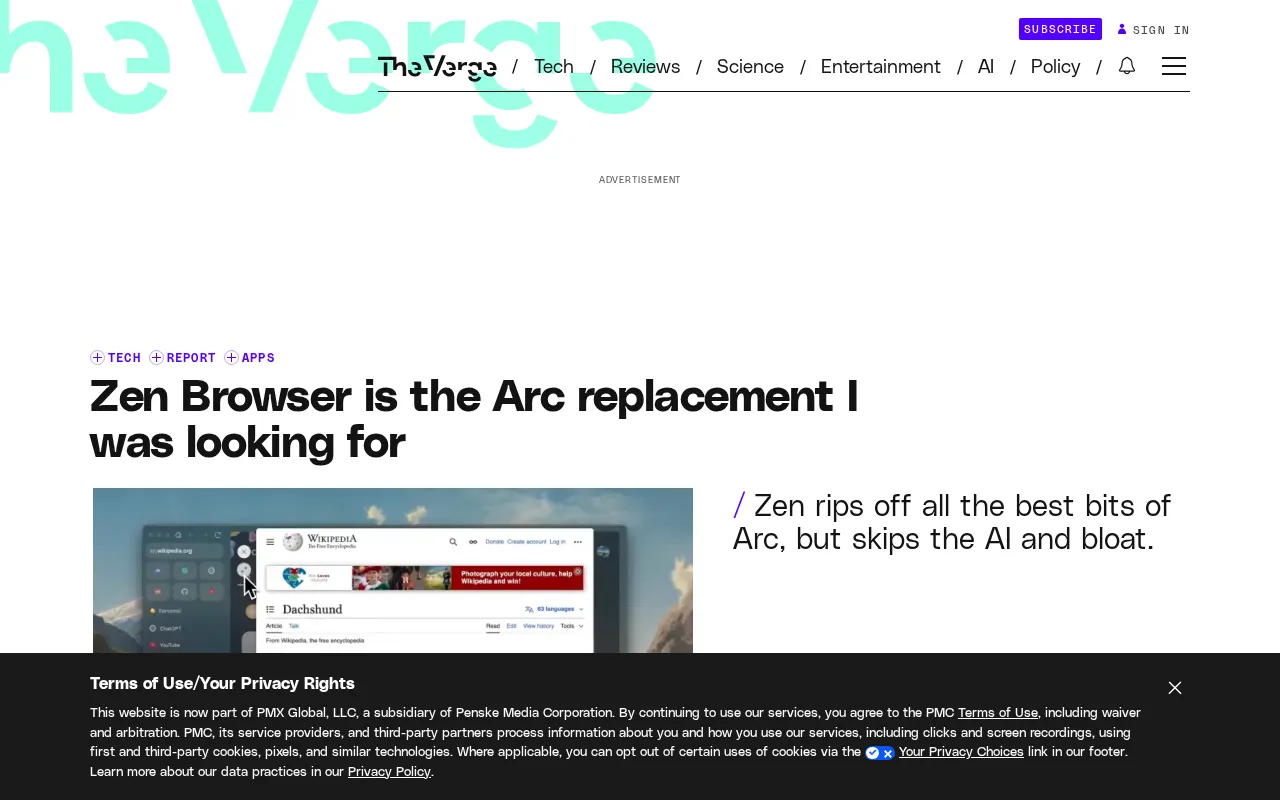
Zen Browser does not simply copy Arc but makes targeted improvements on its foundation. It retains core elements like vertical tabs and sidebar workspaces but places greater emphasis on customization and privacy. Unlike Arc's mandatory account binding, Zen is based on the Firefox core and inherits the open-source community's traditions of extensibility and privacy protection. According to community user feedback, Zen's interface transition animations and shortcut key designs are closer to native experiences, reducing the occasional lag felt in Arc. This "decentralized" design approach actually makes users feel freer.
Differences Between Firefox Core (Gecko) and Chromium
Zen Browser is based on Firefox's Gecko rendering engine, rather than the Chromium used by Arc. Gecko is maintained by Mozilla and is the core of Firefox; its open-source license allows third parties to deeply customize the interface and features. Compared to the Chromium ecosystem, Gecko has different trade-offs in privacy protection (such as enhanced tracking protection) and extension models (WebExtensions): Firefox's extension review is relatively lenient and supports more granular user scripts and style customizations. This explains why Zen can offer stronger customization capabilities, though it may mean less compatibility with some websites compared to Chromium-based browsers, in exchange for respect for user control.
Vertical Tabs and Sidebar Workspaces
Vertical tabs change the traditional top horizontal tab arrangement to a vertical list on the side, displaying more complete titles when there are many tabs, reducing squeezing and misclicks; sidebar workspaces group tabs by project or scenario, similar to virtual desktops, where switching workspaces switches an entire group of tabs and historical context. Arc was a representative promoter of this interaction paradigm, and Zen inherits this approach, allowing users to more flexibly reorganize groups via drag-and-drop while retaining Firefox's native tab management logic as underlying support.
Feature Comparison: How Zen Addresses Arc's Shortcomings
Arc's closed ecosystem and mandatory login have sparked controversy, while Zen directly supports Firefox account synchronization and allows users to operate entirely locally. In tab management, Zen's "workspace" feature supports more flexible drag-and-drop grouping, and its resource usage is significantly lower than Arc's Chromium core. Multiple YouTube tech reviewers have noted in their evaluations that Zen's vertical tab bar is more stable than Arc's with a large number of tabs, especially suitable for heavy tab users. However, some users feel that Zen's default theme is too plain and requires some configuration to achieve Arc's visual refinement.
Firefox Account Synchronization and Local Use
A Firefox account (Mozilla account) can synchronize bookmarks, history, passwords, extensions, and tabs, with synchronization data end-to-end encrypted by default. Unlike Arc, which requires login to use full features, Zen allows users to operate entirely without logging in, purely locally, with all configurations saved on the device. This is particularly important for users who value data sovereignty or are in restricted network environments. It should be noted that Zen's synchronization relies on Mozilla's infrastructure rather than Zen team-built services, thus inheriting Firefox's framework in terms of privacy policy.
Resource Usage Characteristics of the Chromium Core
Chromium uses a multi-process architecture, where each tab and extension may run as an independent process, providing better isolation and stability but typically higher memory usage, especially with many tabs. Arc, based on Chromium, inherits this characteristic. Zen, based on Firefox's Gecko, has a different process model (such as Fission site isolation) for resource scheduling; community evaluations often report lower memory usage with a moderate number of tabs, but this advantage varies with usage patterns and is not absolute.
Community Ecosystem and Future Outlook
Zen Browser is maintained by an independent developer team under an open-source model, with a high update frequency. In contrast to Arc's stagnation after acquisition, Zen's GitHub repository activity continues to rise, with community-contributed plugins and themes gradually enriching. Although Zen currently lags behind competitors like Dia in mobile synchronization and AI integration, its focus on desktop efficiency and privacy precisely meets the core needs of former Arc users. As the original author said, Zen is "the Arc replacement I've been looking for," rekindling the spark of browser innovation with open source and customization.
For users nostalgic for Arc, Zen Browser offers a low-migration-cost, high-freedom option. Its success also reminds the industry: browser innovation does not necessarily require big company backing; community-driven efforts can also nurture excellent products.
Open Source Model and GitHub Community Contributions
Zen Browser's source code is hosted on GitHub under an open-source license, allowing anyone to view the code, submit issues, initiate pull requests, or build derivative versions based on its code. This model means the update pace is not dictated by a single commercial company's strategy, and the community can contribute themes, plugin compatibility fixes, and localization translations. In contrast to Arc's closed source and stagnant updates after acquisition, Zen's activity is reflected in commit frequency, issue responses, and community discussions. However, open source also means the project relies on volunteer sustainability, and long-term maintenance still faces funding and manpower challenges.
Current Status of Mobile Synchronization and AI Integration
Zen currently focuses primarily on the desktop experience, with mobile synchronization capabilities not yet complete; users who need seamless transitions between phone and desktop may still need to use Firefox mobile or third-party tools. In terms of AI integration, Zen has not yet built in conversational browsing features like Dia's, but can access some AI assistants through the Firefox extension ecosystem. This is both a shortcoming and consistent with its positioning of "focusing on desktop efficiency and privacy"—not blindly stacking AI features but leaving the choice to users.
One-line Summary
Zen Browser inherits Arc's design with an open-source Firefox core, becoming its active replacement.
Paragraph Summary
The article reviews the background of Arc Browser's acquisition by Atlassian, its strategic shift to Dia causing update stagnation and user disappointment, and points out that Zen Browser fills the gap just in time. Zen is based on the Firefox core, retaining Arc's core interactions like vertical tabs and sidebar workspaces, but emphasizes customization, privacy, and local use, supporting Firefox account synchronization without mandatory login. Feature comparisons show Zen excels over Arc in tab management flexibility and resource usage but falls slightly short in default visual refinement. The community-driven open-source model keeps Zen actively updated with growing plugins and themes; although mobile synchronization and AI integration lag behind competitors, it precisely meets former Arc users' needs for desktop efficiency and freedom, seen as an ideal low-migration-cost alternative.
Related articles
Email Identity Management for Multiple AI Agents: Aliases, Dedicated Inboxes, or API Solutions?
How should multiple AI agents manage email identities? This article analyzes email aliases, dedicated inboxes, and API on-demand creation, with layered management advice by agent role.

iPhone Duo Crackgate: YouTuber Teardown Reveals Hinge Defect
Apple's iPhone Duo foldable has been hit by Crackgate, with users reporting rapid screen cracking at the hinge. A YouTuber's teardown found a hinge design flaw or foreign object intrusion causing stress concentration. The incident has sparked community debate, Apple has not responded, and foldable reliability is once again under scrutiny.

ChatGPT Is Building a Psychological Profile of You: Privacy Boundaries Under Fire Again
A Reddit thread debates whether ChatGPT builds psychological profiles of users. This article analyzes how chat memory, emotional signals, and behavioral data accumulate into psychological profiles, explores the boundary between personalization and covert surveillance, and offers practical privacy tips.