Let the Agent Be the Director: A Vision for a Fully Local AI Production Workstation

Orchestrating multiple models with an Agent turns a one-sentence instruction into a full AI short film, but full local deployment is still limited by compute and consistency challenges.
The article explores a Bilibili creator's concept of a "local AI director workstation": a single instruction triggers an Agent to orchestrate screenwriting, storyboarding, image generation (ComfyUI), video generation, voiceover, sound, and editing (Remotion, FFmpeg) into a finished film. Automated review—detecting face changes or action breaks and auto-fixing or regenerating—is the most valuable yet hardest part. The author notes that full-local multi-model chaining has exponentially rising fault-tolerance costs, with VRAM and latency as key constraints, and suggests validating one stage at a time.
AI video models generating ten-odd seconds of cinematic footage is no longer novel, but stitching together script, storyboard, generation, voiceover, and editing into a complete short film is far more grueling than one might imagine. A concept proposed by a Bilibili creator deserves serious attention: using a single computer equipped with an NVIDIA RTX Spark to build a local AI director workstation, where an Agent orchestrates different models and tools to take over the entire production pipeline.
From a Single Instruction to a Short Film
In the creator's vision, the entire interaction is compressed into one sentence: "Help me make a sci-fi action short set in a future world."
Once the instruction is issued, the Agent begins scheduling the workflow: first it calls a screenwriting tool to write the story, then designs the storyboard based on the plot, determining the characters, scenes, and actions for each shot; next it calls ComfyUI workflows to generate character reference images and keyframes, and works with video models to animate the visuals. The value of this pipeline lies not in how strong any single model is, but in handing over the steps that previously required a human to switch between back and forth to an Agent with task-decomposition capabilities for unified orchestration.
ComfyUI and Node-Based Workflows: ComfyUI is an open-source Stable Diffusion frontend based on node graphs, where users break down steps such as model loading, prompt encoding, sampling, VAE decoding, and image post-processing into individual nodes, connecting them with wires to define data flow. Compared to the fixed-interface WebUI, its advantage is that workflows can be programmatically serialized and saved, and called externally via API—this is precisely the premise that allows an Agent to take over image generation: the Agent only needs to generate or modify a node-graph JSON to control the generation parameters for different outputs such as character reference images and keyframes. The ComfyUI ecosystem also supports plugins like ControlNet, IP-Adapter, and LoRA for character consistency and pose control, so it is often used as the "image frontend" of video generation pipelines.
Beyond Generation: Handing Review and Post-Production to the Agent Too
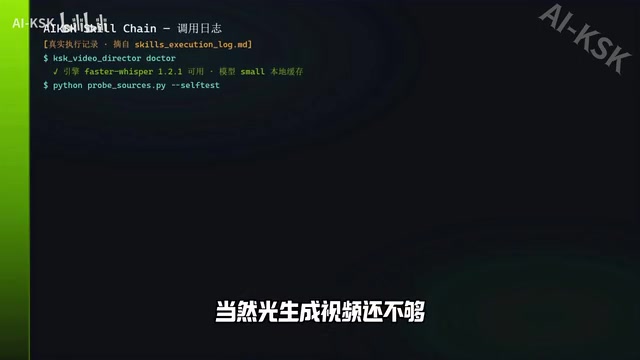
Generating video is only an intermediate step. The creator also wants to integrate more modules—character consistency review, intelligent voiceover, sound effects processing, and automated editing. Tools like Remotion and FFmpeg can be called directly by the Agent to arrange footage in order based on analysis results, add music and transitions, and finally render the finished film.
Even more interesting is the automated review feature: when a character's face suddenly changes, actions don't connect, or a shot's generated result is off, the Agent must be able to detect the problem itself, fix what it can directly, and regenerate what it can't. This essentially turns "QA inspection" into an automated node in the pipeline, and it is also the hardest—yet most valuable—part of the entire concept.
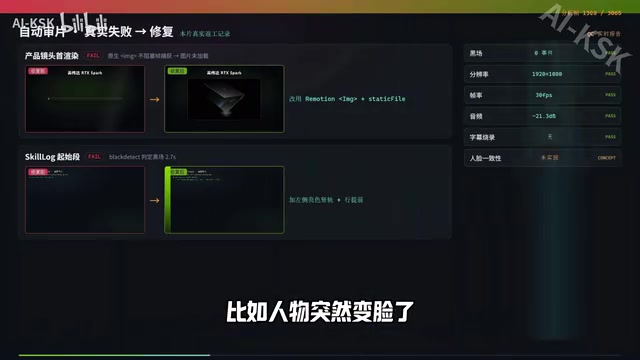
The Division of Labor Between Remotion and FFmpeg: FFmpeg is the oldest audio-video processing command-line tool, excelling at low-level operations such as decoding, concatenation, transcoding, frame extraction, and audio mixing—virtually every editing software's export stage depends on it directly or indirectly. Remotion, on the other hand, describes video through React components—timelines, subtitles, and transitions are all written as code, then rendered frame by frame via a browser rendering engine to composite the video. The value of combining the two lies in "programmability": the Agent generates a script or a timeline JSON to drive the editing process, without a human dragging clips on a timeline. This also allows the results of automated review to be directly translated into editing instructions—for example, cutting out or replacing problematic shots and re-concatenating them.
Localization Is the Selling Point—and the Biggest Bottleneck
Getting this system to actually run is no easy feat. The orchestration among local models, the Agent, and various tools places high demands on compute and stability. The creator's approach is to use NVIDIA RTX Spark to integrate models suitable for local execution and the Agent onto a single computer, progressively connecting the pipeline.

A bit of cold water is warranted here: the fault-tolerance cost of chaining multiple models rises exponentially with the number of stages, and consistency review itself is an open problem in the current video generation field. Running screenwriting, image, video, speech, and editing models on a single machine means VRAM and inference latency will be the most practical constraints. A more viable path may not be full local operation in one step, but rather running core generation models locally while scheduling heavy tasks on demand—first closing the loop on a single stage (such as storyboard to keyframes), then expanding outward.
Why VRAM and Inference Latency Become Hard Constraints: Video generation models (especially diffusion-based ones) need to hold weights, activations, and intermediate features in memory simultaneously during inference; as resolution and frame count increase, VRAM usage balloons rapidly. If language models, speech synthesis, and image models also need to be loaded in parallel, a single GPU's VRAM is easily exhausted, forcing repeated swapping in and out and further worsening latency. Moreover, multi-model chaining is a "cascading error" structure: if any stage's output deviates from expectations, downstream stages amplify the problem, and retry costs compound with the number of stages. This is the engineering reason why "full local operation in one step" is difficult to achieve; on-demand scheduling and staged validation are more realistic strategies.
Signals Worth Watching
This concept comes from an individual creator's imagination and has yet to be validated in practice, but the direction is worth noting: competition in AI video is shifting from "generation quality" to "pipeline orchestration." Whoever can turn Agent scheduling, consistency control, and automated review into a stable pipeline will be one step closer to "one person equals an entire film crew." For creators, freeing up time from mechanical operations to invest in creativity is the true significance of this kind of workstation.
One-line Summary
Using an Agent to orchestrate multiple models turns a one-sentence instruction into a complete AI short film, but full local deployment remains constrained by compute and consistency challenges.
Paragraph Summary
The article explores a Bilibili creator's concept of a "local AI director workstation": the user gives a single instruction, and the Agent sequentially orchestrates modules for screenwriting, storyboarding, image generation (ComfyUI), video generation, voiceover, sound effects, and editing (Remotion, FFmpeg), ultimately rendering a finished film. The most valuable and difficult part of the concept is automated review—detecting issues like character face changes and action discontinuities and automatically fixing or regenerating them, effectively turning QA inspection into a pipeline node. The author also notes that the fault-tolerance cost of full-local multi-model chaining rises exponentially with the number of stages, with VRAM and inference latency being the most practical constraints, and suggests closing the loop on a single stage before expanding. The conclusion is that industry competition is shifting from generation quality to pipeline orchestration.
Related articles

Email Identity Management for Multiple AI Agents: Aliases, Dedicated Inboxes, or API Solutions?
How should multiple AI agents manage email identities? This article analyzes email aliases, dedicated inboxes, and API on-demand creation, with layered management advice by agent role.

iPhone Duo Crackgate: YouTuber Teardown Reveals Hinge Defect
Apple's iPhone Duo foldable has been hit by Crackgate, with users reporting rapid screen cracking at the hinge. A YouTuber's teardown found a hinge design flaw or foreign object intrusion causing stress concentration. The incident has sparked community debate, Apple has not responded, and foldable reliability is once again under scrutiny.

ChatGPT Is Building a Psychological Profile of You: Privacy Boundaries Under Fire Again
A Reddit thread debates whether ChatGPT builds psychological profiles of users. This article analyzes how chat memory, emotional signals, and behavioral data accumulate into psychological profiles, explores the boundary between personalization and covert surveillance, and offers practical privacy tips.