GitHub Daily · September 1st: Claude Ecosystem Explodes, Local AI Tools on the Rise

Claude ecosystem explodes and local-first AI tools surge on GitHub Trending September 1st.
GitHub Trending on September 1st reveals two major trends: the Claude Code ecosystem is booming with projects like openclaude (a universal runtime framework) and academic-research-skills (an AI-powered paper writing pipeline), while local-first tools like VoiceStudio (an open-source ElevenLabs alternative with 500+ daily Stars) and reclip (a self-hosted video downloader) signal a strong push toward data sovereignty and cost control.
Today's Overview
Today's GitHub Trending sends a very clear signal: the developer ecosystem around Claude Code is expanding rapidly, while local, self-hosted AI tools are collectively gaining ground.
Among the top five on the leaderboard, two projects are deeply tied to Claude Code, and two others focus on local deployment with full data control. Behind this are two converging trends: one is AI coding assistants evolving from simply writing code to covering complete workflows; the other is developers' growing wariness of cloud-based black boxes, with more and more people wanting to bring AI capabilities back to their own machines.
Let's break them down one by one.
Gitlawb/openclaude: Run Claude Anywhere
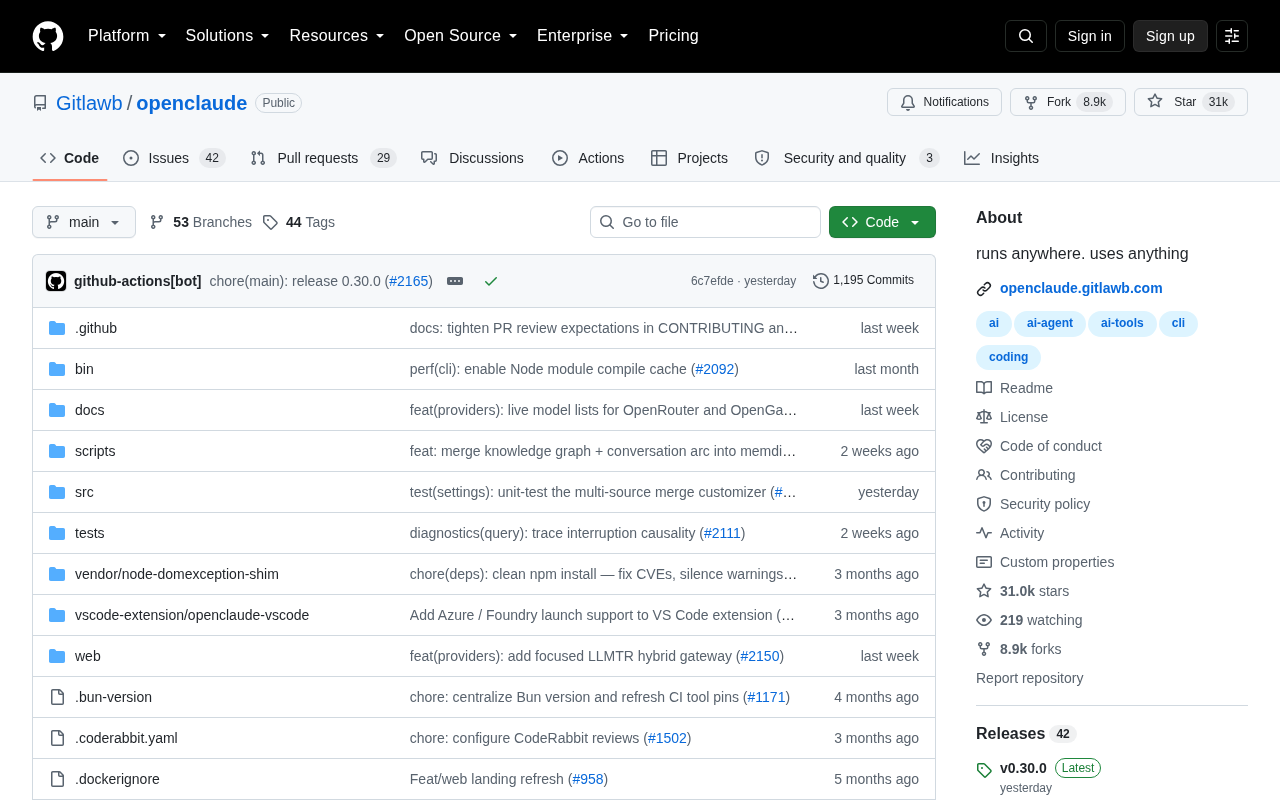
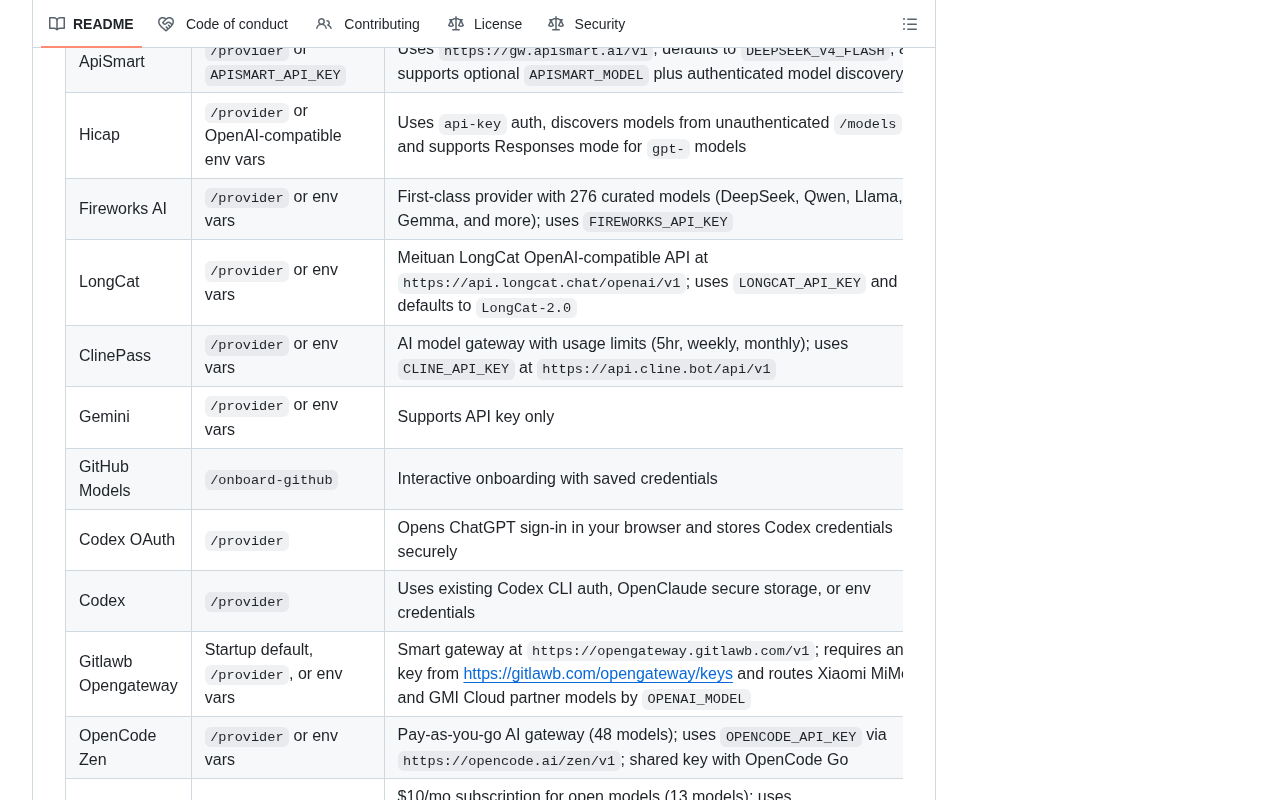
This project's tagline is bold — "runs anywhere, uses anything." At its core, it's a Claude runtime framework written in TypeScript, designed to let you run it in any environment and connect to any model backend.
What's the core pain point it solves? Right now, using Claude often means being locked into the official CLI or a specific platform. openclaude aims to decouple the underlying model from the upper-layer interaction. You can use Claude today, switch to a different model tomorrow, and your workflow doesn't need to be rewritten.
The choice of TypeScript as the tech stack is very frontend- and full-stack-friendly, meaning it can be easily embedded into the existing Node ecosystem. It already has over 30,000 Stars and nearly 9,000 Forks — that Fork count is remarkable, indicating that a large number of developers aren't just bookmarking it but are actually modifying and building on top of it.
For teams that want to build their own AI workbench without being locked into a single vendor, this is a foundation worth studying.
Imbad0202/academic-research-skills: Let Claude Help You Write Papers
This project gained over 160 Stars today, pushing its total past 44,000 — one of the largest projects on the list. Its positioning is clear: equip Claude Code with a set of academic research skills.
It breaks academic writing down into a complete pipeline — research, writing, peer review, revision, and finalization. Each step has a corresponding skill module. Think of it as encoding a graduate advisor's methodology into a process that AI can execute.
Why is this project so popular? Because academic writing is a highly structured yet extremely time-consuming task. Many researchers aren't bad writers — they're just drained by literature reviews and endless revisions. This project, implemented in Python, automates the entire process, with AI playing different roles at each stage.
The use cases are very specific: PhD students writing literature reviews, researchers organizing experiment reports, or even technical teams that need to produce white papers. It fills a gap that general-purpose AI assistants often lack — domain-specific methodology — by encoding academic methodology directly into the workflow.
debpalash/VoiceStudio: A Fully Local Voice Factory
If there's one project with the most explosive growth today, it's VoiceStudio. It gained over 500 Stars in a single day — the momentum is fierce.
It positions itself as an open-source, local alternative to ElevenLabs. ElevenLabs is a popular AI voice service, but it's cloud-based, paid, and requires data uploads. VoiceStudio brings the entire capability set to your local machine: voice cloning, voice design, video dubbing, dictation, transcription, and audiobook production.
The most impressive claim? It supports 646 languages. That coverage is practically overwhelming. Implemented in Python, its core selling point is "fully local" — everything runs on your own machine, so you never have to worry about voice data leaks.
Who would use it? Think about content creators who need to batch-dub videos, or localization teams that need to translate content into dozens of languages. Previously, all of this required paid cloud API calls — now you can set up your own system. For privacy-sensitive scenarios like medical or legal transcription, local deployment is an absolute must.
The 500+ single-day Star growth shows it's precisely hitting that contradiction people feel about voice AI — wanting to use it but worrying about cost and data exposure.
VoltAgent/awesome-design-md: Let AI Build UI Like Top Brands
This project has a massive Star count of over 112,000 — the largest on the entire list. It's essentially a curated collection of DESIGN.md files from well-known brand design systems.
The approach is brilliantly clever. Everyone's using AI to generate interfaces now, but AI-generated UI tends to be mediocre and lacks brand identity. This project's solution is to organize mature brands' design specifications into individual DESIGN.md documents. Just drop the relevant file into your project, and your coding assistant can generate interfaces that match the brand's style.
It doesn't champion any particular programming language because it's essentially a set of design instructions for AI. It fills the gap where AI can write code but doesn't understand aesthetics — these documents translate designers' aesthetic sensibilities into rules AI can understand.
The use case is straightforward: a small team without a dedicated designer that wants their product to look like it came from a major company can leverage these design specifications. It gained over 480 Stars today, showing that the concept of "design as documentation" is being embraced by more and more people.
averygan/reclip: A Lightweight Self-Hosted Video Downloader
This last project is relatively small but highly practical. reclip is a self-hosted media download tool that can download videos from almost any website, complete with a clean web interface.
It's primarily implemented in HTML, emphasizing lightweight design and self-hosting. Current download tools are either command-line based with a high barrier to entry, or web services cluttered with ads and restrictions. reclip's goal is simple: deploy it on your own server, and you have a private, clean-looking download center.
With over 7,000 Stars and 1,300+ Forks, these are very healthy numbers for a utility project. The use cases include people who want to save learning materials offline, or researchers who need to archive web content. Its value lies in turning a common need into a small tool everyone can control themselves.
Today's Trend Observations
Looking at these five projects together, two main threads become very clear.
The first is the explosive growth of the Claude ecosystem. Both openclaude and academic-research-skills are built around Claude. One provides a foundational runtime framework, the other delivers domain-specific skills on top. This shows that Claude Code is no longer just a coding tool — it's becoming a platform, with people building all sorts of applications on top of it.
The second is the collective return of local deployment and self-hosting. VoiceStudio champions fully local operation, and reclip champions self-hosting. In an age of highly developed cloud services, why do people want to move things back to their own machines? The answer is data sovereignty and cost. Cloud services are convenient but expensive, and your data sits in someone else's hands. The developer community is voting with their feet, pursuing solutions where they call the shots.
There's also a hidden trend worth mentioning: packaging knowledge into documents to feed to AI. Both awesome-design-md and academic-research-skills essentially follow this pattern. The former packages design specifications; the latter packages research methodology. In the future, we'll likely see a flood of these AI-oriented knowledge packs.
Today's Must-See TOP 3
My number one pick is VoiceStudio. The 500+ single-day growth speaks for itself — it fully localizes expensive cloud-based voice capabilities and supports over 600 languages, making it a genuine boon for content creators.
Number two is academic-research-skills. It breaks down the perennial challenge of academic writing into an executable AI pipeline, delivering very direct value to the research community.
Number three goes to awesome-design-md. It uses an exceptionally clever approach to solve the pain point of AI-generated interfaces lacking brand identity, and the concept can be replicated across many domains.
Overall, today's leaderboard shows us that AI tools are moving from general-purpose to specialized, and from cloud to local. Developers are no longer satisfied with a one-size-fits-all assistant — they're starting to build solutions that are both professional and controllable for each specific scenario. That's a great sign.
Related articles

GitNexus: Replacing Vector Retrieval with Code Knowledge Graphs, Cutting AI Coding Costs by 51%
GitNexus is an open-source code knowledge graph kernel that replaces vector embeddings with deterministic graphs for coding AI Agents, cutting costs by 51% in official benchmarks. Supports MCP protocol for plug-and-play integration.

Qwen3 27B Open-Source Breakdown: Native Multimodal Dense Architecture and Agent Capability Benchmarks
Deep dive into Qwen3 27B: 27B dense architecture, hybrid attention design, native 260K context, Apache 2.0 license. Agent benchmarks, hardware requirements, and FP8 quantization analysis.

Is Programming Meditation? Decoding Flow States in Deep Work
When developers are fully absorbed in coding, is that intense focus equivalent to meditation? This article analyzes the overlap between deep work and meditation through flow theory and neuroscience.