Is Programming Meditation? Decoding Flow States in Deep Work

Exploring how the flow state in deep programming mirrors meditation, and how to cultivate focus in the AI era.
Inspired by a viral tweet asking "is this meditation?" during deep coding, this article explores how flow states in programming mirror meditation through neuroscience and Csikszentmihalyi's flow theory. It examines how both states suppress the brain's Default Mode Network, why attention is the scarcest resource in the AI era, and how AI tools are redefining flow triggers. Practical strategies for cultivating deep focus are also shared.
A Tweet That Sparked Reflection
Recently, a short tweet resonated widely across the tech community: "i'm so close, is this meditation?" This seemingly offhand quip perfectly captures a unique psychological state that many developers and creators experience during deep work.
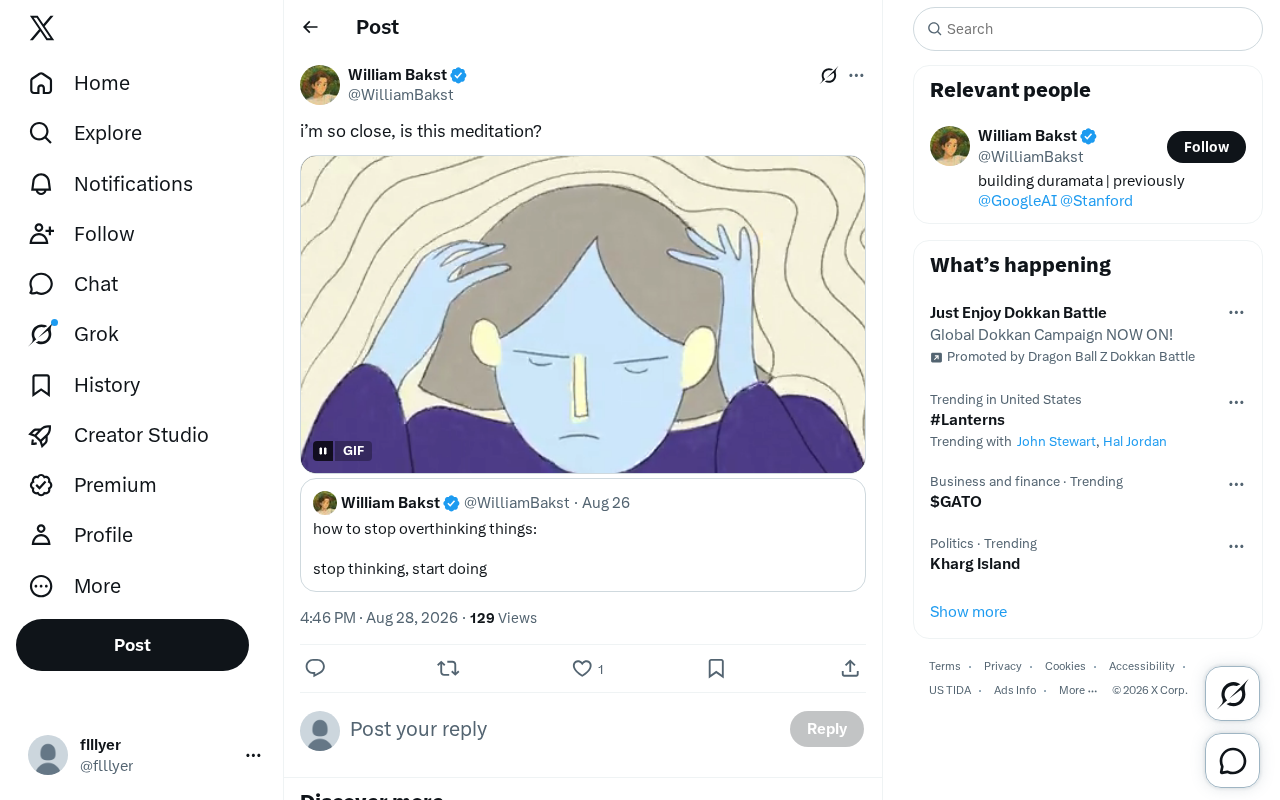
When someone is fully immersed in problem-solving, writing code, or doing creative work, they often enter a meditation-like flow state. The reason this tweet struck a chord is that it touches on a universal, genuine experience among knowledge workers — losing track of time, losing the sense of self, and even forgetting everything around you in the depths of concentration.
What Is Flow State
The Classic Psychological Definition
The concept of "flow" was first introduced by psychologist Mihaly Csikszentmihalyi in his landmark research, describing a mental state in which people become completely absorbed in an activity, losing all sense of self. Those in flow experience intense focus, distorted perception of time, and a deep sense of inner fulfillment.
Csikszentmihalyi first systematically articulated this theoretical framework in his 1975 book Beyond Boredom and Anxiety, later popularizing it for a mainstream audience in his 1990 bestseller Flow: The Psychology of Optimal Experience. His research methodology was distinctive — through large-scale, cross-cultural interviews with practitioners across diverse fields including artists, athletes, surgeons, and chess players, he discovered a remarkably consistent pattern of optimal experience. The theory went on to become one of the four foundational pillars of positive psychology, profoundly influencing practical methodologies in fields ranging from educational curriculum design and sports psychology to video game development.
The core characteristics of flow include:
- Intense concentration: External distractions are almost completely filtered out
- Merging of action and awareness: Zero delay between thinking and executing
- Loss of self-consciousness: No longer worrying about "what others think of me"
- Strong intrinsic motivation: The activity itself is the reward
These characteristics bear a striking resemblance to the experiences reported in meditation practice.
What Flow and Meditation Have in Common
The core of meditation involves anchoring attention on a single object — be it the breath, bodily sensations, or a particular thought. During deep programming or creative work, a developer's attention is similarly anchored firmly on code logic or creative construction.
From a neuroscience perspective, both states involve reduced activity in the brain's Default Mode Network (DMN) and significantly enhanced activity in task-oriented networks. The DMN was discovered in 2001 by Marcus Raichle's team at Washington University through functional magnetic resonance imaging (fMRI) studies. It comprises a network of brain regions including the medial prefrontal cortex, posterior cingulate cortex, and angular gyrus. The DMN is most active when a person is awake but not engaged in any specific task — the "resting state" — and is responsible for higher cognitive functions such as self-referential thinking, future planning, and social cognition. When a person focuses on an external task, DMN activity is significantly suppressed, replaced by the dominance of the Task-Positive Network, which includes the dorsolateral prefrontal cortex and intraparietal sulcus. Brain imaging studies of long-term meditation practitioners show that they can more effectively suppress unnecessary DMN activation — a pattern highly consistent with the neural activity observed during flow states, providing a neuroscientific explanation for the intuition behind "programming as meditation."
An active DMN is typically associated with mind-wandering, self-rumination, and anxiety, while its quieting means the brain's entire resources are devoted to serving the task at hand.
This also explains a common experience: after hours of focused work, people often feel a sense of "emptiness" and "fulfillment" similar to the end of a meditation session — physically tired, yet mentally remarkably calm.
Why This Matters Especially for Workers in the AI Era
Attention Has Become the Scarcest Resource
In today's world of information overload and ubiquitous AI tools, attention has become an even scarcer resource than time. Push notifications, instant messages, and social media feeds constantly fragment our focus time. Research shows that after a single interruption, the brain needs an average of 23 minutes to return to its previous state of focus.
This data comes from landmark research by Gloria Mark, a professor of informatics at the University of California, Irvine. Through long-term field observations of office knowledge workers, her team found that people need an average of 23 minutes and 15 seconds to fully recover their prior cognitive depth after being interrupted. Even more alarming, in her 2023 book Attention Span, she noted that the average attention duration on screens has plummeted from 2.5 minutes in 2004 to roughly 47 seconds, clearly reflecting the systematic erosion of human attention by digital environments. Every seemingly harmless "quick glance at the phone" actually incurs a steep cognitive switching cost.
The ability to enter and sustain a flow state is becoming a core competitive advantage for high-performing workers. Those who can maintain deep focus amid noisy environments consistently produce work far above average.
Ironically, while AI tools help us boost efficiency and reduce repetitive labor, they also introduce more sources of distraction and an increasingly fragmented work rhythm. How to maintain deep focus in an AI-assisted environment is a challenge every modern knowledge worker must seriously confront.
New Forms of Focus with AI Assistance
With the proliferation of AI coding assistants (such as GitHub Copilot, Claude, Cursor, etc.), the nature of programming work is undergoing a fundamental transformation. GitHub Copilot debuted in June 2021, built on OpenAI's Codex model, marking the transition of AI-assisted programming from academic concept to large-scale commercial deployment. Since then, the Cursor editor has deeply integrated AI capabilities into the IDE workflow, while large language models like Claude have provided stronger contextual understanding and code reasoning abilities. According to research data published by GitHub in 2023, developers using Copilot completed tasks 55% faster on average, and 74% of developers reported that AI assistants allowed them to focus their energy on more satisfying work.
Developers no longer need to memorize every syntax detail and can instead devote more energy to overall problem architecture and creative thinking. The essence of this efficiency gain is outsourcing low-level syntax recall and template writing to AI, thereby freeing precious cognitive resources for architectural design and creative problem-solving.
In a sense, this lowers the barrier to entering flow — AI handles the tedious mechanical work, allowing people to focus on higher-level thinking. When code flows smoothly with AI assistance, that feeling of "everything is clicking, I'm almost there" is remarkably similar to the moment in meditation when you're about to break through a mental barrier.
In other words, AI is redefining the trigger conditions for flow: states that previously required lengthy "warm-up" periods may now be more easily achieved because AI has lowered the mechanical barriers. From the perspective of Cognitive Load Theory, AI tools effectively reduce "extraneous cognitive load," allowing working memory to more fully serve "intrinsic cognitive load" and "germane cognitive load," thereby creating more favorable cognitive conditions for the emergence of flow states.
How to Actively Cultivate Deep Focus
Create a Distraction-Free Work Environment
To enter a meditation-like state of deep work, the first step is reducing external distractions:
- Turn off unnecessary push notifications on your phone
- Set daily "focus blocks" and let colleagues and family know about them
- Use the Pomodoro Technique (25 minutes of focus + 5 minutes of rest) to build a rhythm
- Wear noise-canceling headphones or choose a quiet workspace
The Pomodoro Technique was invented by Italian Francesco Cirillo in the late 1980s during his university years, named after the tomato-shaped kitchen timer he used. The core idea is to leverage time constraints to combat procrastination and distraction: each 25-minute "pomodoro" constitutes an indivisible unit of work during which no interruptions are allowed. The method's effectiveness has been supported by multiple cognitive psychology studies, as it essentially harnesses two cognitive mechanisms — the "deadline effect" to generate urgency and the "spacing effect" to consolidate learning through rest breaks. In recent years, variations optimized for deep work have also emerged, such as the 52-minute work + 17-minute rest rhythm discovered by productivity research company DeskTime, which is better suited for knowledge work scenarios requiring extended deep thinking.
Organizing your environment is itself a signal to the brain: it's time to go all in. This type of "environmental cue" is known in behavioral psychology as "context-dependent memory" — when you repeatedly enter a focused state in the same environment, the brain forms a conditioned association between that environment and focus mode, gradually shortening the "warm-up time" needed to enter flow.
Set Clear, Measurable Goals
Flow depends on clear objectives and immediate feedback. Breaking a large project into specific, completable sub-goals makes it easier for the brain to find an entry point and enter a focused state.
For example, instead of setting a vague goal like "finish this feature today," break it down into "first complete the data validation logic," "then write unit tests," and "finally handle edge cases." When each completed sub-goal provides clear positive feedback, the virtuous cycle of flow sustains itself. This approach is closely related to the dopamine reward mechanism in neuroscience — each completed sub-goal triggers a small burst of dopamine from the brain's reward system, which not only brings satisfaction but also reinforces the motivation to stay focused, forming a positive neurochemical feedback loop.
Find the Balance Between Challenge and Skill
Csikszentmihalyi's research clearly demonstrates that flow is most likely to occur when the difficulty of the challenge matches one's personal skill level:
- Task too easy → boredom, mind-wandering
- Task too hard → anxiety, frustration
- Difficulty just right → the flow zone
This balance point is often called the "Flow Channel" in psychology. It's not a fixed point but a dynamic range that shifts upward as personal skills improve. Csikszentmihalyi visualized this concept with a two-dimensional graph: the horizontal axis represents personal skill level, the vertical axis represents task challenge level, and flow occurs in the region where the two are roughly balanced along the diagonal. This means that to consistently experience flow, one must continually improve their abilities to match increasingly greater challenges — which itself constitutes an intrinsic drive mechanism for continuous growth.
In daily work, actively adjusting task difficulty is crucial. If the current task is too simple, try raising the bar (such as pursuing a more elegant implementation or exploring more efficient algorithms); if it's too complex, start with the parts you're confident about and gradually build momentum before tackling the hard parts. In the age of AI-assisted programming, this adjustment becomes even more flexible — you can let AI handle the parts below your skill level while concentrating your cognitive resources on the challenging work that falls right within your flow channel.
Focus as Practice
The tweet's author was probably half-joking, but the insight that "programming is meditation" is genuinely worth contemplating for every knowledge worker. In an era reshaped by AI tools and overwhelming information, the ability to fully immerse yourself in your work is a precious capability in its own right.
Whether it's meditation or deep work, both are fundamentally about training and mastering attention. When we truly immerse ourselves in present-moment creation and thinking, work ceases to be just another item on a checklist and becomes something closer to a contemplative practice. As Cal Newport argued in his influential book Deep Work: in an increasingly shallow world, the ability to do deep work is becoming ever more valuable — and this ability needs to be strengthened through deliberate practice, just like a muscle. Every time you choose deep focus over mindlessly scrolling an information feed, you're adding one more rep for your attention "muscle."
Next time you lose track of time while coding, try telling yourself: "is this meditation?" The answer may be closer to "yes" than you think.
Related articles

The Mean Reversion Trap: Why Churn Models Misclassify Growing Physicians
Why churn models misclassify growing physicians as churn risks due to mean reversion. Learn how to fix problem framing, prediction targets, and trend feature engineering.

What to Do When Your Open Source Project Has a Rival? The Right Call Between Publishing and Giving Up
Discovered a rival open source project right before your launch? Learn how to handle project collisions with proper etiquette, differentiation strategies, and community-minded approaches.

Getting Started with Agent Skills: From Using AI to Developing Intelligent Agent Capabilities
A deep dive into Agent Skills: core concepts, file structure, and practical applications. Learn the SKILL.md metadata, references, scripts, and assets mapping to build reusable, extensible Agent capabilities.