GitHub Sensation REEA: The Open-Source MCP Tool That Lets AI Agents Reverse-Engineer Anything

REEA is an MIT-licensed open-source MCP server that lets AI Agents call reverse-engineering tools via natural language.
REEA (Reverse-Engineer Anything) is an MIT-licensed open-source MCP server positioned as a reverse-engineering toolbox for AI Agents. It doesn't perform analysis itself but wraps professional tools like Ghidra, Hopper, IDA, and Chrome browser drivers, returning structured evidence for Agent reasoning. It supports website analysis (recording page structure and network requests), application analysis (Electron/APK/.NET/Flutter), and native binaries (decompilation and call relationship extraction). In showcased cases, its reconstructed C code passed 3,205 tests, and Notion's clipboard chain was traced from page to main process. The project surpassed 300K stars in October, but there are risks of counterfeit copies, and analysis results are sent as context to model providers, creating potential sensitive data exposure.
From Obscurity to 300K Stars: What Is REEA
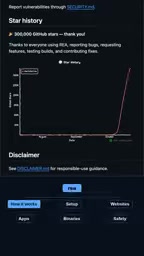
An open-source project called REEA (Reverse-Engineer Anything) sat quietly on GitHub for months before suddenly exploding in October, with its star count surging past 300,000. Its pitch is straightforward: enable AI Agents to reverse-engineer websites, applications, and even native binaries. The project is MIT-licensed and completely free.
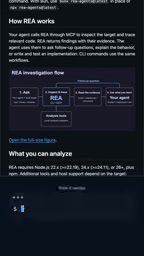
REEA's core idea isn't complicated—it isn't a reverse-engineering engine itself, but an MCP (Model Context Protocol) server. Think of it as a toolbox that your coding Agent can call upon when needed. Ask a question in natural language, the Agent calls REEA, REEA drives real reverse-engineering tools to execute the task, and finally returns evidence, code, references, and unsolved problems. Your Agent then interprets the functional logic or uses it to build its own version.
This division of labor is worth noting: REEA handles the "hands-on" work, while the Agent handles the "talking." The professional reverse-engineering toolchain is wrapped behind the MCP interface, so users don't need to operate IDA or Hopper themselves—they just describe to the Agent what they want to know.
MCP (Model Context Protocol) is an open protocol proposed by Anthropic, designed to standardize how AI models connect to external tools and data sources. Before MCP, every AI application needed a custom integration layer to connect to external tools—costly to develop and hard to reuse. MCP defines a universal interface specification: tool providers only need to implement an MCP server once, and any AI client supporting the protocol (such as Claude Desktop or various coding Agents) can call it directly. This "implement once, use everywhere" model is like a USB interface for hardware peripherals, significantly lowering the integration barrier for the AI Agent ecosystem. REEA is built on this protocol, so it doesn't need to implement its own Agent communication mechanism—it simply reuses the capabilities of existing MCP clients.
One-Command Install, Three Types of Targets
REEA's installation is compressed into a single command. Once installed, the interaction is simply asking questions. The official example is: "How does the search feature in the Notes app work? Show me the evidence, then help me build one."
REEA calls different underlying capabilities depending on the target:
Website analysis: Drives the Chrome browser, recording page structure, scripts, and every network request. This means the Agent receives traceable data flows rather than screenshot-level surface information.
Application analysis: Supports JavaScript and Electron bundles, Android APKs, .NET assemblies, and Flutter apps. In one showcased case, REEA traced the complete chain of Notion's clipboard feature—starting from the page, through the preload script and IPC, and finally into the main process.
Native binaries: Connects to Ghidra, Hopper, or IDA to extract pseudocode, assembly, strings, and call relationships. In another showcased case, the C code reconstructed by REEA passed all 3,205 tests against the original game.
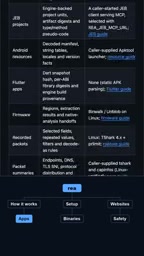
What these three directions share: REEA doesn't replace professional tools—it converts their output into structured material that the Agent can understand and reason about. The 3,205 passing tests are persuasive because they validate not just "can it decompile" but "is the decompiled result behaviorally equivalent."
Ghidra, Hopper, and IDA are three mainstream tools in reverse engineering, each with different strengths. Ghidra was open-sourced by the U.S. National Security Agency (NSA); it's free, fully featured, supports multi-architecture decompilation, and is the top choice for academia and the open-source community. IDA Pro is commercial software with a long history; its disassembly accuracy and debugging capabilities are widely recognized in the industry, but licensing costs are high. Hopper is a lightweight commercial disassembler for macOS and Linux, relatively affordable with a friendly interface. REEA integrating all three means users can flexibly choose the underlying engine based on existing licenses and preferences, rather than being locked into a single tool. This also explains why REEA can cover binary analysis needs across architectures from x86 to ARM.
Two Risks Behind the Convenience
As popularity grew, counterfeits began to appear. The original video explicitly warns that users should only install from the Morluto/REEA repository or the official NPM package. Third-party "REEA" copies may contain malicious code, and since these tools inherently have deep system access, contamination could have serious consequences.

The second risk is more fundamental: REEA runs locally, but the Agent's model sees the analysis results. In other words, the code, strings, and call relationships you reverse-engineer are sent as context to the model provider. For binaries involving trade secrets or sensitive data, this constitutes a real information exposure.
Moreover, the more powerful the tool, the more self-awareness is needed about usage boundaries. Only analyze software you have permission to analyze—this principle becomes even more important as AI lowers the barrier to reverse engineering. Analyses that once required years of experience can now be launched with a single natural-language question.
Electron app architecture makes reverse engineering require cross-process tracing. These apps consist of a main process (Node.js environment with full system privileges) and a renderer process (Chromium environment running page code), exchanging messages through IPC (inter-process communication) channels, with preload scripts acting as a security bridge in between. When analyzing an Electron app, looking only at the renderer process code reveals only page logic—key system calls and file operations often occur in the main process. Therefore REEA needs to simultaneously capture preload scripts, IPC channel messages, and main process code to reconstruct the full functional chain. The Notion clipboard case is a typical example of this complexity: triggered by a page event, forwarded through preload, reaching the main process via IPC, and finally calling the system clipboard API.
What This Means
REEA pushes reverse engineering from "expert skill" to "Agent-callable service," and what changes isn't just efficiency. When the cost of understanding a closed-source product drops dramatically, competitive dynamics, security research, and the speed at which open-source alternatives emerge may all shift accordingly. The 300,000 stars reflect exactly this expectation.
For developers, the more practical takeaway is that protocols like MCP are becoming the standard interface between AI Agents and professional tools. REEA is a sample: professional tools don't need to become AI products themselves—they just need to expose an interface that Agents can call, and they can be incorporated into automated workflows.
Related articles

LLaMA-Factory in Practice: A Complete No-Code Guide to Fine-Tuning Large Models
An introduction to LLaMA-Factory, the open-source fine-tuning tool: its 60.1K-star background, supported models and algorithms, local vs. cloud deployment, and CUDA setup steps.

Zeng Ming's Deep Retrospective: Why OpenAI May Not Be the Ultimate Winner — and Why the Corporate System Will Disappear
Zeng Ming's deep retrospective on the AI endgame: model companies are just infrastructure, OpenAI and Anthropic won't be the final winners; the next battle is the Agent entry point standard; the corporate system will disappear as AI restructures collaboration, and only mission-driven companies can survive the cycle.

OpenHands v1.28.0: OpenCode and PI Added as Built-in Agents, API Keys Requestable In-Conversation
OpenHands ships 5 releases in 21 days: v1.27.0 adds OpenCode and PI as built-in agents, v1.28.0 enables in-chat key requests. ACP integration, credential reuse, model list changes, and upgrade advice.