gitroots: Path-Level GitHub Access Control for AI Agents
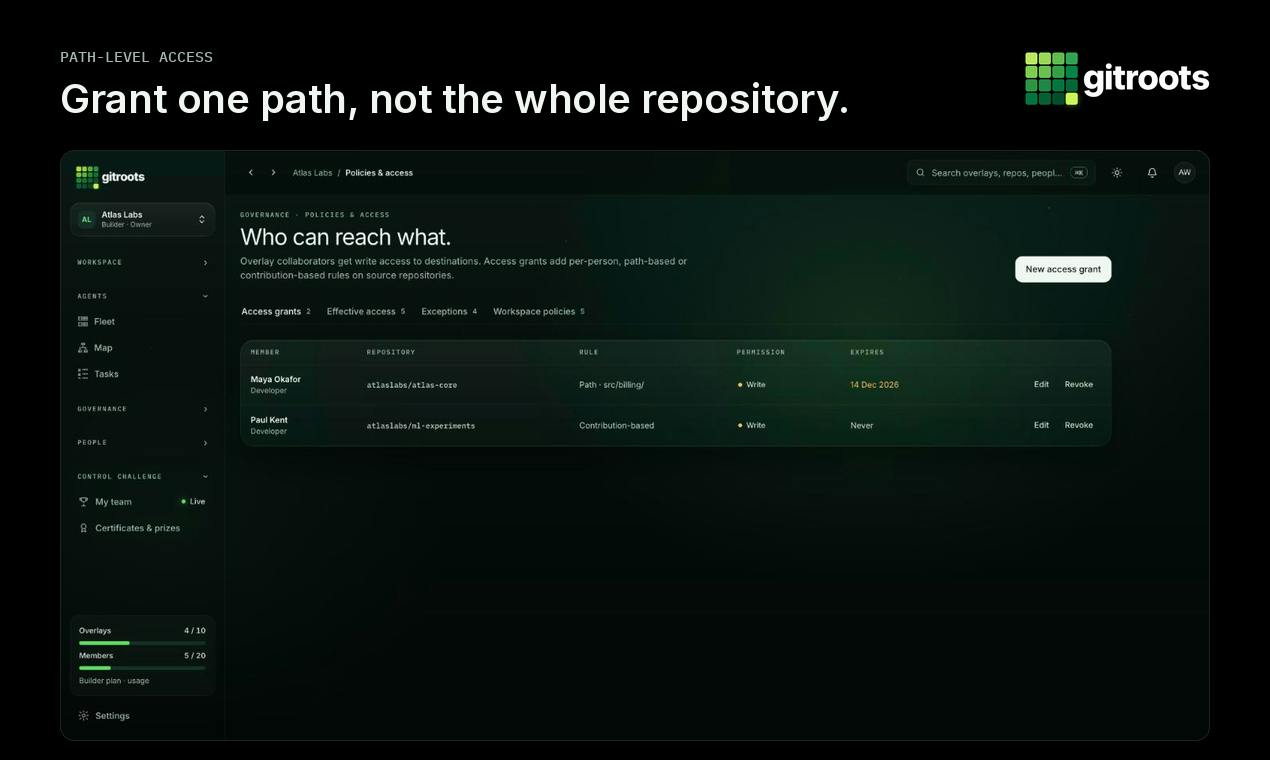
gitroots adds path-level permissions, approvals, and auditing to GitHub so AI agents can safely contribute code.
gitroots is a governance-layer tool for GitHub that tackles the all-or-nothing authorization problem when AI agents contribute code. It adds path-level permission control so developers or agents can access only the directories or files needed for their tasks, not the entire repository. All changes require approval before merging and leave searchable audit records for tracing agent behavior and responsibility. It suits multi-agent collaboration and external contributors. Developed by Shawki Aladdin and still early-stage, it has 55 upvotes and ranks 20th for the day; the trade-off is higher configuration complexity, but it addresses the real need for permission management to move to the path level once AI agents enter the codebase.
When AI Agents Need to Touch Your Codebase
Having AI agents participate in code development sounds great, but a practical problem immediately arises: once you hand over repository permissions, the agent can see and modify every file. For projects involving sensitive configurations, secrets, or core business logic, this "all-or-nothing" authorization model is clearly unacceptable. A new tool on Product Hunt called gitroots attempts to solve this tension with path-level permission control.
gitroots positions itself as a "governance layer for GitHub," and its core idea is straightforward: each developer or AI agent only gets access to the paths needed to complete its task, all changes go through an approval process, and a searchable audit trail is left behind. In other words, you can open your codebase to AI agents without handing over control of the entire repository.
Path-Level Permissions: Finer-Grained Access
The traditional GitHub permission model is repository-based. Collaborators can either read the entire repository or write to the entire repository. Although role divisions exist (Read/Triage/Write/Maintain/Admin), they cannot be scoped to specific directories or file paths. gitroots adds a layer of path-level authorization inside the repository: you can specify that one agent can only access the src/agents/ directory, while another developer can only modify content under docs/.
This design is particularly useful in two scenarios. First, multi-agent collaboration: when different AI agents are responsible for different modules, path isolation prevents accidental interference between agents. Second, external contributors or temporary collaborations: you want the other party to touch only a specific portion of the code, not the entire project.
GitHub's native permission model uses the repository as the smallest authorization unit. Collaborator roles (Read, Triage, Write, Maintain, Admin) determine the ability to operate on the entire repository, not on a subdirectory within it. This design stems from Git's own distributed model, which uses the repository as its boundary, but it exposes insufficient granularity when facing AI agents. Path-level permissions require the system to maintain a file-tree-level access control table beyond Git's commit objects, and to validate it on every read, write, and merge. Implementation typically requires Git hooks, proxy-layer interception, or the fine-grained token capabilities of a GitHub App to move authorization decisions from the repository level down to the tree and blob levels. This also explains why path-level control is rare in traditional Git workflows—it requires layering governance logic on top of version control semantics.
Approval Flows and Audit Trails
Once permissions are narrowed, how do changes get merged? gitroots routes changes from agents or developers into an approval process. This means that even if an agent has write permission for a certain path, its commits still need human or rule-based approval before landing. Combined with searchable audit records, teams can trace "who changed which path, when, and who approved it."
For teams incorporating AI agents into their R&D workflows, auditability is often more important than permissions themselves. Agent behavior needs to be explainable and traceable; otherwise, when problems arise, it is difficult to identify the responsible link. gitroots treats approval and auditing as components of the governance layer rather than after-the-fact patches.
An audit trail in security governance refers to a logging system that records all access and change events in chronological order and whose records cannot be silently tampered with. For AI agents, the value of auditing lies in attributability of behavior: agents may modify files in bulk or generate changes that are difficult for humans to review line by line. Once a regression or security incident occurs, teams need to quickly answer a chain of questions: "which agent, on which path, under what authorization, and approved by whom." Searchability means audit records are not just log files but a structured index that supports retrieval by path, agent identity, time window, approver, and other dimensions. This aligns with the direction of change management and access logging requirements in compliance frameworks such as SOC 2 and ISO 27001, and it is also a key capability that distinguishes governance-layer tools from ordinary CI checks.
The Balance Between Security and Collaboration
gitroots makes a clear trade-off: finer authorization granularity in exchange for safer AI collaboration. The cost is increased configuration complexity—teams need to plan path divisions, set approval rules, and maintain audit policies. For small projects, this governance layer may seem redundant; but for teams with large codebases and many participants (especially mixed human and AI agent contributors), path-level control provides flexibility that traditional repository permissions cannot.
The product currently has 55 upvotes and ranks 20th for the day, categorized under Developer Tools, GitHub, and Security. From a product perspective, it targets an emerging need: once AI agents enter the codebase, permission management can no longer remain at the repository level.
The Principle of Least Privilege is a foundational principle in information security: any subject should have only the minimum access necessary to complete its task, and permissions should be revoked when the task ends. In the context of human developers, this principle is usually implemented through role divisions and periodic permission reviews; but AI agents have shorter lifecycles and more dynamic task boundaries, and repository-based authorization naturally violates least privilege—an agent gains write permission to the entire repository in order to change one configuration file, multiplying the attack surface. Path-level authorization refines the implementation point of least privilege from "person-repository" to "subject-path-operation," allowing permissions to be granted temporarily with agent tasks and revoked after completion. This is precisely the gap that governance tools like gitroots attempt to fill.
Signals Worth Watching
gitroots was developed by Shawki Aladdin and is still an early-stage product. The question it raises is more worth pondering than its current features: as AI agents become regular participants in code contribution, the principle of least privilege needs to be implemented at the path level, and approval and auditing need to become default configurations rather than add-ons. There will be more and more tools in this direction, and gitroots is one of the earlier attempts.
One-line Summary
gitroots adds path-level permissions and approval auditing to GitHub, enabling AI agents to participate safely in code development.
Paragraph Summary
gitroots is a governance-layer tool for GitHub designed to solve the "all-or-nothing" authorization dilemma when AI agents participate in code development. It adds path-level permission control inside the repository, so developers or AI agents can only access the specific directories or files needed to complete their tasks, rather than the entire repository. All changes must go through an approval process before being merged, and searchable audit records are left behind to trace agent behavior and responsibility. This design is suitable for scenarios requiring fine-grained authorization, such as multi-agent collaboration and external contributors. The product was developed by Shawki Aladdin and is still in its early stage, with 55 upvotes and a 20th-place ranking for the day. The cost is increased configuration complexity, but it addresses the real need for permission management to move down to the path level once AI agents enter the codebase.
Related articles

500,000 Robots to 'Refreeze' the Arctic? Real Ice's Wild Plan
A startup called Real Ice plans to use 500,000 underwater drones to thicken Arctic ice, with test-area ice already 50 cm thicker. This article breaks down the technology, the 4-million-fold scale gap, the controversial $10 billion annual cost, and the window before an ice-free summer in the 2030s.

T3 Code: One Tool Aggregates All AI Coding Assistants and Models
T3 Code aggregates multiple AI models and coding assistants like Claude and DeepSeek into one interface, enabling mid-conversation switching with automatic context handoff. This article covers its core selling points, hands-on switching flow, and use cases.

Why Did The New York Times Ban Photographers From Using the Latest Version of Photoshop?
The New York Times told photographers not to use the latest Photoshop, a ban that reflects photojournalism's caution toward AI-generated content and authenticity. This article analyzes the logic behind the ban, its impact on photographers' workflows, and the long-term struggle between tools and ethics in the news industry.