Give AI Agents Their Own Email and Messaging Accounts: Isolated Permissions for Better Security

Artail proposes giving AI Agents independent accounts and MCP integration to achieve scoped access and secure collaboration.
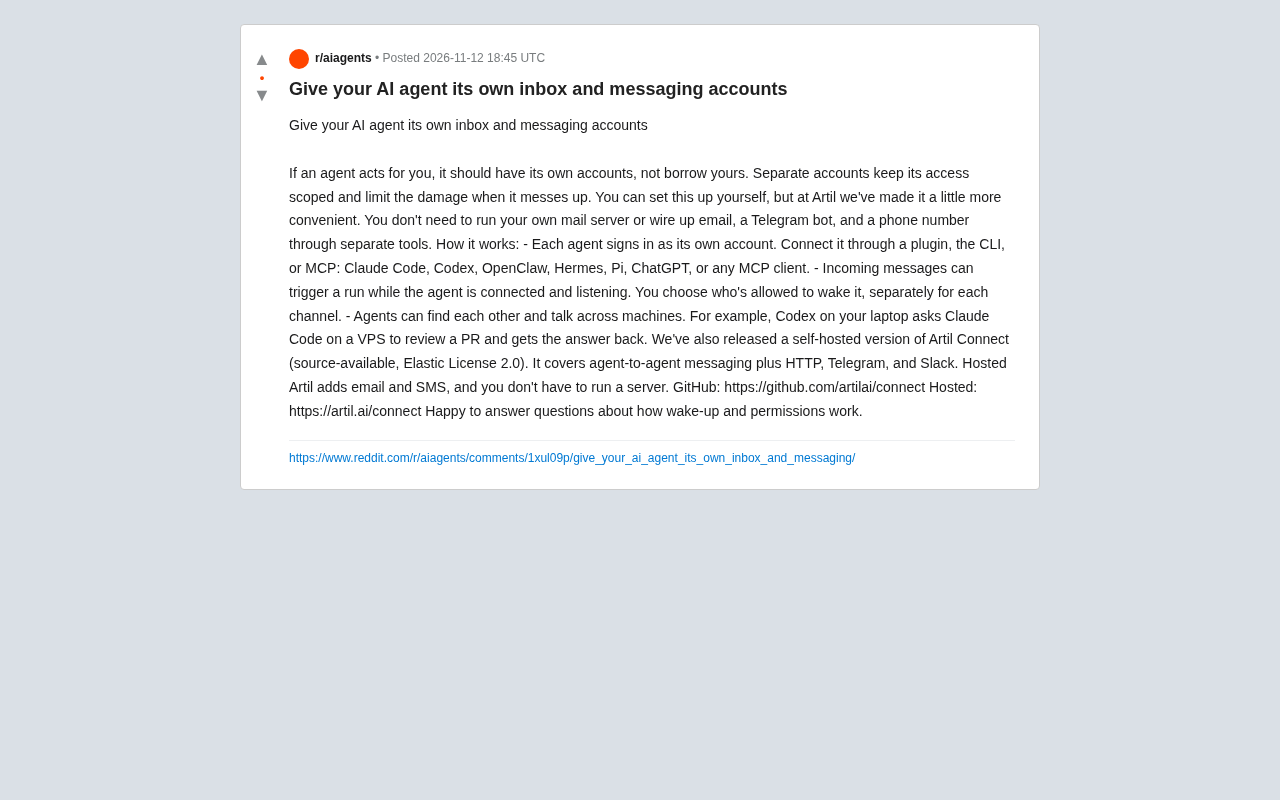
The article introduces the Artail team's argument on Reddit: AI Agents should use their own independent accounts rather than borrowing user identities. The core value of independent accounts is scoped access, limiting the resources an Agent can access to explicitly granted ranges, so that when errors occur, damage is controllable and auditing and accountability are facilitated. Artail Connect lets each Agent log in with its own account and connect to clients like Claude Code, Codex, and ChatGPT through plugins, CLI, or MCP, and provides per-channel wake control and cross-machine inter-Agent communication. The product comes in a self-hosted version (source-available, Elastic License 2.0, covering HTTP, Telegram, and Slack) and a managed version (additionally supporting email and SMS). The author believes its design principle is worth borrowing for developers: manage Agents as independent entities rather than extensions of user identity.
When an AI Agent executes tasks on your behalf, whose account should it use? The Artail team's argument on Reddit is: give the Agent its own independent account, rather than borrowing yours. This idea seems simple, but it touches on the most easily overlooked security and collaboration issues in AI Agent deployment.
Why Agents Need Independent Accounts
If an Agent borrows your email, Telegram, or phone number, all its actions leave traces under your identity, and once something goes wrong, the scope of damage is hard to control. The original post points out that the core value of independent accounts lies in scoped access: the Agent can only access resources explicitly granted to it, and when errors occur, the impact is confined within controllable boundaries.
This aligns with traditional software permission management thinking, but is even more critical in Agent scenarios—Agents proactively initiate actions, respond to messages, and even interact with other Agents. Mixed identities make auditing and accountability difficult.
MCP (Model Context Protocol) is an open protocol proposed by Anthropic in late 2024 to enable large language model applications to connect to external tools, data sources, and services in a standardized way. It adopts a client-server architecture: MCP clients (such as Claude Code, ChatGPT, and other AI applications) call tools and resources exposed by MCP servers through a unified JSON-RPC interface, eliminating the need to write integration code for each model separately. In Agent scenarios, the significance of MCP is that it allows the same Agent identity to be reused across different clients, and lets third-party tools be accessible to multiple AI clients by implementing an MCP server just once. This is precisely why Artail Connect mentioned in the article includes "any MCP-compatible client" in its access scope, so that the Agent's independent identity and communication capabilities are not bound to any single vendor's ecosystem.
Scoped access draws on the "principle of least privilege" in cloud security and the scope mechanism of OAuth 2.0: tokens are granted only the minimum set of permissions needed to complete a specific task, and operations beyond that scope are rejected. In traditional systems, permission boundaries are usually divided by user roles; in Agent scenarios, permission boundaries need to be bound to the Agent as an independent entity, otherwise the Agent's autonomous behavior inherits all the user's permissions. Scoped access also implies revocability and auditability: each Agent's credentials can be revoked individually, and its operation logs can be recorded separately by identity, making troubleshooting and accountability traceability possible.
How Artail Connect Implements This
The post introduces that Artail Connect lets each Agent log in with its own account, and connect to mainstream tools through plugins, CLI, or MCP, including Claude Code, Codex, OpenClawAd, Hermes, Pi, ChatGPT, and any MCP-compatible client.
The core mechanism has two points:
- Wake control: When an Agent is in connection listening state, received messages can trigger a run. You can set who has the right to wake it per channel, avoiding frequent interruptions from irrelevant messages or malicious triggers.
- Inter-Agent communication: Agents can discover each other and converse across machines. For example, Codex on your laptop can ask Claude Code on a VPS to review a PR, then get the results back.
This means Agents are no longer isolated execution units, but can form a small collaborative network, with each node having an independent identity and permission boundary.
Trade-offs Between Self-Hosted and Managed Versions
Artail has also released a self-hosted version of Artail Connect, using a source-available approach under the Elastic License 2.0. The self-hosted version covers inter-Agent messaging and HTTP, Telegram, and Slack integrations.
If you don't want to maintain your own server, the managed version additionally provides email and SMS support, saving the hassle of configuring email servers, Telegram bots, and phone numbers. For teams that want quick validation or don't want to handle operations, the managed version lowers the barrier to entry; for teams with data sovereignty requirements who prefer self-hosting, the source-available version provides another path.
Elastic License 2.0 (ELv2) is the license Elastic adopted in 2021 after switching from Apache 2.0. Its characteristics are that the source code is publicly readable, modifiable, usable, and distributable for self-use, but it prohibits providing the software as a hosted service to third parties and prohibits bypassing license key functionality. It is not an OSI-approved open source license, so it is often called "source-available." The article uses "source-available" rather than "open source" to describe the self-hosted version precisely because of this distinction: users can audit the code and deploy it themselves, but providing commercial hosting services based on it externally is restricted. For teams that want data sovereignty while also caring about code transparency, this is a compromise between fully closed-source and permissive open source.
Implications for Developers
Behind this solution is a design principle worth borrowing: manage Agents as independent entities, not as extensions of user identity. When building multi-Agent systems, assigning independent credentials to each Agent, limiting communication channels, and clarifying wake permissions can significantly reduce the risk of accidental operations.
The post author also mentions that discussion on the specific implementation of wake and permission mechanisms is welcome. For developers building Agent workflows, the open source part of Artail Connect is worth a look, especially the design ideas for inter-Agent communication and channel integration.
One-line Summary
Artail proposes giving AI Agents their own independent accounts and connecting them via MCP to achieve scoped access and secure collaboration.
Paragraph Summary
The article introduces the Artail team's argument on Reddit: AI Agents should use their own independent accounts rather than borrowing user identities. The core value of independent accounts is scoped access, limiting the resources an Agent can access to explicitly granted ranges, so that when errors occur, damage is controllable and auditing and accountability are facilitated. Artail Connect lets each Agent log in with its own account and connect to clients like Claude Code, Codex, and ChatGPT through plugins, CLI, or MCP, and provides per-channel wake control and cross-machine inter-Agent communication. The product comes in a self-hosted version (source-available, Elastic License 2.0, covering HTTP, Telegram, and Slack) and a managed version (additionally supporting email and SMS). The author believes its design principle is worth borrowing for developers: manage Agents as independent entities rather than extensions of user identity.
Related articles

From 0 to 1: Vibe Coding an AI Knowledge Base — A Practical Retrospective and Tech Stack Breakdown
A retrospective on building the AI knowledge base OilBook from scratch with Vibe Coding: Next.js+Neon stack, Oil Dev Skill workflow, Stripe paywall security, interview-style writing, AI-flavor control, and Vercel deployment.

GLM-5.4 Hands-On: Native Vision Meets a New Vibe Coding Workflow
Hands-on with Zhipu GLM-5.4: native vision tested across a 3D product demo, pure-code video generation, and remote-control Vibe Coding, compared with GPT-6.2 and Gemini Neon.

AI and Humans Claim to Prove the Riemann Hypothesis: Machine-Verified, Yet Nobody Can Understand It
Anthropic mathematician and AI Claude claim to prove the Riemann Hypothesis with 17 million lines of Lean code, machine-verified but unreadable by humans. This article analyzes the event, the zero proportion record from 41.6% to 67.2%, and the gap between machine verification and human understanding.